



















































Busque também em nossas outras coleções:

Tipo de arquivo:

Tipo do arquivo:

Orientação:

Total de Resultados: 53

Página 1 de 1

PIX4662766 Spinosaur - Spinosaurus - Spinosaur is a theropod dinosaur that lived in what is now Egypt during the cretacious period 95 to 93 million years ago. It was probably the largest carnivorous dinosaurs. An eight ton Spinosaurus searches for its next meal 95 million years ago in shallow waters of what is today Egypt. With a massive crocodile-like head and enormous muscular body, this terrifying carnivore was larger than the Early Cretaceous Suchomimus and may have been mightier even than the famous Tyrannosaurus Rex of approximately the same period
DC
PIX4644468 Satellite Orbiting Carbon Observatory - Artist's concept of the Orbiting Carbon Observatory - Artist's view of the Orbiting Carbon Observatory (OCO) satellite orbiting Earth. This satellite, scheduled to launch in early 2009, will be dedicated exclusively to the study of carbon dioxide on Earth. The mission, scheduled to launch in early 2009, will be the first spacecraft dedicated to studying atmospheric carbon dioxide, the main human - produced driver of climate change. It will provide the first global picture of the human and natural sources of carbon dioxide and the places where this important greenhouse gas is stored. Such information will improve global carbon cycle models as well as forecasts of atmospheric carbon dioxide levels and of how our climate may change in the future
DC
PIX4571471 A comete approaches the Sun - Illustration - Comet near our Sun - artwork - Artist's view of the comete McNaught near the Earth and the Sun eclipse through the Moon. Comet Mcnaught makes its close approach to Earth in early 2007. It is New Moon and we are situated in a position above Earth where the moon eclipses the sun
DC
PIX4644635 Satellite Orbiting Carbon Observatory - Artist's concept of the Orbiting Carbon Observatory - Artist's view of the Orbiting Carbon Observatory (OCO) satellite orbiting Earth. This satellite, scheduled to launch in early 2009, will be dedicated exclusively to the study of carbon dioxide on Earth. The mission, scheduled to launch in early 2009, will be the first spacecraft dedicated to studying atmospheric carbon dioxide, the main human - produced driver of climate change. It will provide the first global picture of the human and natural sources of carbon dioxide and the places where this important greenhouse gas is stored. Such information will improve global carbon cycle models as well as forecasts of atmospheric carbon dioxide levels and of how our climate may change in the future
DC
PIX4662030 Dilophosaurus - Dilophosaurus amidst Williamsonia - An adult male dilophosaur (Dilophosaurus) among ferns, cycas and Williamsonia gigas (first flowering plants). Dilophosaur is the first known predatory dinosaur, it appeared at the beginning of the Jurassic almost 200 million years ago. A colorful adult male Dilophosaurus explores a hilltop that is host to Williamsonia gigas, Sago Palms, and ferns. The tree-like Williamsonia gigas was a seed plant belonging to the order of Bennettitales and reigned for 130 million years before becoming extinct. Williamsonia gigas produced what appears to be large flowers, which were really a group of seeds surrounded by a crown of leaf-like structures known as bracteae. True flowers didn't begin to dominate the landscape until relatively recently - about 50 million years ago. The 0ther flora illustrated here live to this day, including the coniferous Araucaria, ferns, and Sago Palms (which in reality are not palms but a type of gymnosperm). The first known predatory dinosaur appeared 190 million years ago during the early Jurassic period. Christened Dilophosaurus (meaning “” two-crested lizard,”” because it had a pair of distinctive bony crests on its head) this bipedal saurischian grew up to 20 feet long, stood 8 feet tall, and weighed as much as a half ton. Dilophosaurus roamed the Earth 100 million years before its larger and more celebrated cousin Tyrannosaurus Rex roared onto the scene
DC
PIX4661960 Cryolophosaur - Cryolophosaurus - Cryolophosaur is the first dinosaur found in Antarctica by paleontologists. About 7 metres long, this carnivore lived at the beginning of the Jurassic about 190 million years ago. Over 20 feet long and weighing as much as a ton, Cryolophosaurus is the first dinosaur to have been unearthed by paleontologists in Antarctica. This formidable predator hunted 190 million years ago during the Early Jurassic period. While the Earth was warmer and Antarctica closer to the equator during Cryolophosaurus' time, the continent was still far enough south for the climate to be temperate rather than tropical. Much of Antarctica was likely covered by dense forests, at least near the coasts. Cryolophosaurus 'remains were found on a mountain range that would have placed it at an altitude of about 10,000 feet and 1,000 miles from the South Pole during its reign
DC
PIX4646098 Satellite Herschel - Illustration - Artist's view of the European satellite Herschel. The Herschel Space Observatory, scheduled to launch in 2009, will study in the infrared the formation of galaxies, stars and planetary systems. This satellite measures nearly 7 metres high by 4.3 metres wide and weighs 3.25 tonnes. Its telescope has a 3.5-meter mirror, making it the largest mirror ever made for a scientific space mission. Herschel will orbit around Lagrange 2, approximately 1.5 million kilometres from Earth. ESA's Herschel Space Observatory (formerly called Far Infrared and Submillimetre Telescope or FIRST) will solve the mystery of how stars and galaxies were born. Objects such as other planetary systems, or processes like the birth of galaxies in the early universe, can best be studied with infrared space telescopes in space. This is the reason for Esa's Herschel. ESA's Herschel Space Observatory will be bigger and better than any of its predecessors. Moreover, it will observe at wavelengths never covered before. It will be located 1.5 million kilometers away from Earth, farther than any previous space telescope. Due for launch in 2009, Herschel is one the Cornerstone missions ESA's Horizons 2000 programme. Herschel is a key project space astronomy in the next millennium
DC
PIX4662022 Dilophosaurus - Dilophosaurus amidst Williamsonia - An adult male dilophosaur (Dilophosaurus) among ferns, cycas and Williamsonia gigas (first flowering plants). Dilophosaur is the first known predatory dinosaur, it appeared at the beginning of the Jurassic almost 200 million years ago. A colorful adult male Dilophosaurus explores a hilltop that is host to Williamsonia gigas, Sago Palms, and ferns. The tree-like Williamsonia gigas was a seed plant belonging to the order of Bennettitales and reigned for 130 million years before becoming extinct. Williamsonia gigas produced what appears to be large flowers, which were really a group of seeds surrounded by a crown of leaf-like structures known as bracteae. True flowers didn't begin to dominate the landscape until relatively recently - about 50 million years ago. The 0ther flora illustrated here live to this day, including the coniferous Araucaria, ferns, and Sago Palms (which in reality are not palms but a type of gymnosperm). The first known predatory dinosaur appeared 190 million years ago during the early Jurassic period. Christened Dilophosaurus (meaning “” two-crested lizard,”” because it had a pair of distinctive bony crests on its head) this bipedal saurischian grew up to 20 feet long, stood 8 feet tall, and weighed as much as a half ton. Dilophosaurus roamed the Earth 100 million years before its larger and more celebrated cousin Tyrannosaurus Rex roared onto the scene
DC
PIX4646125 Satellite Herschel - Illustration - Ariane 5 fairing with satellite Herschel. Artwork - Artist's view of the European satellite Herschel during its launch by an Ariane 5 rocket. The Herschel Space Observatory, scheduled to launch in 2009, will study in the infrared the formation of galaxies, stars and planetary systems. This satellite measures nearly 7 metres high by 4.3 metres wide and weighs 3.25 tonnes. Its telescope has a 3.5-meter mirror, making it the largest mirror ever made for a scientific space mission. Herschel will orbit around Lagrange 2, approximately 1.5 million kilometres from Earth. ESA's Herschel Space Observatory (formerly called Far Infrared and Submillimetre Telescope or FIRST) will solve the mystery of how stars and galaxies were born. Objects such as other planetary systems, or processes like the birth of galaxies in the early universe, can best be studied with infrared space telescopes in space. This is the reason for Esa's Herschel. ESA's Herschel Space Observatory will be bigger and better than any of its predecessors. Moreover, it will observe at wavelengths never covered before. It will be located 1.5 million kilometers away from Earth, farther than any previous space telescope. Due for launch in 2009, Herschel is one the Cornerstone missions ESA's Horizons 2000 programme. Herschel is a key project space astronomy in the next millennium
DC
PCT4269363 The earth pot and the iron pot: La Fontaine fable illustrated by Grandville. Edition Garnier 1860.
DC
GIA4780955 The Earth Pot and the Iron Pot. Fables by Jean de La Fontaine (1621-95). Illustration by François Chauveau (1613-1676). Edition of 1728.
DC
XIR240290 Peace comes to comfort men and brings back abundance also says the earth stretched up with eyes to heaven to bring an end to its misfortunes; Painting by Ferdinand Victor Eugene Delacroix; study for the central ceiling of the Salon de la Paix in the Hotel de Ville destroyed in 1871 during the Commune
RF
PIX4646153 Satellite Herschel - Illustration - Ariane 5 stage with satellite Herschel. Artwork - Artist's view of the European satellite Herschel during its launch by an Ariane 5 rocket. The Herschel Space Observatory, launched on 14 May 2009, is studying in the infrared the formation of galaxies, stars and planetary systems. This satellite measures nearly 7 metres high by 4.3 metres wide and weighs 3.25 tonnes. Its telescope has a 3.5-meter mirror, making it the largest mirror ever made for a scientific space mission. Herschel is in orbit around Lagrange 2, approximately 1.5 million kilometres from Earth. ESA's Herschel Space Observatory (formerly called Far Infrared and Submillimetre Telescope or FIRST) will solve the mystery of how stars and galaxies were born. Objects such as other planetary systems, or processes like the birth of galaxies in the early universe, can best be studied with infrared space telescopes in space. This is the reason for Esa's Herschel. ESA's Herschel Space Observatory will be bigger and better than any of its predecessors. Moreover, it will observe at wavelengths never covered before. It will be located 1.5 million kilometers away from Earth, farther than any previous space telescope. Launched on May 14 2009, Herschel is one the Cornerstone missions ESA's Horizons 2000 programme. Herschel is a key project space astronomy in the next millennium
DC
PIX4646169 Satellite Herschel - Illustration - Ariane 5 fairing with satellite Herschel. Artwork - Artist's view of the European satellite Herschel during its launch by an Ariane 5 rocket. The Herschel Space Observatory, launched on 14 May 2009, is studying in the infrared the formation of galaxies, stars and planetary systems. This satellite measures nearly 7 metres high by 4.3 metres wide and weighs 3.25 tonnes. Its telescope has a 3.5-meter mirror, making it the largest mirror ever made for a scientific space mission. Herschel is in orbit around Lagrange 2, approximately 1.5 million kilometres from Earth. ESA's Herschel Space Observatory (formerly called Far Infrared and Submillimetre Telescope or FIRST) will solve the mystery of how stars and galaxies were born. Objects such as other planetary systems, or processes like the birth of galaxies in the early universe, can best be studied with infrared space telescopes in space. This is the reason for Esa's Herschel. ESA's Herschel Space Observatory will be bigger and better than any of its predecessors. Moreover, it will observe at wavelengths never covered before. It will be located 1.5 million kilometers away from Earth, farther than any previous space telescope. Launched on May 14 2009, Herschel is one the Cornerstone missions ESA's Horizons 2000 programme. Herschel is a key project space astronomy in the next millennium
DC
CH990407 An Allegory of the Elements, Earth, Air and Water: Nymphs bathing in a wooded Glade with Trophies of the Hunt nearby. Jan Brueghel I (1568-1625) and Hendrick van Balen I (1575-1632). Oil on panel. Painted circa 1621. 58.7 x 81cm.
DC
RBG9032550 The current accepted plant name in the artwork is Arachis hypogaea.Painting by Marianne North (1830-1890)
DC
PIX4606645 Mars Express - Artist's View - Mars Express artist's view - The European Mars Express probe was launched on June 2, 2003 and began its observations in March early 2004. Mars Express left Earth for Mars on 2 June 2003 when the positions of the two planets made for the shortest possible route, a condition that occurs once every twenty - six months. The european spaceprobe began its March observations in 2004
DC
PIX4606616 Mars Express - Artist's View - Mars Express artist's view - The European Mars Express probe was launched on June 2, 2003 and began its observations in March early 2004. Mars Express left Earth for Mars on 2 June 2003 when the positions of the two planets made for the shortest possible route, a condition that occurs once every twenty - six months. The european spaceprobe began its March observations in 2004
DC
PIX4606614 Mars Express - Artist's View - Mars Express artist's view - The European Mars Express probe was launched on June 2, 2003 and began its observations in March early 2004. Mars Express left Earth for Mars on 2 June 2003 when the positions of the two planets made for the shortest possible route, a condition that occurs once every twenty - six months. The european spaceprobe began its March observations in 2004
DC
PIX4606610 Mars Express - Artist's View - Mars Express artist's view - The European Mars Express probe was launched on June 2, 2003 and began its observations in March early 2004. Mars Express left Earth for Mars on 2 June 2003 when the positions of the two planets made for the shortest possible route, a condition that occurs once every twenty - six months. The european spaceprobe began its March observations in 2004
DC
CH659746 Prometheus Consoled by the Spirits of the Earth 'How Fair These Air-Borne Shapes! And Yet I Feel Most Vain All Hope But Love...' -Shelley. George Spencer Watson (1869-1934). Oil on canvas. Signed and dated 1900. 142.3 x 108.4cm.
DC
FAF3572501 Artist: Zuliani G.Date of Artwork: 1777Location: FlorencePhotographer: Alinari
DC
FAF3572500 Artist: Zuliani G.Date of Artwork: 1777Location: FlorencePhotographer: Alinari
DC
FAF3572504 Artist: Zuliani G.Date of Artwork: 1779Location: FlorencePhotographer: Alinari
DC
FAF3572499 Artist: Zuliani G.Date of Artwork: 1779Location: FlorencePhotographer: Alinari
DC
DUV4215056 Illustrations by JJ Granville (1803-1847), reported on wood by Auguste Desperet (1804-1865)and engraved by Franz Robert Richard Brend'Amour
DC
FAF3572498 Artist: Zuliani G.Date of Artwork: 1777Location: FlorencePhotographer: Alinari
DC
PIX4646142 Satellite Herschel - Illustration - Artist's view of the European satellite Herschel. The Herschel Space Observatory, scheduled to launch in 2009, will study in the infrared the formation of galaxies, stars and planetary systems. This satellite measures nearly 7 metres high by 4.3 metres wide and weighs 3.25 tonnes. Its telescope has a 3.5-meter mirror, making it the largest mirror ever made for a scientific space mission. Herschel will orbit around Lagrange 2, approximately 1.5 million kilometres from Earth. ESA's Herschel Space Observatory (formerly called Far Infrared and Submillimetre Telescope or FIRST) will solve the mystery of how stars and galaxies were born. Objects such as other planetary systems, or processes like the birth of galaxies in the early universe, can best be studied with infrared space telescopes in space. This is the reason for Esa's Herschel. ESA's Herschel Space Observatory will be bigger and better than any of its predecessors. Moreover, it will observe at wavelengths never covered before. It will be located 1.5 million kilometers away from Earth, farther than any previous space telescope. Due for launch in 2009, Herschel is one the Cornerstone missions ESA's Horizons 2000 programme. Herschel is a key project space astronomy in the next millennium
DC
XIR183308 Painting by Henri Testelin
RF
PIX4646040 Herschel Satellite - Illustration - Herschel Satellite. Artwork - Artist's view of the European satellite Herschel. The Herschel Space Observatory, scheduled to launch in 2009, will study in the infrared the formation of galaxies, stars and planetary systems. This satellite measures nearly 7 metres high by 4.3 metres wide and weighs 3.25 tonnes. Its telescope has a 3.5-meter mirror, making it the largest mirror ever made for a scientific space mission. Herschel will orbit around Lagrange 2, approximately 1.5 million kilometres from Earth. ESA's Herschel Space Observatory (formerly called Far Infrared and Submillimetre Telescope or FIRST) will solve the mystery of how stars and galaxies were born. Infrared astronomy is as young as it is fruitful. In less than three decades infrared astronomers have unveiled tens of thousands of new galaxies, and have made discoveries as surprising as the huge amounts of water vapour that fill the galaxy. Yet scientists know there is still much more to discover. Objects such as other planetary systems, or processes like the birth of galaxies in the early universe, can best be studied with infrared space telescopes in space. This is the reason for Esa's Herschel. ESA's Herschel Space Observatory will be bigger and better than any of its predecessors. Moreover, it will observe at wavelengths never covered before. It will be located 1.5 million kilometers away from Earth, farther than any previous space telescope. Due for launch in 2009, Herschel is one the Cornerstone missions ESA's Horizons 2000 programme. Herschel is a key project space astronomy in the next millennium
DC
XOS8988658 This untitled artwork, by John L. Dunmore, showcases a striking monochrome landscape captured in 19th-century photography.
DC
BAL148809 By Thomas de Keyser
RF
PIX4646048 Herschel Satellite - Illustration - Herschel Satellite. Artwork - Artist's view of the European satellite Herschel. The Herschel Space Observatory, scheduled to launch in 2009, will study in the infrared the formation of galaxies, stars and planetary systems. This satellite measures nearly 7 metres high by 4.3 metres wide and weighs 3.25 tonnes. Its telescope has a 3.5-meter mirror, making it the largest mirror ever made for a scientific space mission. Herschel will orbit around Lagrange 2, approximately 1.5 million kilometres from Earth. ESA's Herschel Space Observatory (formerly called Far Infrared and Submillimetre Telescope or FIRST) will solve the mystery of how stars and galaxies were born. Infrared astronomy is as young as it is fruitful. In less than three decades infrared astronomers have unveiled tens of thousands of new galaxies, and have made discoveries as surprising as the huge amounts of water vapour that fill the galaxy. Yet scientists know there is still much more to discover. Objects such as other planetary systems, or processes like the birth of galaxies in the early universe, can best be studied with infrared space telescopes in space. This is the reason for Esa's Herschel. ESA's Herschel Space Observatory will be bigger and better than any of its predecessors. Moreover, it will observe at wavelengths never covered before. It will be located 1.5 million kilometers away from Earth, farther than any previous space telescope. Due for launch in 2009, Herschel is one the Cornerstone missions ESA's Horizons 2000 programme. Herschel is a key project space astronomy in the next millennium
DC
CH650979 The Animal Tamer Presents. Charles Demuth (1883-1935). Watercolor and pencil on paper. 32.7 x 20.1cm. This watercolor was an illustration for Frank Wedekind's Lulu play Earth Spirit (1895), published after the playwright's death in 1918
DC
CH825089 Scrap Landscape; Paysage en Ferraille. Max Ernst (1891-1976). Gouache, pen and black ink and pencil on paper. Painted in 1921. 77.8 x 67.9cm.
DC
XOS8986353 Le Combat des soldats nés des dents du serpent (Main title); Esquisses pour la tenture de l'Histoire de Jason (Overall title)Troy, Jean-François deThe dragon of Thebes is mentioned in Apollonius of Rhodes' Argonautics. It was his teeth, a gift from the goddess Athena, that King Aietes of Colchis ordered Jason to plant, in order to test him. As with Cadmos in Thebes, an army of soldiers rose from the earth sown with the teeth of the monstrous serpent.Stock number: PPP4989
RF
CH656774 The Giant; Le Geant. Rene Magritte (1898-1967). Gouache on paper. Dated circa 1936. 30.4 x 38.3cm.
DC
WGL5326 Hesperides were guardians of the tree that produced golden apples, a gift to earth from Hera; Painting by Frederic Leighton
DC
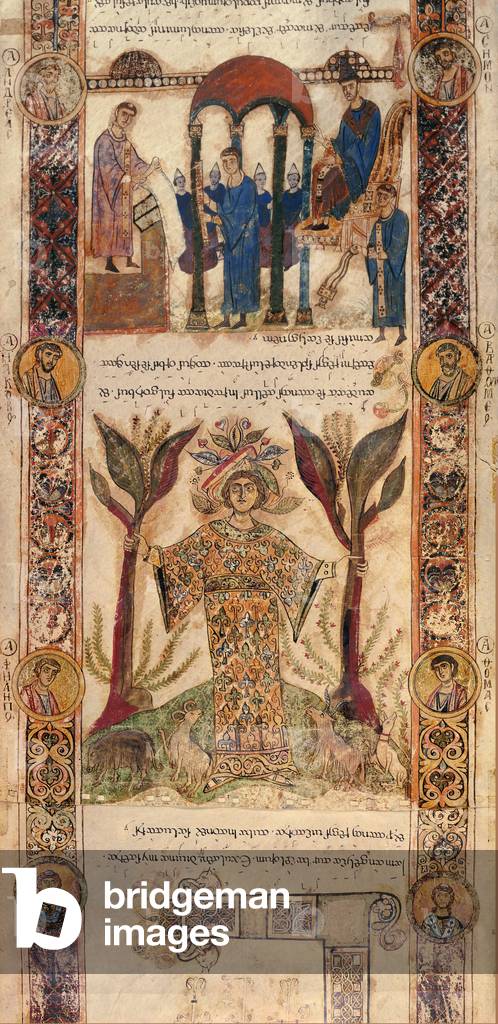
FAF3114465 Cathedral, Bari1992Date of Artwork: 1025 ca.Photographer: Pedicini, Luciano for Alinarithe Earth represented as a female figure in the guise of a Byzantine princess; Exultet contains the texts of the liturgy of Easter; this example is 5.25m long;
DC
JAB7345975 The giant cannon in Malta island.Science fiction artwork " From the Earth tothe Moon " by Jules Verne.Design by Henri de Montaut1865
DC
JAB7345951 Observation of the gun fire to the Moon.Science fiction artwork "From the Earth to the Moon " by Jules Verne.Design by Henri de Montaut. 1865
DC
JAB7345954 Cambridge observatory. Artwork " From the Earth to the moon " by Jules Verne.Science fiction. Design by Henri de Monrtaut1865
DC
JAB7345957 The giant space gun from J.T. Maston.Science fiction artwork" From the Earthto the Moon "by Jules Verne.Design by Henri de Montaut1865
DC
JAB7345974 The giant gun Columbiad Rodmar . Science fiction artwork " From the Earth to the Moon " by Jules Verne.Design by Henri de Montaut1865
DC
JAB7345955 Train of bullets ( or projectiles ) fired by a giant gun cannon to the Moon.Artwork science-fiction " From the Earth to the Moon " by Jules VerneDesign by Henri de Montaut. 1865
DC
JAB7345949 The giant gun projectile arrived at Stone's Hill to be fired to the Moon.Science-fiction artwork from the book by Jules Verne " From the Earth to theMoon ".Design by Henri de Montaut. 1865
DC
JAB7345956 Bigs guns factory at Goldspring, near New-York.Science fiction artwork from" From the Earth to the Moon " by Jules Verne.Design by Henri de Montaut.1865
DC
JAB7345958 The monk Berthold Schwartz ( 1318-1384 ) german chemist invented the gunpowder in 14th century.Science fiction artwork " From the Earth to the Moon "by Jules Verne. Design by Henri de Montaut.1865
DC
XIR287277 Serie 'News of the Day'; comet Charles-Quint predicted for 13th June 1857; expected to hit the earth; prophecy of the ending of the world; Jacques Babinet (1794-1872) French physicist, mathematician and astronomer; fulfill;
RF
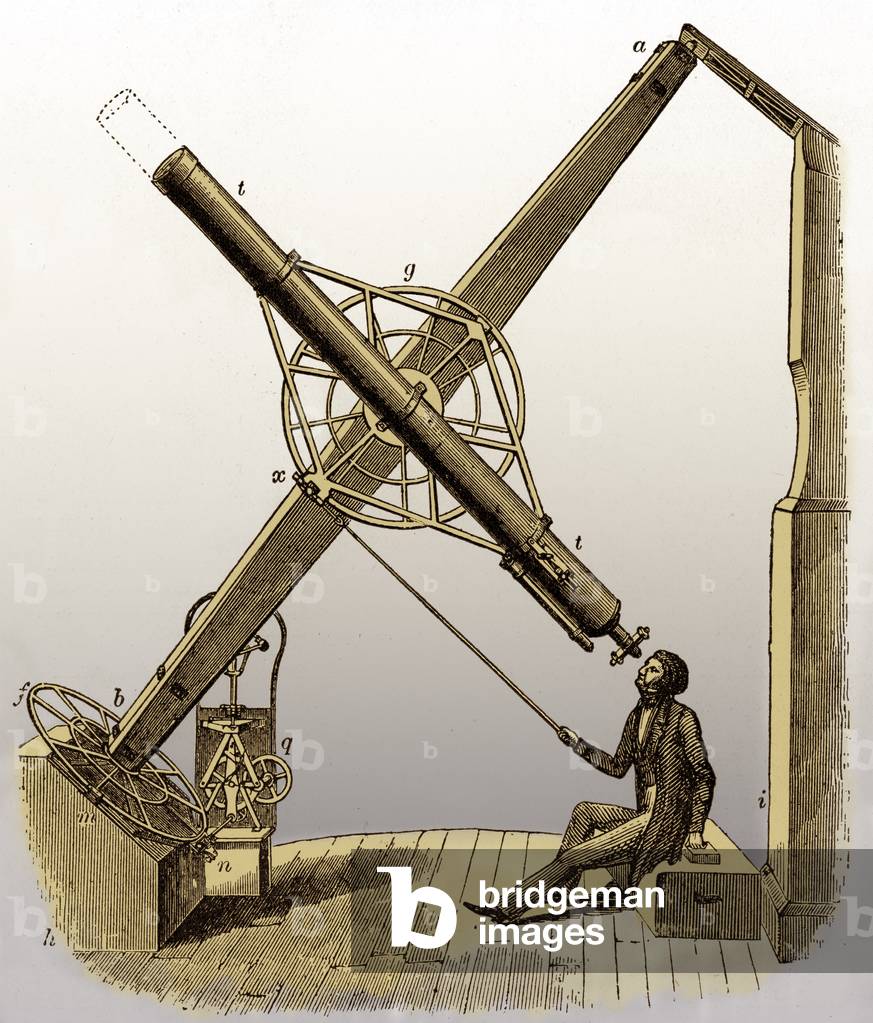
XLF3792765 English equatorial refractor. Refractor mounted on a typical 'English' stand of early 19th century. The observer is using a micrometer and controlling the telescope in declination by means of the slow motion.Equatorial mount is a mount for instruments that compensate the rotation of earth by having one rotational axis parallel to the Earth's axis of rotation. Artwork from Descriptive and Practical Astronomy by G F Chambers.Splendour of the Heavens 1923
DC
PIX4653098 Telescope E - ELT - Artist's view - European Extremely Large Telescope - Artwork - Artist's view of the E - ELT (European Extremely Large Telescope), a telescope project measuring 40 metres in diameter. Its main mirror will consist of 906 hexagonal mirrors assembled together, and its total surface will be equal to that of a football field. A new architectural concept drawing of Eso's planned European Extremely Large Telescope (E - ELT) shows the telescope at work, with its dome open and its record - setting 40 - metre - class primary mirror pointed to the sky. In this illustration, clouds float over the valley overlooked by the E - Elt's summit. The comparatively tiny pickup truck parked at the base of the E - ELT helps to give a sense of the scale of this massive telescope. The E - ELT dome will be similar in size to a football stadium, with a diameter at its base of over 100 m and a height of over 80 m. Scheduled to begin operations early in the next decade, the E - ELT will help track down Earth - like planets around other stars in the habitable zones”” where life could exist. The E - ELT will also make fundamental contributions to cosmology by measuring the properties of the first stars and galaxies and probing the nature of dark matter and dark energy.
DC
XLF3792686 English equatorial refractor. Refractor mounted on a typical 'English' stand of early 19th century. The observer is using a micrometer and controlling the telescope in declination by means of the slow motion.Equatorial mount is a mount for instruments that compensate the rotation of earth by having one rotational axis parallel to the Earth's axis of rotation. Artwork from Descriptive and Practical Astronomy by G F Chambers.Splendour of the Heavens 1923
DC
PIX4653092 Telescope E - ELT - Artist's view - European Extremely Large Telescope - Artwork - Artist's view of the E - ELT (European Extremely Large Telescope), a telescope project measuring 40 metres in diameter. Its main mirror will consist of 906 hexagonal mirrors assembled together, and its total surface will be equal to that of a football field. A new architectural concept drawing of Eso's planned European Extremely Large Telescope (E - ELT) shows the telescope at work, with its dome open and its record - setting 40 - metre - class primary mirror pointed to the sky. In this illustration, clouds float over the valley overlooked by the E - Elt's summit. The comparatively tiny pickup truck parked at the base of the E - ELT helps to give a sense of the scale of this massive telescope. The E - ELT dome will be similar in size to a football stadium, with a diameter at its base of over 100 m and a height of over 80 m. Scheduled to begin operations early in the next decade, the E - ELT will help track down Earth - like planets around other stars in the habitable zones”” where life could exist - - one of the Holy Grails of modern observational astronomy. The E - ELT will also make fundamental contributions to cosmology by measuring the properties of the first stars and galaxies and probing the nature of dark matter and dark energy.
DC

Total de Resultados: 53

Página 1 de 1