





















































Busque também em nossas outras coleções:

Tipo de arquivo:

Tipo do arquivo:

Tipo da licença:

Orientação:

Total de Resultados: 15

Página 1 de 1

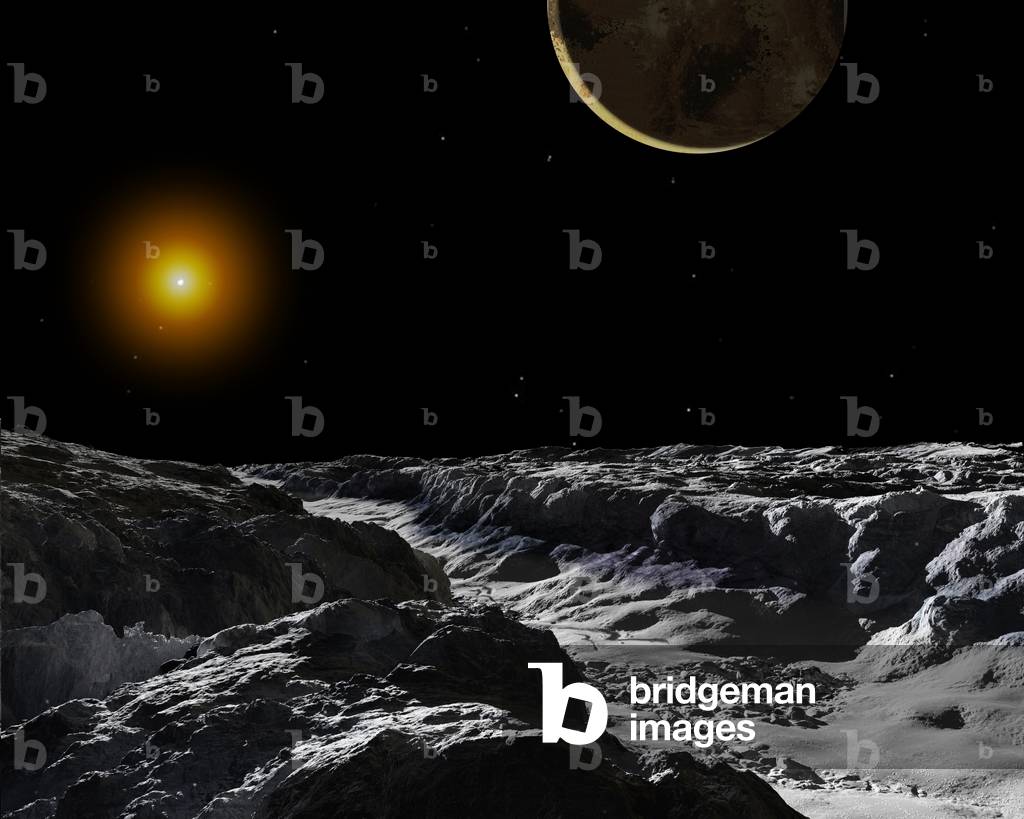
PIX4624692 Pluto vue de Charon - View d'artiste - Pluto seen from Charon - Artist view: View d'artiste de la surface de Charon. Pluto is visible in the sky. Charon surface.
DC
PIX4624674 Pluto vue de Charon - Vue d'artiste - Pluto seen from Charon - Artist view: Vue d'artiste de la glace à la surface de Charon. Pluto is visible in the sky - Ice on Charon surface
DC
PIX7223426 Artist's impression of Pluto seen in the sky from its Charon satellite.
DC
PIX6039530 Pluto and its atmosphere seen from the surface of its Charon satellite. Charon surface.
DC
PIX4607362 New Horizons closest approach to Pluto - Artist's view of the New Horizons probe near Pluto and its largest satellite Charon. The New Horizons probe was launched on 19 January 2006 to Jupiter, then Pluto and Charon, which it will reach in 2015 and Kuiper's objects in 2020. Nasa's New Horizons unmanned spacecraft flies into the shadow of dwarf planet Pluto and its moon Charon. New Horizons has been en route to Pluto since its launch from Earth in 2006 and is scheduled to make its closest approach on 14 July 2015. New Horizons will be traveling at a velocity relative to Pluto of 30,800 mph, far too fast for it to enter orbit around and become a satellite of Pluto. Instead after passing Pluto, New Horizons will continue farther into the Kuiper belt searching for other objects with diameters of 30 to 60 miles. New Horizons is about the size and shape of a grand piano and weighed 1,054 pounds at launch. The high - gain dish antenna is about 7 feet in diameter and is employed for communication with the Earth. In this image the New Horizons spacecraft is about 6,000 miles from Pluto (left), 17,000 miles from its largest moon Charon (far left) and 2.97 billion miles from the Earth While little is known about Pluto's appearance, here this Kuiper belt dwarf planet is realized as a frozen world covered with various ices, hosting a thin atmosphere of nitrogen, methane and other hydrocarbons too possibly, with a significantly weathered surface as Pluto's 248 - year orbit alternately brings it closer then further from the warmth of the sun
DC
PIX4607277 Artist's view of the New Horizons probe near Pluto - The New Horizons spacecraft near Pluto - Artist's view of the New Horizons probe near Pluto and its largest satellite Charon. The New Horizons probe was launched on 19 January 2006 to Jupiter, then Pluto and Charon, which it will reach in 2015 and Kuiper's objects in 2020. Artist's concept of the New Horizons spacecraft as it approaches Pluto and its largest moon, Charon, in July 2015. The craft's miniature cameras, radio science experiment, ultraviolet and infrared spectrometers and space plasma experiments will characterize the global geology and geomorphology of Pluto and Charon, map their surface compositions and temperatures, and examine Pluto's atmosphere in detail. The spacecraft's most prominent design feature is a nearly 7 - foot (2.1 - meter) dish antenna, through which it will communicate with Earth from as far as 4.7 billion miles (7.5 billion kilometers) away
DC
PIX4607330 Artist's view of the New Horizons probe near Pluto - The New Horizons spacecraft near Pluto - Artist's view of the New Horizons probe near Pluto and its largest satellite Charon. The New Horizons probe was launched on 19 January 2006 to Jupiter, then Pluto and Charon, which it reached in 2015 and Kuiper's objects in 2020. Artist's concept of the New Horizons spacecraft as it approaches Pluto and its largest moon, Charon, in July 2015. The craft's miniature cameras, radio science experiment, ultraviolet and infrared spectrometers and space plasma experiments will characterize the global geology and geomorphology of Pluto and Charon, map their surface compositions and temperatures, and examine Pluto's atmosphere in detail. The spacecraft's most prominent design feature is a nearly 7 - foot (2.1 - meter) dish antenna, through which it will communicate with Earth from as far as 4.7 billion miles (7.5 billion kilometers) away
DC
PIX4607366 New Horizons near Pluto and Charon - Artist's view of the New Horizons probe near Pluto and its largest satellite Charon. The New Horizons probe was launched on 19 January 2006 to Jupiter, then Pluto and Charon, which it will reach in 2015 and Kuiper's objects in 2020. Nasa's New Horizons unmanned spacecraft flies by dwarf planet Pluto and its moon Charon. New Horizons has been en route to Pluto since its launch from Earth in 2006 and is scheduled to make its closest approach on 14 July 2015. New Horizons is about the size and shape of a grand piano and weighed 1,054 pounds at launch. The high - gain dish antenna is about 7 feet in diameter and is employed for communication with the Earth. In this image the New Horizons spacecraft is about 11,000 miles from Pluto (lower left), 23,000 miles from its largest moon Charon (upper right) and 2.97 billion miles from the Earth. While little is known about Pluto's appearance, here this Kuiper belt dwarf planet is realized as a frozen world covered with various ices, hosting a thin atmosphere of nitrogen, methane and other hydrocarbons too possibly, with a significantly weathered surface as Pluto's 248 - year orbit alternately brings it closer then further from the warmth of the sun
DC
PIX4607323 Artist's view of the New Horizons probe near Pluto - New Horizons over Pluto and Charon - Artist's view of the New Horizons probe near Pluto and its largest satellite Charon. The New Horizons probe was launched on 19 January 2006 to Jupiter, then Pluto and Charon, which it will reach in 2015 and Kuiper's objects in 2020. Nasa's New Horizons unmanned spacecraft approaches dwarf planet Pluto and its moon Charon. New Horizons has been en route to Pluto since its launch from Earth in 2006 and is scheduled to make its closest approach on 14 July 2015. New Horizons is about the size and shape of a grand piano and weighed 1,054 pounds at launch. The high - gain dish antenna is about 7 feet in diameter and is employed for communication with the Earth. In this image the New Horizons spacecraft is about 15,000 miles from Pluto (upper right), 27,000 miles from its largest moon Charon (lower left) and 2.97 billion miles from the Earth. This side of the spacecraft on the left can be seen the Visible/Near Infrared Multi - Spectral Imager and the Short Wavelength Infrared Spectral Imager (aka “” Ralph”), and the Ultraviolet Imaging Spectrograph (aka “” Alice””). On the right extending about four feet from the main body of the spacecraft is the radioisotope thermoelectric generator (RTG) which provides constant electric power for the 10 year mission from heat produced by 24 pounds of plutonium - 238. While little is known about Pluto's appearance, here this Kuiper belt dwarf planet is realized as a frozen world covered with various ices, hosting a thin atmosphere of nitrogen, methane and other hydrocarbons too possibly, with a significantly weathered surface as Pluto's 248 - year orbit alternately brings it closer then further from the warmth of the sun
DC
PIX4607314 Artist's view of the New Horizons probe near Pluto - The New Horizons spacecraft near Pluto - Artist's view of the New Horizons probe near Pluto and its largest satellite Charon. The New Horizons probe was launched on 19 January 2006 to Jupiter, then Pluto and Charon, which it reached in 2015 and Kuiper's objects in 2020. Artist's concept of the New Horizons spacecraft as it approaches Pluto and its largest moon, Charon, in July 2015. The craft's miniature cameras, radio science experiment, ultraviolet and infrared spectrometers and space plasma experiments will characterize the global geology and geomorphology of Pluto and Charon, map their surface compositions and temperatures, and examine Pluto's atmosphere in detail. The spacecraft's most prominent design feature is a nearly 7 - foot (2.1 - meter) dish antenna, through which it will communicate with Earth from as far as 4.7 billion miles (7.5 billion kilometers) away
DC
PIX4607329 Artist's view of the New Horizons probe near Pluto - New Horizons over Pluto and Charon - Artist's view of the New Horizons probe near Pluto and its largest satellite Charon. The New Horizons probe was launched on 19 January 2006 to Jupiter, then Pluto and Charon, which it will reach in 2015 and Kuiper's objects in 2020. Nasa's New Horizons unmanned spacecraft over dwarf planet Pluto and its moon Charon. New Horizons has been en route to Pluto since its launch from Earth in 2006 and is scheduled to make its closest approach on 14 July 2015. New Horizons is about the size and shape of a grand piano and weighed 1,054 pounds at launch. The high - gain dish antenna is about 7 feet in diameter and is employed for communication with the Earth. In this image the New Horizons spacecraft is about 10,000 miles from Pluto (upper right), 22,000 miles from its largest moon Charon (upper left) and 2.97 billion miles from the Earth. Dominating this side of the spacecraft with an 8 inch aperture is the Long - Range Reconnaissance Imager (LORRI), a digital camera with a large telephoto telescope fortified to operate in the cold, hostile environs of deep space. At 90 days before closest approach to Pluto, Lorri's images will surpass the quality of the best Hubble Space Telescope images of Pluto. While little is known about Pluto's appearance, here this Kuiper belt dwarf planet is realized as a frozen world covered with various ices, hosting a thin atmosphere of nitrogen, methane and other hydrocarbons too possibly, with a significantly weathered surface as Pluto's 248 - year orbit alternately brings it closer then further from the warmth of the sun
DC
PIX4607290 Artist's view of the New Horizons probe near Pluto - The New Horizons spacecraft near Pluto - Artist's view of the New Horizons probe near Pluto and its largest satellite Charon. The New Horizons probe was launched on 19 January 2006 to Jupiter, then Pluto and Charon, which it will reach in 2015 and Kuiper's objects in 2020. Artist's concept of the New Horizons spacecraft as it approaches Pluto and its largest moon, Charon, in July 2015. The craft's miniature cameras, radio science experiment, ultraviolet and infrared spectrometers and space plasma experiments will characterize the global geology and geomorphology of Pluto and Charon, map their surface compositions and temperatures, and examine Pluto's atmosphere in detail. The spacecraft's most prominent design feature is a nearly 7 - foot (2.1 - meter) dish antenna, through which it will communicate with Earth from as far as 4.7 billion miles (7.5 billion kilometers) away
DC
PIX4629992 Comparison between the Earth, Pluto, Charon and the Moon - Earth, Pluto, Charon, and Earth's Moon compared - Comparison at the scale of the sizes of the Earth, Pluto, Charon and the Moon. Since August 2006, Pluto is now called 134340 Pluto and is no longer considered a planet but designed as a dwarf planet. Pluto's diameter less than 20 percent that of the Earth's (smaller than the Earth's Moon). It has less than one percent the mass. If you weigh 180 pounds on Earth, you would weigh 11 pounds on Pluto. Pluto is 30 to 48 times further from the Sun than the Earth (Pluto's orbit is highly elliptical). Pluto's moon Chiron is over half the size of Pluto itself, leading astronomers to originally classify the Pluto-Charon system as a “” double planet.” They were also considered “” binary planets”” because the smaller Charon doesn't actually orbit around Pluto, rather Pluto and Charon orbit a common gravitational center (the “” barycenter ') located above Pluto's surface. In 2006 the International Astronomical Union (IAU) demoted Pluto from its status as the Solar System's 9th planet to a dwarf planet, and as the IAU has yet to formalize a definition for binary dwarf planets, Charon is currently regarded as a satellite of Pluto
DC
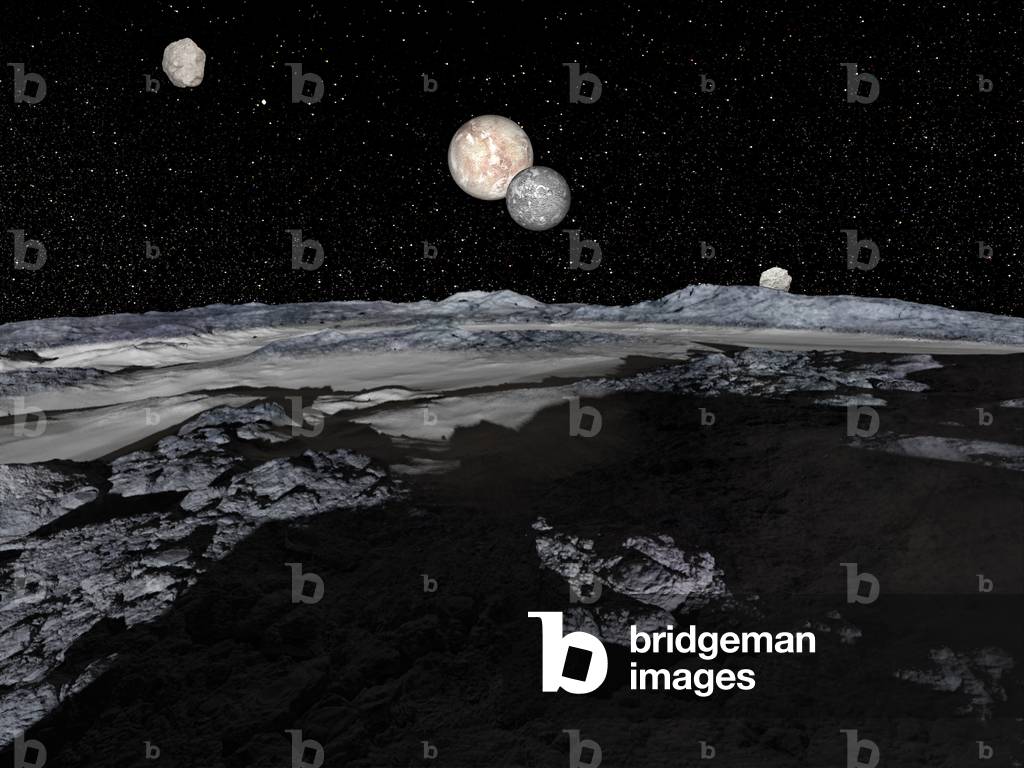
PIX7223427 Surface du satellite Hydre. Dans le ciel, Pluton et Charon, accompagnés des satellites Styx, Nix et Kerberos.
DC
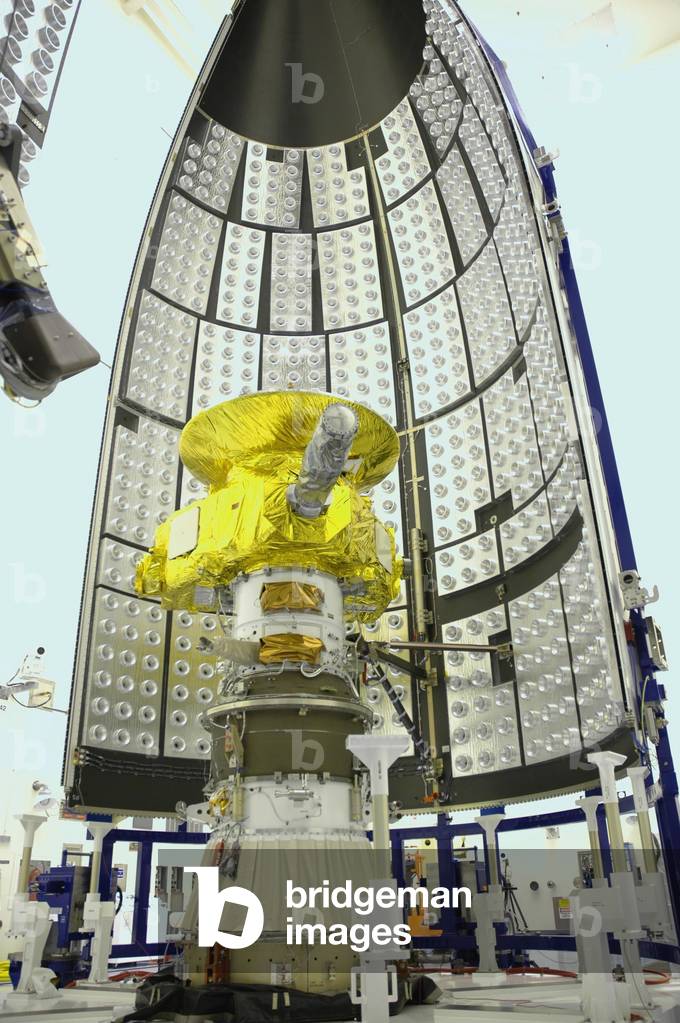
PIX4607348 The New Horizons probe - The New Horizons spacecraft - The New Horizons probe at Nasa's Kennedy Space Center in December 2005. The New Horizons probe was launched on 19 January 2006 to Jupiter, then Pluto and Charon, which it reached in 2015 and Kuiper's objects in 2020. In the Payload Hazardous Servicing Facility, the New Horizons spacecraft waits for encapsulation within the fairing sections waiting nearby. The fairing protects the spacecraft during launch and flight through the atmosphere. Once out of the atmosphere, the fairing is jettisoned. The compact 1,060 - pound New Horizons probe carries seven scientific instruments that will characterize the global geology and geomorphology of Pluto and its moon Charon, map their surface compositions and temperatures, and examine Pluto's complex atmosphere. After that, flybys of Kuiper Belt objects from even farther in the solar system may be undertaken in an extended mission. New Horizons is the first mission in Nasa's New Frontiers program of medium - class planetary missions. The spacecraft, designed for NASA by the Johns Hopkins University Applied Physics Laboratory in Laurel, Md., will fly by Pluto and Charon as early as summer 2015
DC

Total de Resultados: 15

Página 1 de 1