Busque também em nossas outras coleções:

Data da imagem:
Pauta
ver mais opções...
Agência
ver mais opções...
Fotógrafo
ver mais opções...
Pais
Estado
ver mais opções...
Cidade
ver mais opções...
Local
ver mais opções...
Tipo de licença
Orientação
Coleção
ver mais opções...

Total de Resultados: 1.649

Página 1 de 17

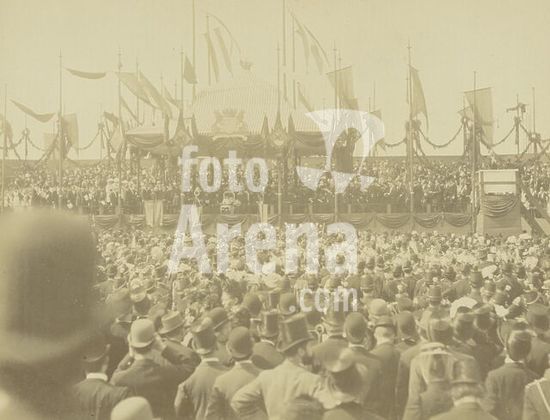
902_05_12516024highres The Graphic Newspaper/Magazine June 1st 1897, Queens Victoria's Diamond Jubilee. The opening of the Imperial Institute by the Queen on May 10 ,1893
DC
902_05_12516028highres The Graphic Newspaper/Magazine June 1st 1897, Queens Victoria's Diamond Jubilee. Kensington Palace where Queen Victoria was born May 24th 1819
DC
902_05_12516042highres The Graphic Newspaper/Magazine June 1st 1897, Queens Victoria's Diamond Jubilee. Her Majesty Queen Victoria distributing medals to the heroes from the Crimea on the Horse Guards Parade May 21 1855
DC
902_05_12512716highres The death of Catherine of Aragon, 1536. Catherine of Aragon, also spelled Katherine, 1485 - 1536. Queen of England from June 1509 until May 1533 as the first wife of King Henry VIII. From Hutchinson's History of the Nations, published 1915.
DC
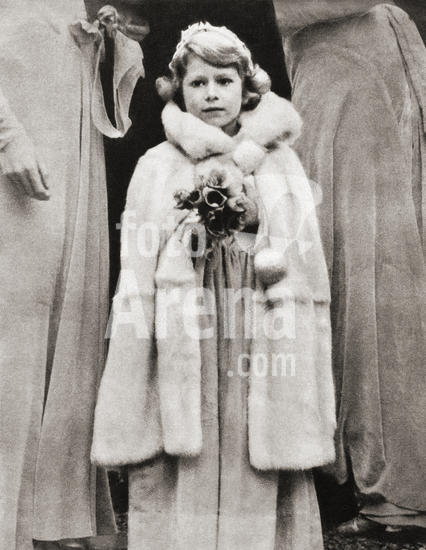
902_05_12512600highres Princess Elizabeth of York, seen here as a bridesmaid at the wedding of Lady May Cambridge in 1931. Princess Elizabeth of York, future Elizabeth II, born 1926. Queen of the United Kingdom. From The Coronation Book of King George VI and Queen Elizabeth, published 1937.
DC
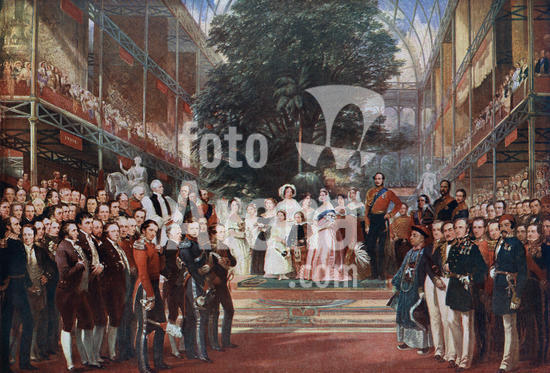
902_05_12310278HighRes The opening by Queen Victoria of The Great Exhibition in Hyde Park, London, England, 1st May, 1851. From The Century Edition of Cassell's History of England, published c. 1900
DC
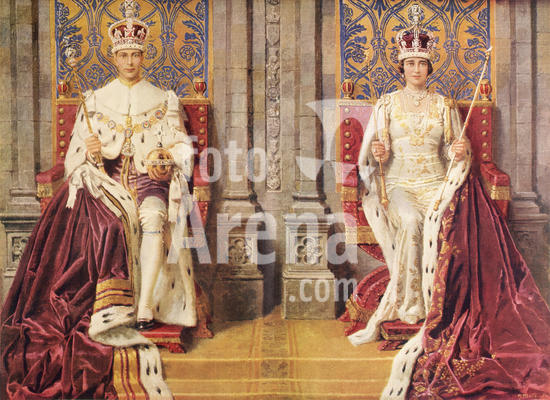
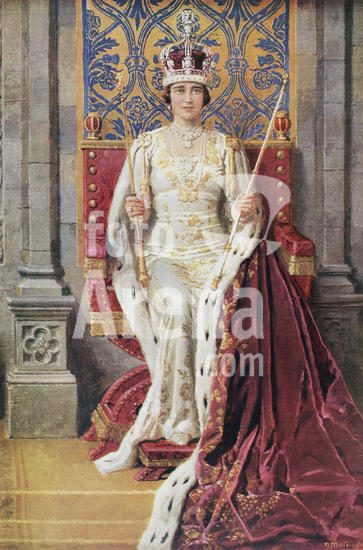
902_05_12288297HighRes The King and Queen Enthroned and Crowned, May 12, 1937. George VI, Albert Frederick Arthur George, 1895 to 1952. King of the United Kingdom. Elizabeth Angela Marguerite Bowes-Lyon, 1900 to 2002. Queen consort of George VI. From The Sphere, Coronation Record Number published 1937.
DC
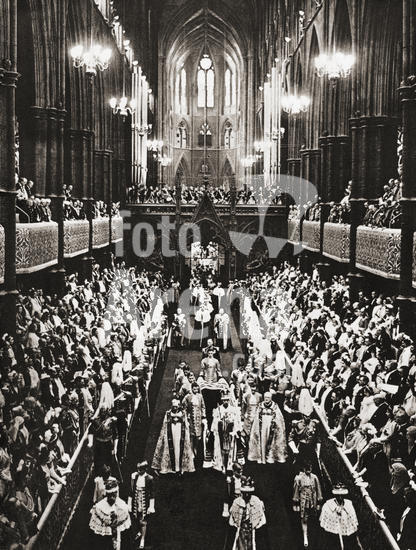
902_05_12310248HighRes The coronation procession of George VI, 12 May 1937, in Westminster Abbey, London, England. George VI, 1895 ? 1952. King of the United Kingdom. From The Coronation of King George VI and Queen Elizabeth, published 1937.
DC
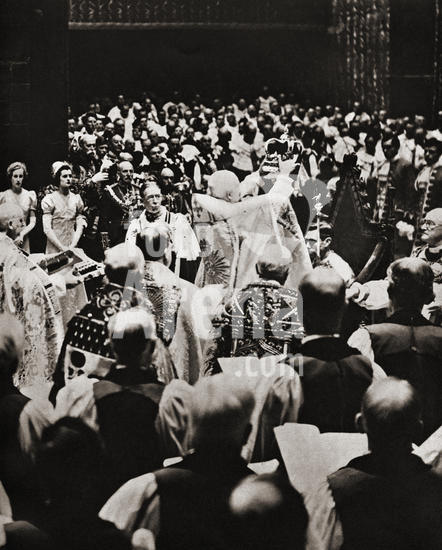
902_05_12310246HighRes The coronation of George VI, (1895 ? 1952), 12 May, 1937. King of the United Kingdom. From The Coronation of King George VI and Queen Elizabeth, published 1937.
DC
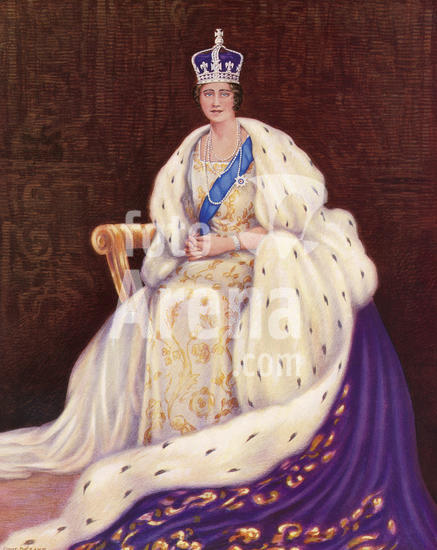
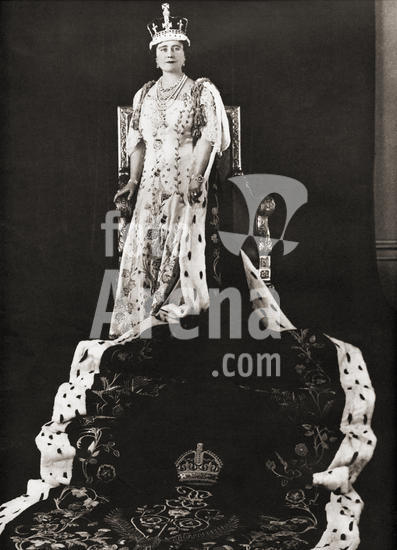
902_05_12310247HighRes The coronation of Elizabeth Angela Marguerite Bowes-Lyon, (1900 ? 2002) 12 May, 1937. Queen consort of the United Kingdom as the wife of King George VI. From The Coronation of King George VI and Queen Elizabeth, published 1937.
DC
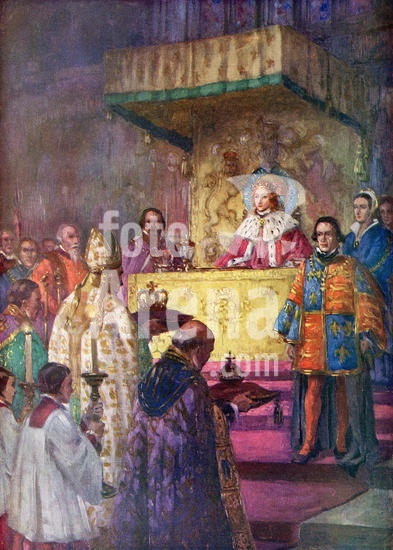
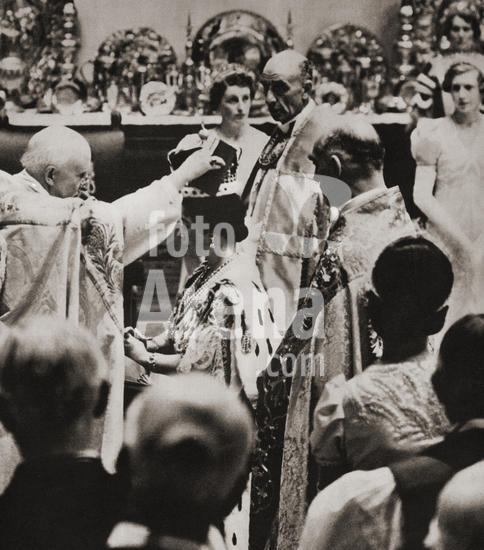
902_05_12323777HighRes The coronation ceremony of Queen Elizabeth, conducted by the Archbishop of Canterbury, 12 May, 1937. Elizabeth Angela Marguerite Bowes-Lyon, 1900 ? 2002. Queen consort of the United Kingdom and the Dominions as the wife of King George VI. From Their Gracious Majesties King George VI and Queen Elizabeth, published 1937.
DC
902_05_12288298HighRes Queen Elizabeth Enthroned and Crowned, May 12, 1937. From The Sphere, Coronation Record Number published 1937.
DC
902_05_12288419HighRes Queen Elizabeth Enthroned and Crowned, May 12, 1937. From the Coronation Souvenir Book published 1937.
DC
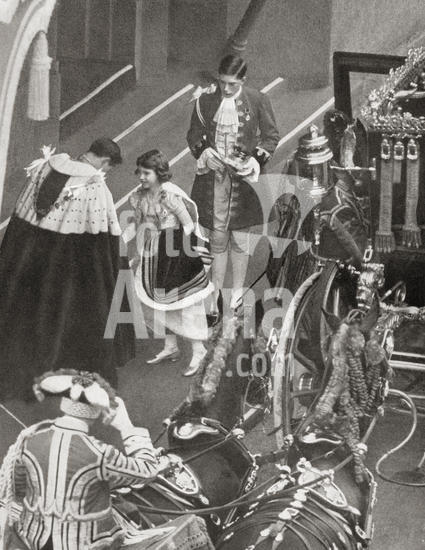
902_05_12323632HighRes Princess Elizabeth, future Queen Elizabeth II, arrives at Westminster Abbey for the Coronation of her parents, 12th May, 1937. From a photograph.
DC
902_05_12323628HighRes Mary of Teck holding her grandaughter Princess Elizabeth, future Queen Elizabeth II, May 1926. Mary of Teck, 1867 ? 1953. Queen of the United Kingdom and the British Dominions and Empress of India as the wife of King-Emperor George V. Elizabeth II, born 1926. Queen of the United Kingdom, Canada, Australia and New Zealand.
DC
902_05_12321078HighRes King George VI and Queen Elizabeth in the coach of state during their journey from the Palace to Westminster Abbey to their coronation ceremony 12th May 1937. George VI, Albert Frederick Arthur George, 1895 to 1952. King of the United Kingdom. Elizabeth Angela Marguerite Bowes-Lyon, 1900 to 2002. Queen consort of George VI. From The Sphere, Coronation Record Number published 1937.
DC
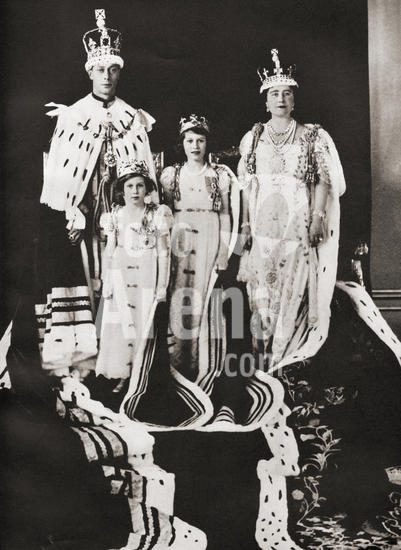
902_05_12310241HighRes King George VI and his wife Queen Elizabeth seen here the day of their coronation, 12 May, 1937, with their daughters Princess Margaret and Princess Elizabeth, future Queen Elizabeth II. George VI, 1895 ? 1952, King of the United Kingdom. Elizabeth Angela Marguerite Bowes-Lyon, 1900 ? 2002. Queen consort of the United Kingdom as the wife of King George VI. Princess Margaret, later Countess of Snowdon, 1930 ? 2002. Princess Elizabeth, later Queen Elizabeth II, born 1926. From The Coronation of King George VI and Queen Elizabeth, published 1937.
DC
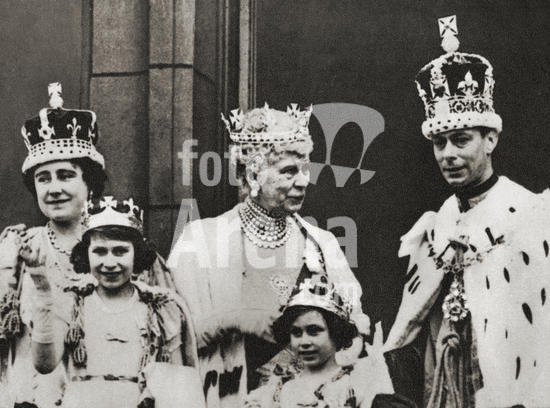
902_05_12310249HighRes King George VI and his wife Queen Elizabeth seen here on the balcony at Buckingham Palace, London, England the day of their coronation, 12 May, 1937, with their daughters Princess Margaret and Princess Elizabeth, future Queen Elizabeth II and the king's mother Mary of Teck. George VI, 1895 ? 1952, King of the United Kingdom. Elizabeth Angela Marguerite Bowes-Lyon, 1900 ? 2002. Queen consort of the United Kingdom as the wife of King George VI. Princess Margaret, later Countess of Snowdon, 1930 ? 2002. Princess Elizabeth, later Queen Elizabeth II, born 1926. Mary of Teck, 1867 ? 1953. Queen consort of the United Kingdom and the British Dominions, and Empress consort of India, as the wife of King-Emperor George V. From The Coronation of King George VI and Queen Elizabeth, published 1937.
DC
902_05_12310239HighRes George VI, 1895 ? 1952. Seen here the day of his coronation, 12 May, 1937. King of the United Kingdom. From The Coronation of King George VI and Queen Elizabeth, published 1937.
DC
902_05_12323625HighRes George VI on the day of his coronation with his wife Queen Elizabeth and their daughters Princess Elizabeth, right, and Princess Margaret, left, 12th May 1937. George VI,1895 ? 1952. King of the United Kingdom and the Dominions of the British Commonwealth. Queen Elizabeth, Elizabeth Angela Marguerite Bowes-Lyon, 1900 ?2002. Wife of King George VI and the mother of Queen Elizabeth II. Princess Elizabeth Alexandra Mary; born 1926. Future Queen Elizabeth II. Princess Margaret, 1930 ? 2002, aka Princess Margaret Rose or Princess Margaret.
DC
902_05_12310240HighRes Elizabeth Angela Marguerite Bowes-Lyon, 1900 ? 2002. Queen consort of the United Kingdom as the wife of King George VI, seen here the day of her coronation, 12 May, 1937. From The Coronation of King George VI and Queen Elizabeth, published 1937.
DC
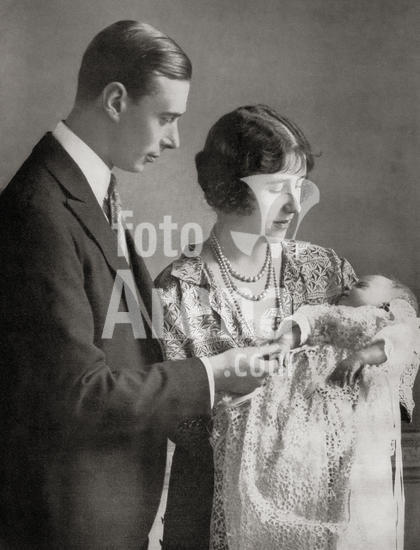
902_05_12323627HighRes Albert Frederick Arthur George, future George VI and his wife Elizabeth Bowes-Lyon future Queen Elizabeth at the christening of their first daughter Princess Elizabeth, future Queen Elizabeth II, 29th May 1926.
DC
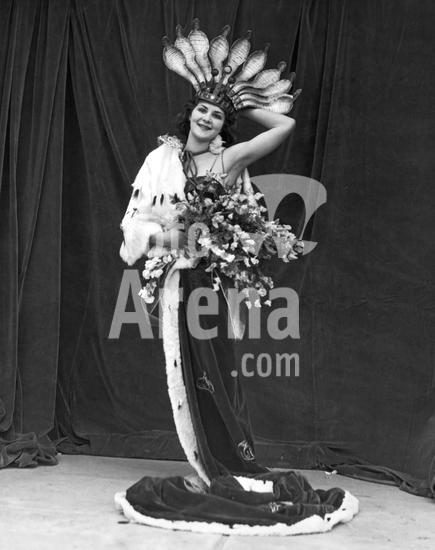
990_16_0-E-BC-CA_2HR Long Beach, California: 1936. The queen of the Neptunes Electrical Extravaganza which will be staged over the Olympic Rowing Course on May 6th in Long Beach.
DC
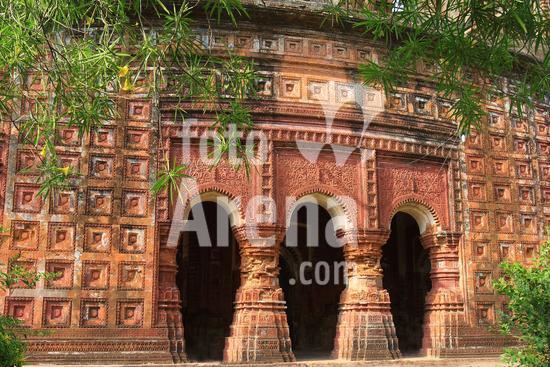
925_07_MW018259 Terracotta details on the wall of the Govinda Temple, a two storied Hindu shrine behind the Puthia Rajbari, a palace complex, in Puthia, about 18 miles east of the Northern district town of Rajshahi
DC
925_02_MW007535 Portrait of two Rajasthani women at Jaisalmir, Rajasthan, India
DC
925_02_MW007534 Rajasthani women are known for their simplicity, beauty and valor all over the world
DC
925_02_MW007532 Portrait of a Rajasthani woman
DC
975_19_TASS-D-S002AF97 18-year-old saratov student olesya kuzmicheva won the queen of the universe title at the international beauty contest in johannesburg, saratov, russia, may 6 2003.
DC
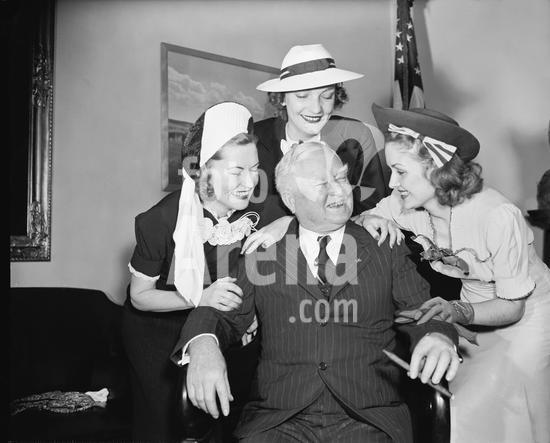
990_05_X-Garner-John_3HR Washington, D.C.: May 19, 1938 Vice President John Nance Garner was in fine fettle as he greeted visiting South Carolina azalea beauty queens. L-R: Elizabeth West, 1937 Azalea Queen; Margaret Lyon, 'Miss Charleston' of this year; and Dorothy Moore, Azalea Queen of 1938.
DC
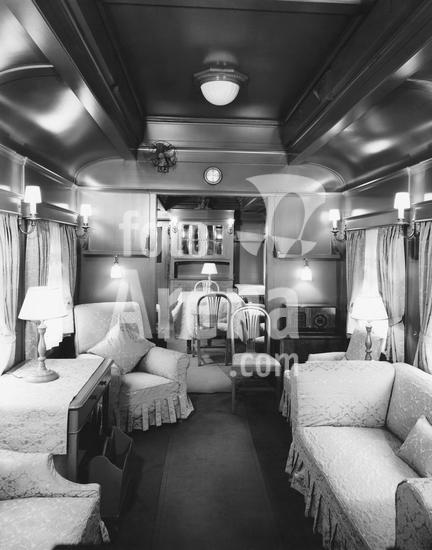
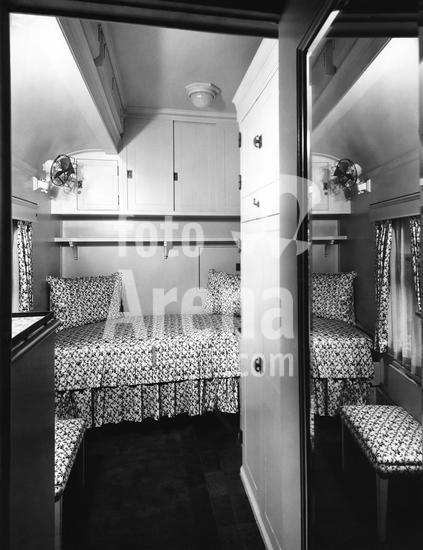
990_05_8-RR-T-IntP_27 Montreal, Canada: May, 1939.One of the two cars in which King George VI and Queen Elizabeth will travel across Canada from Quebec to Vancouver on the Canadian National Railways..This view is looking from the dining room into the sitting room of Their Majesties' car of the Royal Train.
DC
990_05_3-Rite-Hol-Val_7HR Cypress Gardens, Florida: February 5, 1958 May Louise Khoury strikes a pose to remind everyone that Valentine's Day will soon be here.
DC
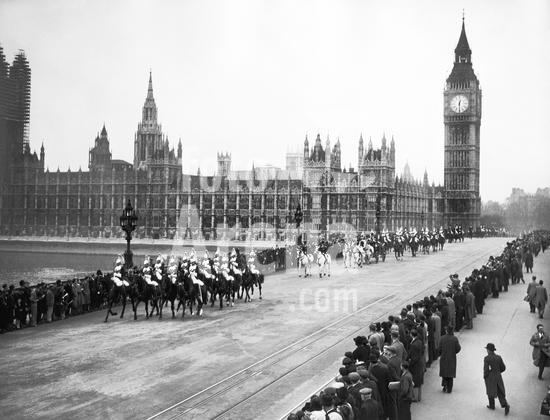
990_05_9-GBrit-Eng-Lon_12HR London, England: May 6, 1939 The King and Queen and other members of the Royal Family in the Royal Procession over Westminster Bridge on their way to Waterloo Station today. They are leaving to visit Canada and The U.S.
DC
990_05_8-RR-T-IntP_33HR Montreal, Canada: May, 1939 The King's bedroom on the Royal Train on which King George VI and Queen Elizabeth will travel across Canada from Quebec to Vancouver on the Canadian National Railways.
DC
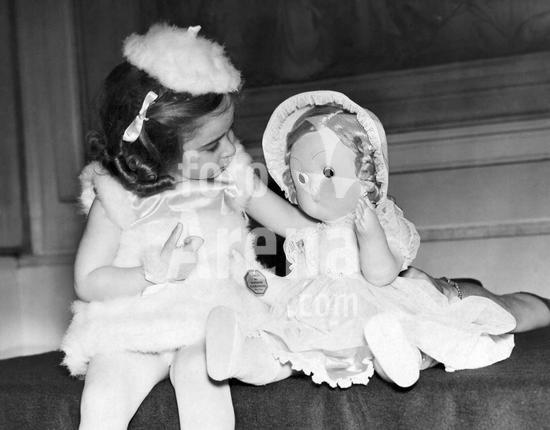
990_05_6-Child-Play-Doll_5HR London, England: May 1, 1939 Little Simone Myers with her doll which was the 'Queen Mary's Prize' at the Peter Pan Party at the Claridge's Hotel today. Simone received it from the Marchioness of Cambridge.
DC
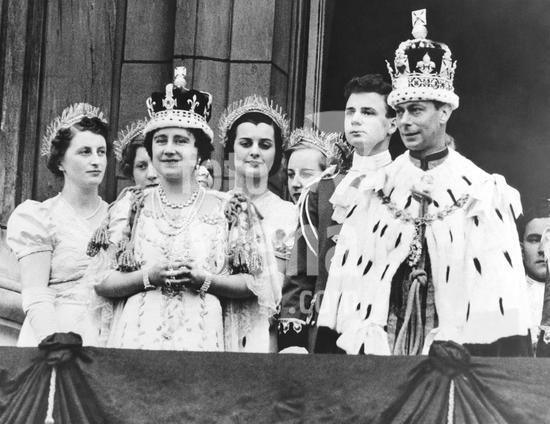
990_05_9-GBrit-Roy-KQ_4HR London, England: May 12, 1937 King George VI and Queen Elizabeth on coronation day on the Buckingham Palace balcony. Right of the Queen is Lady Ursula Manners, one of her six trainbearers, and to the left of the King is Earl Kitchener, one of the nine pages who bore the King's train at the coronation.
DC
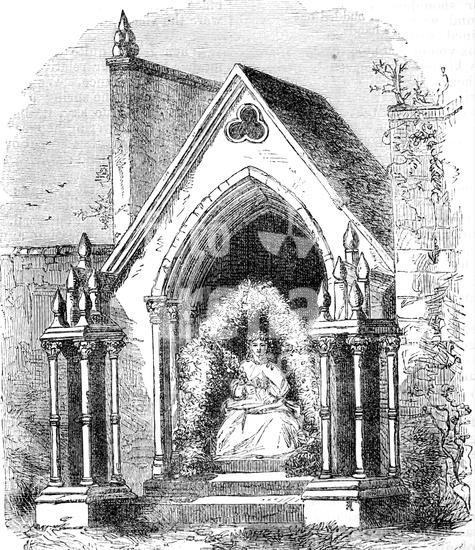
917_05_WHA_091_0110 Illustration depicting the crowning of the May Queen with a wreath of hawthorn by her sweetheart. Illustrated by William Small (1843-1929) an English illustrator. Dated 19th Century.
DC
917_05_WHA_091_0635 Illustration depicting the recently appointed May-Queen, in the South of France. Dated 19th Century.
DC
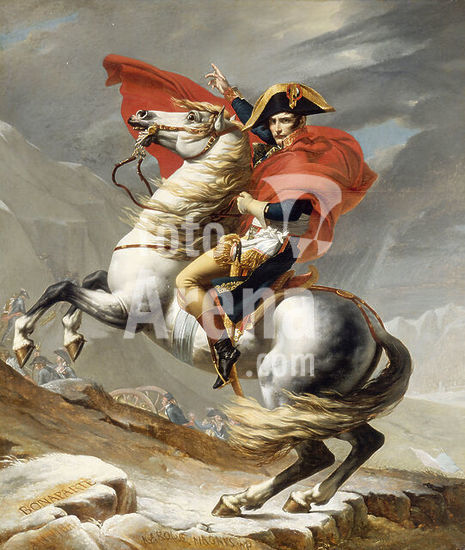
alb3901126 Napoleon Crossing the Alps. Date/Period: 1802. Painting. Oil on canvas. Height: 273 cm (107.4 in); Width: 234 cm (92.1 in). Author: JACQUES LOUIS DAVID. Jérôme-Martin Langlois.
DC
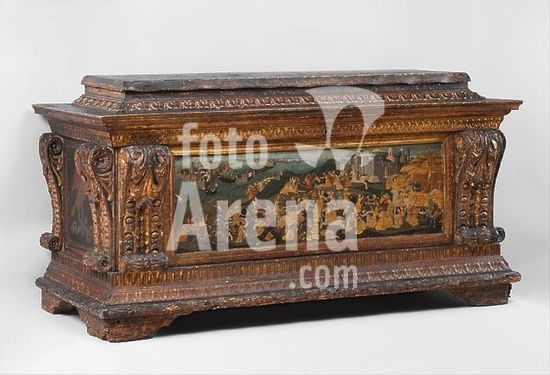
alb3600110 Cassone with painted front panel depicting the Conquest of Trebizond. Culture: Italian, Florence. Dimensions: H. 39-1/2 x W. 77 x D. 32-7/8 in. (100.3 x 195.6 x 83.5 cm); Painted surface 15 1/4 x 49 1/2 in. (38.7 x 125.7 cm). Maker: Attributed to workshop of Apollonio di Giovanni di Tomaso (Italian, Florence ca. 1416-1465 Florence); and workshop of Marco del Buono Giamberti (Italian, Florence 1402-1489 Florence). Date: after ca. 1461.Purchased in 1913 from the Florentine dealer Stefano Bardini (1836-1922), this elaborate chest, or cassone, has long enjoyed status as one of the few fifteenth-century objects of its kind to survive intact and, moreover, to portray a contemporary historical event--the conquest of Trebizond, the last outpost of the Byzantine Empire, by Mehmed II in 1461 (for another example of a cassone panel depicting a contemporary historical event, see 07.120.1). This status has been called into question by a detailed, technical examination undertaken in 2008. It has now been demonstrated that so far from being intact, various parts of the chest are not integral and that, most importantly, the painted front may originate from another chest. This means that the purported provenance of the chest from Palazzo Strozzi, first asserted by Weisbach [see Ref. 1913], may have no bearing on the interpretation of the scene on the painted front. That the chest itself is connected with some member of the Strozzi family is clear from the emblems that appear on the end pieces, which are original to it: the Strozzi falcon or hawk perched on a caltrop (spiky metal devices that, when scattered on the ground, destabilize the enemy's horses) with a banderole inscribed ME[Z]ZE--perhaps indicating another Strozzi emblem, the half-moon crescent [see Ref. Nickel 1974]. The inside of the lid and the back of the cassone retain their original stenciled patterns simulating patterned fabric, and the top of the lid is embellished by a gessoed piece of cloth that is gilded and tooled to simulate a runner of cut velvet (this motif is worn, the paint having been almost entirely lost, so that the design is barely legible today). The scene on the painted front is universally recognized as coming from the most active and prestigious workshop for the production of painted cassone in mid-fifteenth-century Florence: that shared by Apollonio di Giovanni and Marco del Buono. Its subject is neither biblical nor mythological, nor even based on a contemporary novella such as those by Boccaccio. Rather, it depicts an event that unfolds before two identifiable cities of the Byzantine Empire. Much work has been done identifying the places shown [see especially Refs. Paribeni 2001, Paribeni 2002, and Lurati 2005]. In the left background, clearly labeled on its walls, is Constantinople. An attempt has been made by the artist to suggest a number of the city's landmarks and distinguishing topographical features, some of which are also labeled. There is the Latin church of San Francesco; the monumental column of Justinian in the Augustaion and the Egyptian obelisk (evidently topped by a crescent) in the Hippodrome originally laid out by Emperor Septimus Severus in the third century AD and further embellished by Constantine; the Hagia Sofia; the nearby sixth-century church of Saint Irene; what must be intended either as the Blachernae Palace or its thirteenth-century annex, the Palace of Porphyrogenitus, which served as the imperial residence for the last Byzantine emperors (the fragmentary inscription may possibly have been intended as [PALAZZO] DEILO [IM]PER[AT]ORI); the Golden Horn--the city's fabled inlet that was protected by a chain that could be drawn across it--with western ships (carracks) moored next to the Genoese quarter of Pera, the walls of which are dominated by the great circular Galata tower, atop which the Genoese flag can be seen. Other boats in the Golden Horn and the Sea of Marmara may be either Greek dromons or Ottoman. Further back, on the European side of the Bosphorus, is the CHASTEL NVOVO (the "new fortress" of Rumeli Hisari built by Mehmed II in 1451-52 in preparation for the seige of Constantinople; its distinctive towers are still a landmark today). Across the Bosphorus is another walled city designated as LO SCUTARIO--Scutari, present-day Üsküdar (the name, Skutarion, derived from the leather shields of the Roman soldiers stationed there; it fell to the Ottomans almost a century before Constantinople). Then, dominating the hill on the right is the walled city of Trebizond (modern-day Trabzon). Located on the southern coast of the Black Sea, it became the seat of a separate Byzantine empire when it was conquered by Alexios Komenos in 1204--the year Constantinople fell to the crusaders--and was the last outpost of the Byzantine Empire following the conquest of Constantinople by the Ottomans in 1453. It fell to the Ottomans in 1461, marking the final demise of Byzantium. Although hardly an accurate depiction, it seems clear that for his depiction of Constantinople the artist was supplied with descriptions and maps, such as the one included in Cristoforo Buondelmonti's Liber insularum Archipelagi of 1420 [see Ref. Pope-Hennessy and Christiansen 1980] as well as, possibly, drawings by that inveterate traveler Cyriac of Ancona and the reports of other visitors to the city [see Ref. Lurati 2005].Before the walled city of Trebizond is depicted a battle. An encampment of tents is shown on the far right, in front of which the leader of one of the armies is seated on a triumphal chariot drawn by two white horses. He wears a turban, as do other members of his army, including the troops emerging behind Scutari, and he points his white baton towards a gesticulating, bearded figure who, dressed in blue, wears the sort of cylindrical hat splayed out at the top that was associated in Western Europe with the Byzantine Greeks [see Ref. Lurati 2005]; he rides a black steed and is plainly either reporting on the progress of the battle or taking orders. Prior to 1980 it was presumed that the figure on the chariot was Mehmed II [see Ref. Weisbach 1913] and that the battle depicted the Ottoman defeat of the Byzantines in 1461--hence the designation of the chest as the Trebizond Cassone. However, as has been pointed out by Paribeni [see Ref. 2001], Trebizond was taken by Mehmed II without a battle: it capitulated without bloodshed. Moreover, a close examination of the costumes reveals that it is the Ottomans who are being vanquished (for the costumes, see especially Refs. Paribeni 2001, Paribeni 2002, and Lurati 2005). Clearly shown among the captives and those in retreat are members of the Ottoman elite infantry, the Janissaries, wearing their distinctive white conical hats with the top folded over. Other conical hats are gold, some with a feathered decoration (for similar Turkish costumes, see Cesare Vecellio's Degli habiti antichi . , Venice, 1664, book 7, pp. 297-302). Their commander is almost certainly the turbaned figure to the left of the melee, dressed in gold, holding a scepter and mounted on a black horse. He is defended by Janissaries, one of whom turns around while pointing with his left hand. Scimitars are wielded by both armies, as are the distinctive recurved composite bows of Ottoman warfare. In front of the triumphal chariot five captives, two of whom kneel, are being presented to the victorious army commanders. The characterization of the two armies should have been enough to refute the common identification of the figure on the triumphal chariot as Mehmed II. And, in fact, a careful examination with the aid of infrared light in 1980 revealed an inscription identifying him as TAN[B]VRLANA--Tamerlane, or Timur (1336-1405), the celebrated Mongol emperor and commander who defeated the Ottomans under Bayezid I at Ankara in 1402 (Bayezid was taken prisoner). The battle, then, would seem to be Tamerlane's victory over Bayezid at Ankara, but anachronistically shown against the backdrop of Trebizond. As remarked by Gombrich [see Ref. 1955], "it cannot have been the intention of the painter simply to represent a Greek disaster." And, indeed, the setting of a battle that took place in 1402 in front of a city that fell to the Ottomans in 1461 signals an emblematic intent.In the minds of Europeans, Tamerlane's victories assured him a place among the "worthies". As such, his image was included in a fresco cycle of famous men commissioned about 1432 by Cardinal Giordano Orsini for his palace in Rome. A number of interpretations have been suggested to explain the apparent anachronisms (see the thorough summary in Ref. Krohn 2008). One would have it that the figure is not actually Tamerlane but the Turkmen rival of the Ottomans, Uzun Hasan (1423-1478), who was known in his time as a second Tamerlane [see Ref. Paribeni 2001 and Baskins, as reported in Ref. Krohn 2008]. Uzun Hasan made a pact with Mehmed II not to aid the Byzantine forces and thus to assist the Ottoman conquest of Trebizond. How this relates to the actual battle scene depicted remains problematic, but it may be worth noting that the Venetians sought Uzun Hasan as an ally against the Ottomans. What cannot be doubted is the intention to conflate historical events, using the past as a template for the future by reminding viewers that the Ottomans--now a threat to Europe--were not invincible. Paribeni [see Ref. 2001] has indicated a pair of cassoni panels commissioned from the workshop of Apollonio, apparently in 1461, that illustrate the triumph of the Greeks over Xerxes' invading Persian army in 480-79 BC. Given the date of the commission, there would appear to be a reference to the conquest of Trebizond, the collapse of the Byzantine Empire, and a hoped for reversal. At the Council of Mantua in 1459, Pius II promoted a crusade against the Turks. An army was assembled in Ancona in 1464, but dispersed when Pius died there on August 15. There were, of course, also mercantile interests, and Paribeni [see Ref. 2001] has pointed out that in December 1460 an accord established a Florentine commercial presence in Trebizond. The presence on the MMA cassone of the two cities of Constantinople and Trebizond would thus seem to transform Tamerlane's victory at Ankara in 1402 into an emblematic prognosis for the defeat of the Ottoman conquerors of Trebizond.As noted above, the painted front may have belonged to another chest so that the attempts to link it with the Strozzi remain speculative. Moreover, it has not been proven that the chest itself came from the Strozzi palace, though it contains Strozzi emblems. Several Strozzi marriages have been suggested as appropriate moments for the commission: Caterina Strozzi, who married Jacopo degli Spini in 1462 [see Ref. Nickel 1974]; the brother of Vanni di Francesco Strozzi, who traveled to Constantinople and Trebizond in 1462 and who commissioned a cassone from Apollonio for the marriage [see Ref. Paribeni 2001]; Strozza di Messer Marcello degli Strozzi, who married in 1459; Benedetto di Marco degli Strozzi, who married in 1462 [Baskins, reported in Ref. Krohn 2008]; and finally, most prominent of all, the wealthy banker Filippo Strozzi--the builder of Palazzo Strozzi--who married Fiammetta degli Adimari in 1466 [Beatrice Paolozzi-Strozzi, in Ref. Krohn 2008]. Museum: Metropolitan Museum of Art, New York, USA.
DC
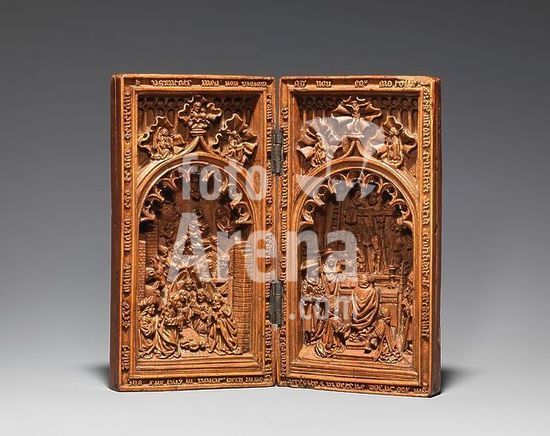
alb3666453 Diptych with the Nativity and the Mass of Saint Gregory. Culture: Netherlandish. Dimensions: Open: 3 1/4 × 3 1/2 × 9/16 in. (8.3 × 8.9 × 1.5 cm)Closed: 3 1/4 × 1 3/4 × 1 1/4 in. (8.3 × 4.5 × 3.2 cm). Date: early 16th century.Among the more than 130 miniature boxwood carvings that have survived, this is the only diptych. While the subjects are not unusual, the inscriptions are particularly complex, drawing on the writings of Saint Bernard of Clairvaux and other theologians. By tradition, it is said that this piece belonged to Queen Christina of Spain in the nineteenth century. It may reflect her Habsburg ancestors' taste for miniature boxwood carvings from the Netherlands, a territory they ruled at the beginning of the sixteenth century. Museum: Metropolitan Museum of Art, New York, USA.
DC

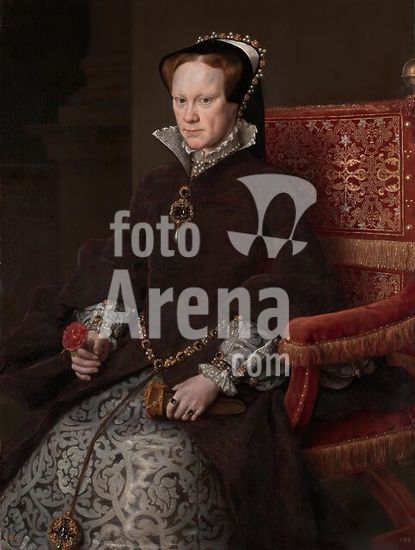
alb2069313 Antonio Moro / 'Mary Tudor, Queen of England, second wife of Felipe II', 1554, Flemish School, Oil on panel, 109 cm x 84 cm, P02108. Museum: MUSEO DEL PRADO, MADRID, SPAIN. MARÍA TUDOR.
DC
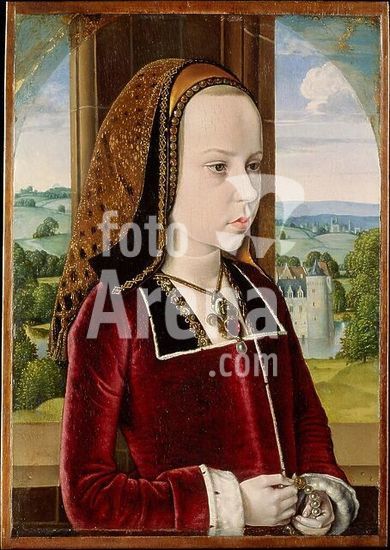
alb3645256 Margaret of Austria. Artist: Jean Hey (called Master of Moulins) (Netherlandish, active fourth quarter 15th century). Dimensions: 12 7/8 x 9 1/8 in. (32.7 x 23 cm). Date: ca. 1490.The daughter of Emperor Maximilian I, Margaret of Austria was betrothed at the age of three to the infant dauphin Charles, the future Charles VIII, and served briefly as "queen of France" from 1483 to 1491. She is shown here around the age of ten, one year before she was repudiated by her intended husband. The initials C and M within the border of Margaret's collar (backwards C in the left border) probably signify their union. The chain of gold shells on her headdress may be part of the armorial insignia of the Bourbon dynasty with which she was then associated. The elaborate pendant of a pelican piercing its breast to draw blood with which to feed its young (the blood represented by the large hanging ruby), a symbol of Christian charity, alludes to the sitter's piety. These elements are mounted on a gold fleur-de-lis. Demonstrably showing her faith, Margaret holds a large gold filagree Paternoster bead of her rosary and looks to the right, presumably toward (what was originally) the object of her devotion. This panel likely formed the left of a diptych, whose right wing, now lost, may have represented a subject from Christ's Passion. Museum: Metropolitan Museum of Art, New York, USA.
DC
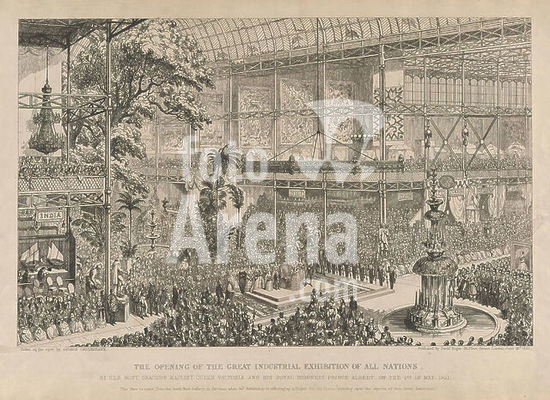
alb4921006 George Cruikshank, The Opening of the Great Industrial Exhibition of All Nations, by Her Most Gracious Majesty Queen Victoria and His Royal Highness Prince Albert, on the 1st of May, 1851: The View is Taken from the South West Gallery, at the time when the Archbishop is offering up a Prayer for the Divine blessing upon the objects in the Exhibition, George Cruikshank (British, London 17921878 London), Queen Victoria (British, London 18191901 Isle of Wight), Prince Albert of Saxe-Coburg and Gotha (Coburg, Germany 18191861 Windsor), Arthur Wellesley, 1st Duke of Wellington (British, 17691852), 1851, Etching, Sheet: 12 1/2 × 19 11/16 in. (31.8 × 50 cm), Prints.
DC
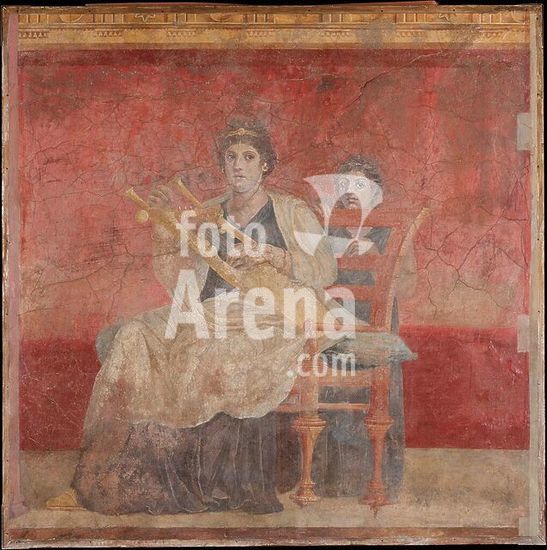
alb3629981 Wall painting from Room H of the Villa of P. Fannius Synistor at Boscoreale. Culture: Roman. Dimensions: Overall: 73 1/2 x 73 1/2in. (186.7 x 186.7cm). Date: ca. 50-40 B.C..This painting of a seated woman playing a kithara is from Room H, either a dining room (triclinium) or a room for social gatherings (oecus), in the villa at Boscoreale. Each of the paintings that originally adorned this room derives from the Greek tradition of megalographia, or large-scale painting, about which so much was written in antiquity; Apollinaris of Sidonius, Petronius in the Satyricon, and Vitruvius all shed light on the use of megalographia in Roman villas.In this fresco, the kithara player is depicted as a plump young woman clothed in a purple chiton and white himation. She is adorned with a bracelet, earrings, and headband with a central medallion, all of gold. A small figure of Atlas supports the arm of her elaborately carved chair that originally was lacquered a deep lustrous red. The instrument she plays is not a simple lyre, but a gilded kithara, a large concert instrument played by Apollo and professional musicians. Behind the seated woman stands a small girl wearing a sleeveless purple chiton. She, too, is adorned with a gold headband, bracelet, and loop earrings. Like portrait figures, the woman and the girl gaze directly at the spectator.Most recently it has been suggested that the pair may represent a Macedonian queen, or princess, and her daughter or younger sister. The gilded kithara and richly adorned, thronelike chair, as well as the carefully rendered gold jewelry and headbands, give the impression of royal personage. Whatever the exact subject, this painting and others in the villa were admired as excellent copies of Hellenistic art that emphasized the erudition and worldliness of the villa's owner. Museum: Metropolitan Museum of Art, New York, USA.
DC

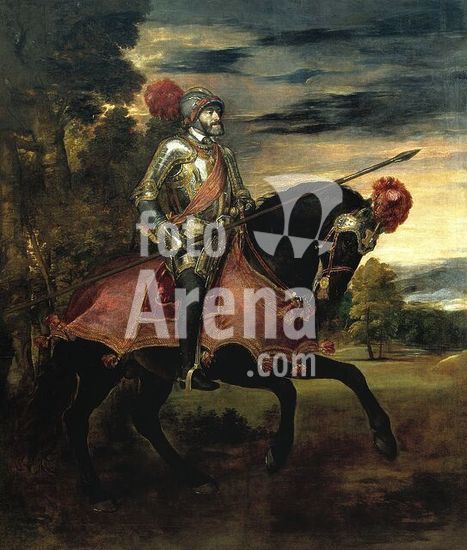
alb2068888 Vecellio di Gregorio Tiziano / 'Emperor Carlos V on Horseback', 1548, Italian School, Oil on canvas, 335 cm x 283 cm, P00410. Museum: MUSEO DEL PRADO, MADRID, SPAIN.
DC
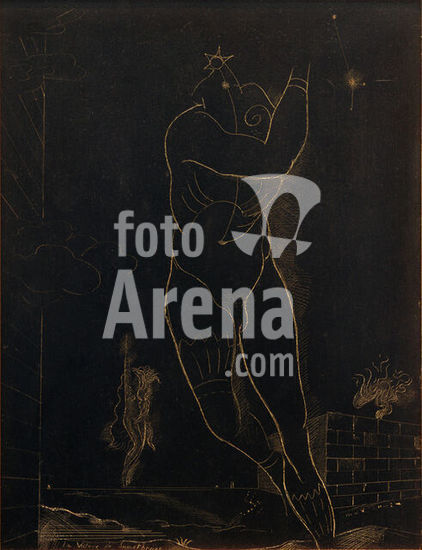
akg8213178 Max Ernst; 1891-1976. "La Victoire de Samothrace" (The Nike of Samothrace), 1923. Oil on wood, carved in black ground, 34 × 26 cm. Private collection. Copyright: © Max Ernst. This artwork is not in the public domain. Additional copyright clearance may be required before use of this image.
DC
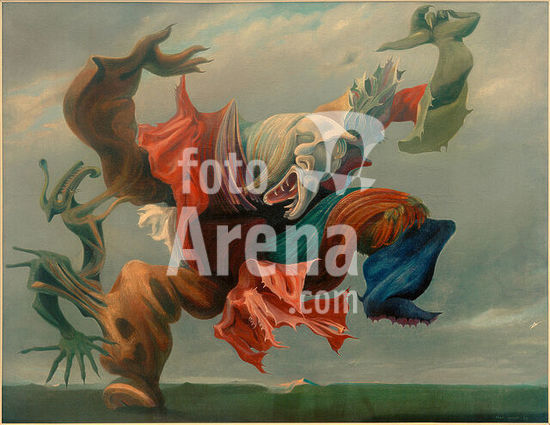
akg8217826 Max Ernst; 1891-1976. "L'ange du foyer (Le triomphe du surréalisme)" (The House Angel (The Triumph of Surrealism)), 1937. Oil on canvas, 114 × 146 cm. Private collection. Museum: Basel, Kunstmuseum. Copyright: © Max Ernst. This artwork is not in the public domain. Additional copyright clearance may be required before use of this image.
DC
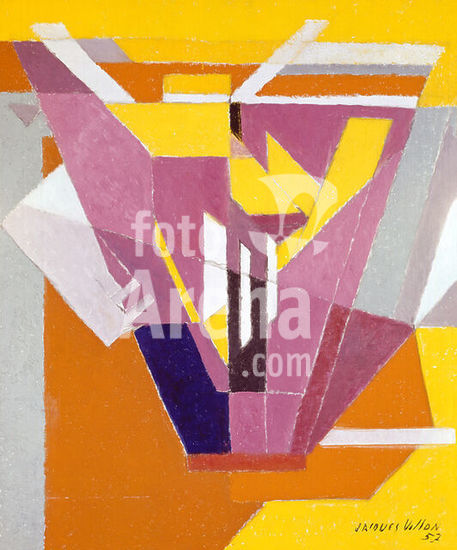
akg5547264 Villon, Jacques (eigentl. Gaston Duchamp); 1875-1963. "Triomphe" (Triumph), 1957. Öl auf Leinwand, 73 x 60 cm. Privatsammlung. Museum: PRIVATE COLLECTION. Copyright: © Jacques Villon. This artwork is not in the public domain. Additional copyright clearance may be required before use of this image.
DC
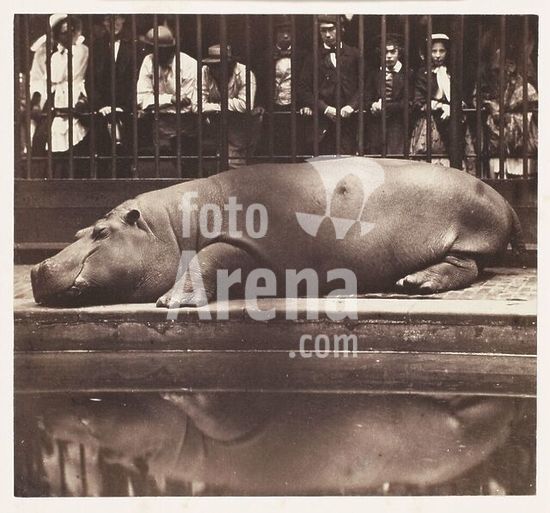
alb3645093 The Hippopotamus at the Zoological Gardens, Regent's Park. Artist: de Borbón, Juan (Spanish, 1822-1887). Dimensions: Image: 11.1 × 12 cm (4 3/8 × 4 3/4 in.)Mount: 43.8 × 30.5 cm (17 1/4 × 12 in.). Date: 1852.Although his childhood was spent at the court of his uncle Fernando VII, the king of Spain, Prince Juan de Borbón spent the major part of his life in England, in exile following his father's violent challenge to the succession of Fernando's daughter Isabel II in 1833. Apparently harboring no royal ambitions, Juan assumed the somewhat obscure title of Count de Montizon in public and, when the dubious title of pretender to the Spanish throne passed to him from his elder brother, he renounced all claim in favor of Queen Isabel. His passions, instead, ran to physics, chemistry, and natural history; photography, it seems, was an appropriate amateur pursuit that combined all three interests.This photograph was the Count de Montizon's contribution to "The Photographic Album for the Year 1855," a publication of the Royal Photographic Society's Photographic Exchange Club. The accompanying text reads: "This animal was captured in August 1849, when quite young, on the banks of the White Nile; and was sent over to England by the Pasha of Egypt as a present to Queen Victoria. He arrived at Southampton on May 25, 1850; and on the evening of the same day was safely housed in the apartment prepared for him at the Zoological Gardens, where he has ever since been an object of great attraction."The animals of the Zoological Gardens were a favorite subject for the count's demonstrations of photography's capacity to arrest movement in photographs "taken on collodion with a double lens, by instantaneous exposure" (as he wrote in the technical caption for this picture). If the notion of instantaneity seems incongruous in this picture of a sluggish and corpulent hippo, it is perhaps better seen in the curious spectators who, from the photographer's vantage point, appear to be the zoo's caged inhabitants. Museum: Metropolitan Museum of Art, New York, USA. Author: Juan de Borbón.
DC
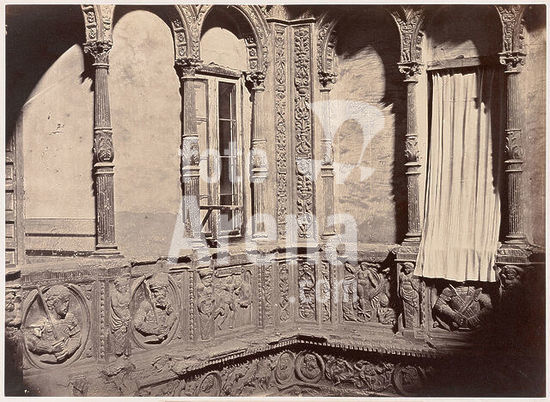
alb3667762 Zaragoza, Patio de la Casa Conocida con el Nombre de los Infantes. Artist: Charles Clifford (Welsh, 1819-1863). Dimensions: Image: 30.9 × 42.5 cm (12 3/16 × 16 3/4 in.)Mount: 42.3 × 58 cm (16 5/8 × 22 13/16 in.). Date: 1860.This print is from an album of fifty-six plates entitled "Photographic Memories of the Trip of Their Majesties and Highnesses to the Balearic Islands, Catalonia and Aragon," which originally belonged to Antoine d'Orléans, duc de Montpensier, a great collector and patron of photographers and the brother-in-law of Queen Isabella II.The photograph represents the patio balcony in the house where the infante Luis Antonio, a son of the eighteenth-century king of Spain, Philip V, was forced to retire after marrying a woman beneath his station. Not long after Clifford's visit, many pieces of the extraordinary plateresque decoration were removed and sold abroad. While the photograph documents the deteriorated state of the house, its unsettling quality emanates less from desuetude than from the mysterious curtain at the right, which in effect decapitates the knight in the cartouche below. In the work of a photographer whose ideal was complete and generalized description, the curtain in the dark-cornered vignette might be considered a mistake. But as Clifford consistently constructed telling images from selected details, the eccentric picture may well be a poignant commentary on the demise of the noble arts and on the personal obscurity of the banished infante. Museum: Metropolitan Museum of Art, New York, USA.
DC

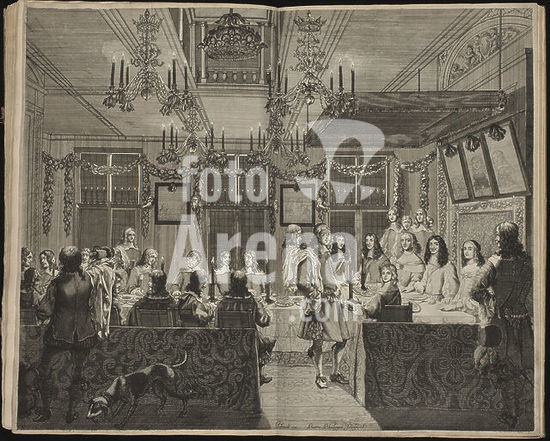
alb3715973 Relation en Forme de Journal du Voyage et Sejour que le Serenissime et Tres-Puissant Prince Charles II Roy De La Grand Bretagne. Dated: May 25 - June 2, 1660. Dimensions: book: 40.8 x 25.7 x 2.2 cm (16 1/16 x 10 1/8 x 7/8 in.). Medium: bound volume with one engraved coat of arms on title, one engraved portrait and six double-page engraved illustrations. Museum: National Gallery of Art, Washington DC. Author: Sir William Lower (author) and Cornelis van Dalen I et al.
DC
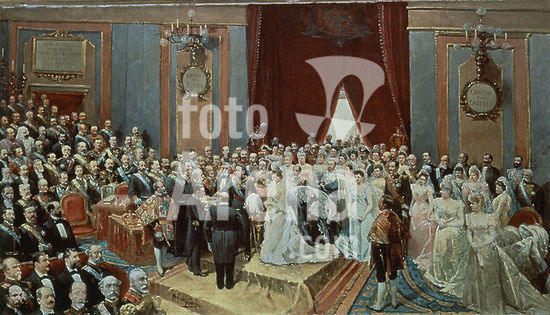
orz009326 JURA DE LA CONSTITUCION POR ALFONSO XIII EN EL CONGRESO EL 17 DE MAYO DE 1902 - SIGLO XX. Author: MANUEL FERNANDEZ CARPIO (1853-1929). Location: PRIVATE COLLECTION. Reinosa. Cantabria. SPAIN. MARIA CRISTINA DE HABSBURGO (1858-1929). ALFONSO XIII (1886-1941).
DC
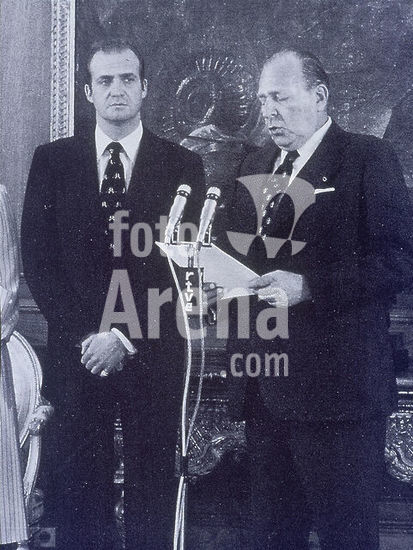
orz233401 DISCURSO DE ABDICACION DE DON JUAN, 14 DE MAYO DE 1977. Location: PALACIO DE LA ZARZUELA. MADRID. SPAIN. CONDE DE BARCELONA. BORBON JUAN III. JUAN DE BORBON Y BATTENBERG (1913-93). JUAN DE BORBON (1913-1993) CONDE BARCELONA. JUAN CARLOS I DE BORBON (1938-). JUAN CARLOS I DE ESPAÑA (1938-).
DC
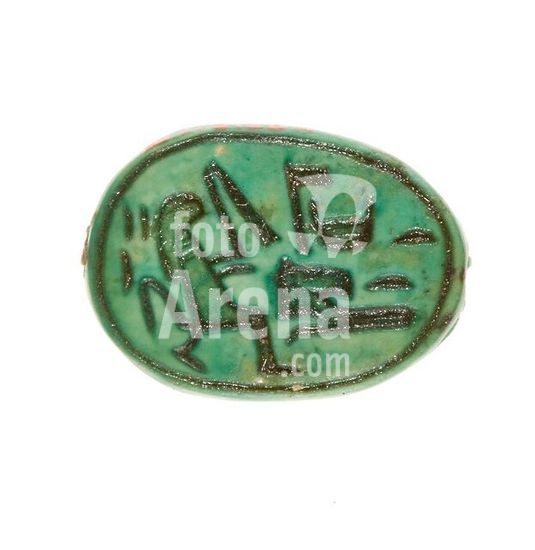
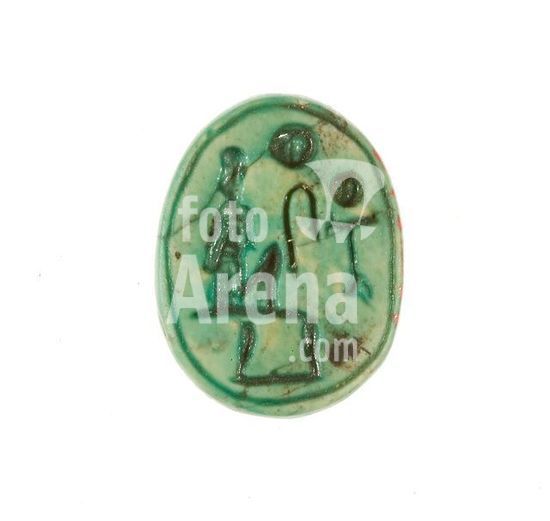
alb3652875 Scarab Inscribed for the God's Wife Hatshepsut. Dimensions: L. 1.7 cm (11/16 in.); W. 1.2 cm (1/2 in.); H. 0.7 cm (1/4 in.). Dynasty: Dynasty 18, early. Reign: Joint reign of Hatshepsut and Thutmose III. Date: ca. 1479-1458 B.C..The inscription on the base of this scarab reads: God's Wife, Hatshepsut. In the late Seventeenth early Eighteenth Dynasties, the title God's Wife was held by the principal queen or the queen mother. Hatshepsut inherited the title while she served as principal queen of her half-brother, Thutmose II. Later, shortly after she took on the titles of king, Hatshepsut passed the title on to her daughter, Neferure (see scarab 27.3.325).Slight variations of the same inscription may be found on two others scarabs (27.3.186, 27.3.187) and a cowroid seal amulet (27.3.191). Although the hieroglyphs are not in exactly the same configuration, they have been carved in a similar fashion. For example, the seated figure leans back and both of her arms are indicated. For different versions of the same inscription, see 27.3.174-27.3.184, 27.3.188-27.3.190. Museum: Metropolitan Museum of Art, New York, USA.
DC

alb3604531 Scarab Inscribed Maatkare (Hatshepsut), She Lives. Dimensions: L. 1.6 cm (5/8 in.); w. 1.2 cm (1/2 in.). Dynasty: Dynasty 18, early. Reign: Joint reign of Hatshepsut and Thutmose III. Date: ca. 1479-1458 B.C..During the 1926-1927 excavation season, the Museum's Egyptian Expedition uncovered three foundation deposits along the eastern enclosure wall of Hatshepsut's funerary temple at Deir el-Bahri in Western Thebes. Among the contents were 299 scarabs and stamp-seals. Sixty-five of these are now in the Egyptian Museum, Cairo, and the rest were acquired by the Museum in the division of finds.Among the inscriptions on the bases of these scarabs and seals are examples of every title Hatshepsut held, from the time she was "king's daughter" during the reign of her father, Thutmose I; through the time she was queen of her half-brother, Thutmose II; and during her regency and co-reign with her nephew/step-son, Thutmose III.The inscription on the base of this scarab records Hatshepsut's throne name, Maatkare, which may be roughly translated as Maat (the goddess of truth) is the life force of Re (the sun god). The two hieroglyphs in front of the crouching goddess (ankh.s) have the meaning "she lives."There are four scarabs in the Museum that have similar inscriptions. Two of them (this one and 27.3.235) have very similar inscriptions, and the back and side design are also almost identical. A third (27.3.236) has a similar back design, but the hieroglyphs are carved with less care. The back design of the fourth scarab (27.3.234) is different, and the hieroglyphs have a slightly different distribution. Museum: Metropolitan Museum of Art, New York, USA.
DC

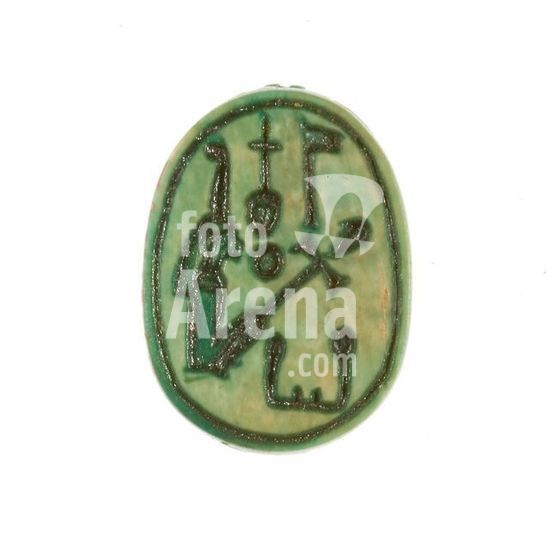
alb3604333 Scarab Inscribed for the Perfect God Maatkare (Hatshepsut). Dimensions: L. 1.6 cm (6/8 in.); W. 1.1 cm (7/16 in.). Dynasty: Dynasty 18, early. Reign: Joint reign of Hatshepsut and Thutmose III. Date: ca. 1479-1458 B.C..During the 1926-1927 excavation season, the Museum's Egyptian Expedition uncovered three foundation deposits along the eastern enclosure wall of Hatshepsut's funerary temple at Deir el-Bahri in Western Thebes. Among the contents were 299 scarabs and stamp-seals. Sixty-five of these are now in the Egyptian Museum, Cairo, and the rest were acquired by the Museum in the division of finds.Among the inscriptions on the bases of these scarabs and seals are examples of every title Hatshepsut held, from the time she was "king's daughter" during the reign of her father, Thutmose I; through the time she was queen of her half-brother, Thutmose II; and during her regency and co-reign with her nephew/step-son, Thutmose III.After the death of her husband, Hatshepsut became regent for her nephew who was a small child. The length of this regency period is uncertain, with estimates ranging from two to seven years. At some time, probably toward the end of the regency, Hatshepsut adopted the name Maatkare which was usually enclosed in a cartouche and became her throne name as king. The name may be roughly translated as Maat (the goddess of truth) is the life force of Re (the sun god). In the inscription on the base of this scarab, the name Maatkare is written with the crouching goddess (Maat, identified by the ostrich plume on her head), the ka hieroglyph (upraised arms at the lower right), and the sun-disk (Re). In this writing, Maat holds the ankh hieroglyph (life, or to live). This writing of the name also occurs on scarab 27.3.214. The hieroglyphs at the top of the inscription record one of the epithets of the Pharaoh, "The Good God," or "The Perfect God.". Museum: Metropolitan Museum of Art, New York, USA.
DC

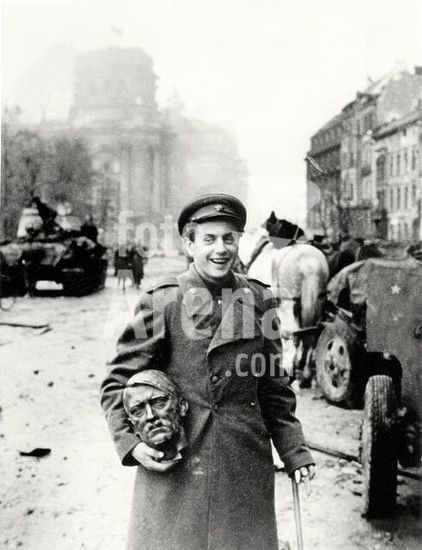
akg209393 Dolmatovsky, Yevgeny Aronovitch; Russian and Soviet lyric poet; born 5.5.1915 in Moscow.-Dolmatovsky as Soviet war reporter in captured Berlin holding the head of a portrait bust of Adolf Hitler.-Photo, 2 May 1945 (Yevgeny Chaldey).
DC
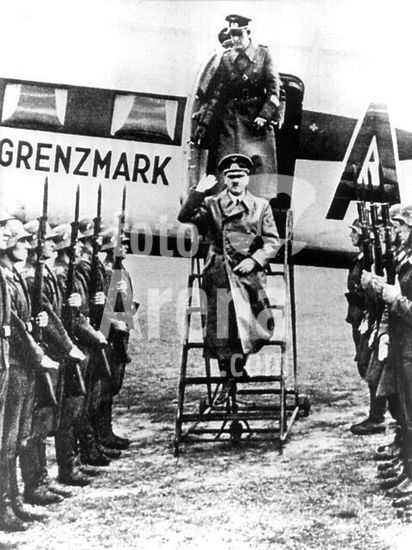
dpa2232774 Führer und Reichskanzler Adolf Hitler trifft auf dem Flugplatz in Warschau ein, um eine Parade der siegreichen Truppen abzunehmen. Am 1. September 1939 um 4:45 Uhr hatte das Linienschiff "Schleswig-Holstein" das Feuer auf die polnischen Befestigungen auf der Westerplatte vor Danzig eröffnet. Der "Fall Weiß", der geplante deutsche Überfall auf Polen ohne Kriegserklärung (sog. "Blitzkrieg") markiert den Beginn des Zweiten Weltkriegs. Für Deutschland endete er mit der Kapitulation am 8. Mai 1945, endgültig war der Zweite Weltkrieg jedoch erst mit der Kapitulation Japans am 2. September 1945 zuende. Mehr als 50 Millionen Menschen wurden während des Krieges getötet, über drei Millionen blieben vermißt.
DC
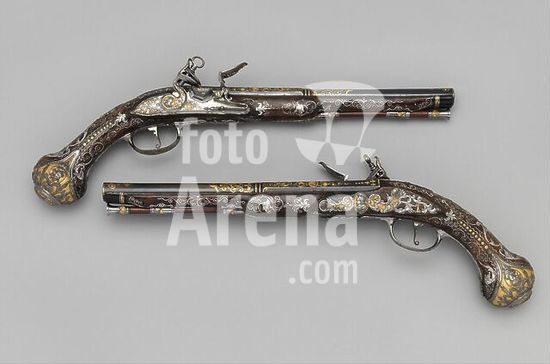
alb3655976 Pair of Flintlock Pistols Made for Ferdinand IV, King of Naples and Sicily (1751-1825). Barrelsmith: Emanuel Esteva (Spanish, active in Naples, Italy, recorded about 1768-73). Culture: Italo-Spanish, Naples. Dimensions: L. of each 17 3/8 in. (44.1 cm); L. of each barrel 11 1/16 in. (28.1 cm); Cal.63 in. (16.0 mm); Wt. of each 2 lb. 4 oz. (1021 g). Gunsmith: Michele Battista (Spanish, active in Naples, Italy, recorded about 1760-90). Manufacturer: Royal Arms Manufactory at Torre Annunziata (Italian, Naples, established 1757). Date: ca. 1768.The Royal Arms Factory in Naples was established in 1757 with the significant participation of Spanish gunmakers, who strongly influenced Neopolitan arms production in both technical innovations and artistic style. These magnificent pistols are signed by two leading craftsmen of the factory and appear to have been made for their patron, King Ferdinand IV of Naples and Sicily (1751-1825). What may be portraits of the young king and his queen on the butts of the pistols suggests that they were made to commemorate the royal wedding in 1768. Museum: Metropolitan Museum of Art, New York, USA.
DC

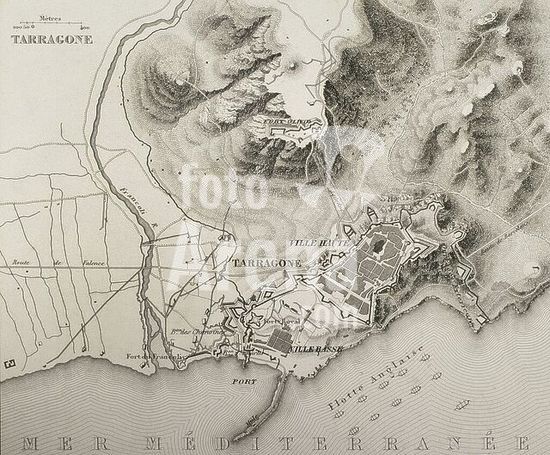
alb3909133 Napoleonic map. Siege of Tarragona (Catalonia, Spain). Tarragona was besieged from 5 May to 29 June 1811. Troops belonging to the French Army of Aragon, commanded by General Suchet, fought against a Spanish garrison led by Lieutenant General Juan Senen de Contreras. A British naval squadron commanded by Admiral Edward Codrington harassed the French besiegers with cannon fire. The city was assaulted and occupied. The Peninsular War. Atlas de l'Histoire du Consulat et de l'Empire. History of the Consulate and the Empire of France under Napoleon by Marie Joseph Louis Adolphe Thiers (1797-1877). Drawings by Dufour, engravings by Dyonnet. Edited in Paris, 1864.
DC
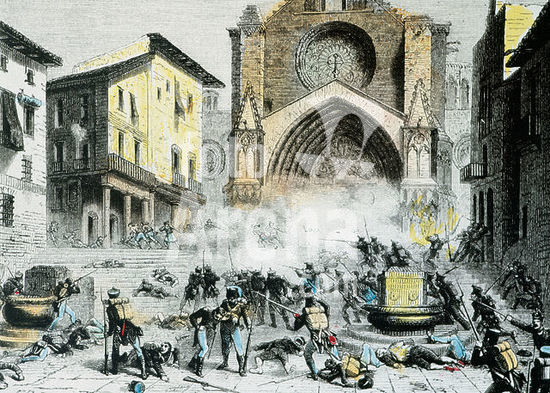
alb1461155 Spanish War of Independence (1808-1814). Siege of Tarragona (Catalonia, Spain) (from 5 May to 29 June 1811) by Louis Gabriel Suchet's French Army. The last battle, in front of the cathedral. Engraving by A. Thiers, 19th century. Later colouration.
DC
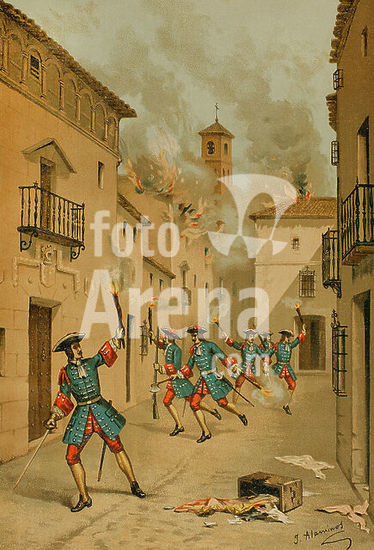
alb5433394 History of Spain. War of the Spanish Succession. Siege of Játiva (8 May to 6 June 1707). After the victory of Philip V's Bourbon troops, he ordered the burning of all the houses owned or occupied by those who had been hostile to him in the town, an action that was executed by the French troops of d'Asfeld. Destruction of Játiva. Illustration by J. Alaminos. Chromolithography. "Historia General de España" (General History of Spain) by Miguel Morayta. Volume V. Madrid, 1891. Author: Juan Alaminos. Spanish artist of the second half of the 19th century.
DC
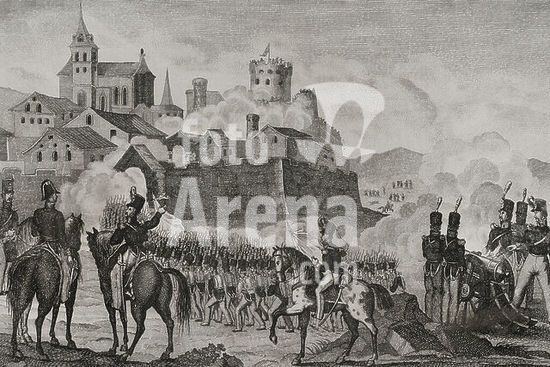
alb5433965 History of Spain. First Carlist War (1833-1840). Northern Front. Taking of the town and fort of Irún (17 May 1837). The Liberal army garrison of San Sebastián, under the command of George de Lacy Evans, took advantage of the departure of the bulk of the Carlist army in the Royal Expedition to attack with the intention of liberating the route to the French border in May 1837. The Carlists established their resistance in Irún, fortifying the town hall and establishing their garrison in the "Parque" fort. On the afternoon of May 16, British artillerymen bombed Irún, doing so again in the early hours of the morning of May 17. Infantry attacks continued throughout May 17, causing numerous deaths. Irún capitulated that afternoon. Engraving. Panorama Español, Crónica Contemporánea. Volume III. Madrid, 1845.
DC
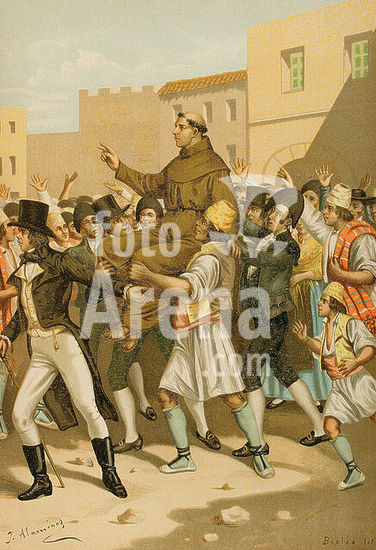
alb5433410 History of Spain. War of Independence (1808-1814). Revolution of Valencia in 1808 (23 May to 28 October 1808). The Franciscan priest Juan Rico y Vidal had a significant role in the uprising against the French that took place in Valencia on 23 May 1808. The priest Rico is carried in triumph to the door of the audience. Illustration by J. Alaminos. Chromolithography. "Historia General de España" (General History of Spain), by Miguel Morayta. Volume VII. Madrid, 1893. Author: Juan Alaminos. Spanish artist of the second half of the 19th century.
DC
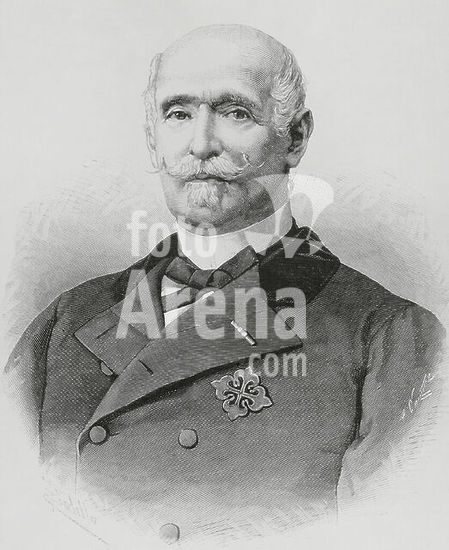
alb4313897 Francisco Javier Arias Dávila Matheu y Carondelet (1812-1890). 13th Count of Puñonrostro. Spanish military officer and politician. In September 1864 he was promoted to lieutenant general and appointed director general of Artillery. He held office of mayor of Madrid from January 1864 to January 1865. After the revolution of 1868, he remained loyal to Queen Isabella II. He was banished in 1871 for refusing to recognise Amadeo I. By the Restoration, in 1875, he was once again assigned to the Directorate-General of Artillery, a charge he held until 1881. Appointed president of the Senate on 16 May 1884, post from which he took office on 19th. Portrait. Drawing by Badillo. Engraving by Arturo Carretero. La Ilustración Española y Americana (The Spanish and American Illustration), June 15, 1884. Author: Arturo Carretero (ca. 1852-1903). Spanish engraver and xylograph. Félix Badillo (1848-1895). Spanish illustrator.
DC
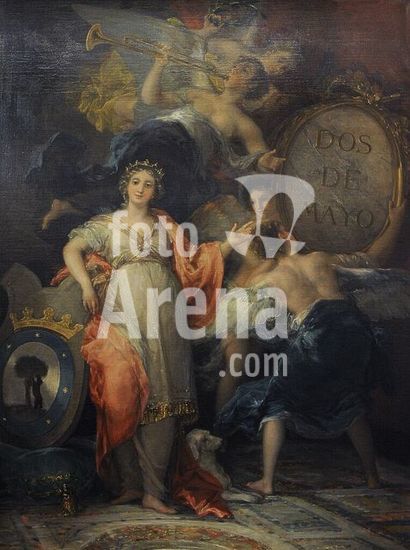
alb4312473 Francisco de Goya y Lucientes (1746-1828). Spanish painter. Allegory of the Villa of Madrid, 1810. History Museum. Madrid. Spain.
DC
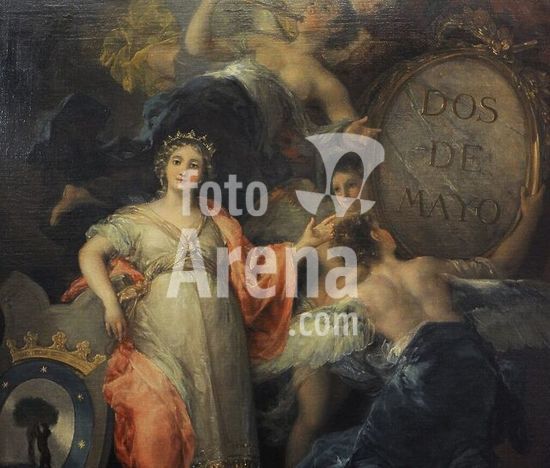
alb4312474 Francisco de Goya y Lucientes (1746-1828). Spanish painter. Allegory of the Villa of Madrid, 1810. Detail. History Museum. Madrid. Spain.
DC
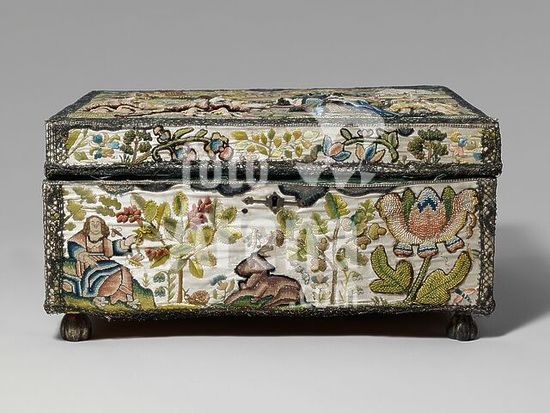
alb3669065 Casket with scenes from the Story of Solomon and the Queen of Sheba. Culture: British. Dimensions: Overall: 8 × 16 × 14 1/2 in. (20.3 × 40.6 × 36.8 cm). Date: 1670s.This casket, the largest in the Metropolitan Museum's collection of embroidered boxes, contains a multitude of objects, from glass bottles, which were typically fitted into boxes of the period, to a large array of sewing implements and materials, including 25 paper thread winders made from folded playing cards, several ivory thread winders, a bodkin, three ivory embroidery tools, a spool of gold filé thread, a silk tassel, several loose skeins of silk thread, a silk needle case, and a piece of detached buttonhole stitch fabric. Some of the objects clearly do not match the casket's seventeenth-century date. Thread, both dyed silk and metal varieties, was purchased by weight, and the number of objects devoted to the organization of threads speaks to the value of this material. Decorated boxes intended to store sewing implements, among other things, were known on the Continent as well as in England; several seventeenth-century Dutch cushion-shaped containers survive, and seventeenth-century genre paintings confirm their practical use as supports for sewing.The completion of a decorated casket or cabinet would have been considered the culmination of a young woman's education in needlework skills, and a few boxes have survived that can be firmly attributed to schoolgirls. Martha Edlin's dated embroidered objects form the most complete record we have of one person's output in the seventeenth century (Victoria and Albert Museum, London), although professional contributions at any point in the work would certainly have been possible. The exuberance of the decoration and the rather indiscriminate combination of materials and techniques suggest that this casket is the work of an amateur. Contrast this with the cabinet illustrating scenes from the Life of Joseph (MMA, 39.13.3a-k), which was executed in a single technique (laid and couched silk) and precisely and evenly worked on all faces of the box. This casket also lacks the consistency of theme present on most cabinets; the top of the lid shows the meeting of King Solomon and the Queen of Sheba, whereas the side panels are apparently random combinations of motifs typical of the period: heraldic animals, a castle, and a fountain, all surrounded by oversized flora and fauna. It is possible that the embroidered panels of this casket may have been applied to the wood carcass at a date significantly later than the execution of the decoration. The carcass itself is too large for the embroidered panels; the gaps where the satin foundation fabric does not cover the wood are patched with more silk and disguised with metal bobbin lace. The color and style of the lining--green silk with a padded main compartment--differ from most other boxes of the seventeenth century as well. Another casket in the Lady Lever Art Gallery collection has a similar padded interior, but the silk lining is described as the typical salmon-pink color.Nevertheless, this casket is important for its possible association with a mirror in the Metropolitan Museum's collection (MMA, 39.13.2a). The back of the mirror frame is marked with the initials A.P. and the date 1672, and the casket contains thread holders or winders and a metal bodkin marked with the same initials. Both of these objects were in the collection of Percival Griffiths, and early scholars assumed that they were the work of the same maker. Although the mirror frame displays a more skilled and certain command of techniques and materials, it does contain some unusual elements, such as actual shells used in the decoration of the grotto. G. Saville Seligman and Talbot Hughes mentioned "Lady Ann Paulet, who was a very accomplished broiderer" in association with these embroideries, possibly referring to a lady-in-waiting to Queen Mary II (1662-1694), but no other evidence exists to support this attribution. The uncertain date of the construction of the casket, along with the survival of various tools and accessories, speaks to the continued significance of embroidery in the lives of women beyond the seventeenth century.[Melinda Watt, adapted from English Embroidery from The Metropolitan Museum of Art, 1580-1700: 'Twixt Art and Nature / Andrew Morrall and Melinda Watt ; New Haven ; London : Published for The Bard Graduate Center for Studies in the Decorative Arts, Design, and Culture, New York, The Metropolitan Museum of Art, New York [by] Yale University Press, 2008.]. Museum: Metropolitan Museum of Art, New York, USA.
DC

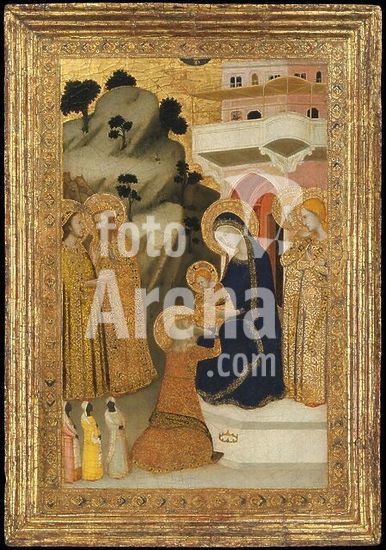
alb3611584 The Adoration of the Magi. Artist: Italian, Neapolitan Follower of Giotto (active second third of the 14th century). Culture: Italian, Naples. Dimensions: Overall, with engaged frame, 26 1/8 x 18 3/8 in. (66.4 x 46.7 cm); painted surface, including tooled border, 21 3/8 x 15 in. (54.3 x 38.1 cm). Date: ca. 1340-43.Dressed in sumptuous gold embroidered robes, three Magi and two angels, shown in profile at the right, adore the Virgin and Child, who are seated in the doorway of a palace. They are accompanied by three diminutive attendants in the lower left corner. Adding to the elaborate surface pattern is the punched gold border that integrates the painted scene with the original engaged frame. Hinge marks on both the left and right sides of the frame indicate that the painting was originally part of a folding altarpiece comprised of multiple panels. The ensemble included scenes of the Annunciation and the Nativity (Musée Granet, Aix-en-Provence) and at least one other lost panel, which may have depicted the Presentation in the Temple or the Flight into Egypt. The backs of the two works in Aix-en-Provence at one time bore the coats of arms of the Anjou and Aragon dynasties, while an unidentified coat of arms that once existed on the reverse of the Lehman panel has since been lost. The altarpiece may have been donated by Robert of Anjou (King of Naples, r. 1309-43) and Queen Sancha to the convent of the Poor Clares in Aix-en-Provence. Previously attributed to an anonymous Sienese artist working in Avignon, the altarpiece has more recently been ascribed to a Neapolitan artist influenced by Giotto, a pivotal figure in Western art, whose activity in Naples from 1328 to 1332 had a significant impact on local artists. Museum: Metropolitan Museum of Art, New York, USA. Author: Italian, Neapolitan Follower of Giotto (active second third of the 14th century).
DC
alb5357659 Saint Francis Borgia (1510-1572). Marquis of Lombay and later 4th Duke of Gandía. This scene depicts Francisco de Borja's renunciation of the world after contemplating the putrefied corpse of the Empress Isabella of Portugal (1503-1539), wife of Emperor Charles I of Spain, whose body would be driven to Granada, the city where the scene took place. Isabella died in Toledo on 1st May 1539. The Conversion of the Duke of Gandía. Illustration after the painting by Moreno Carbonero. Chromolithography. Historia General de España (General History of Spain), by Miguel Morayta. Volume III. Madrid, 1890.
DC
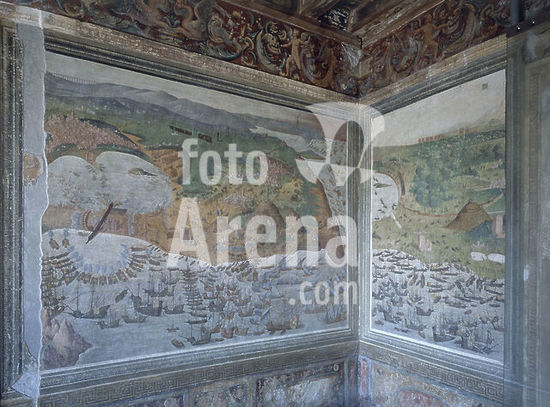
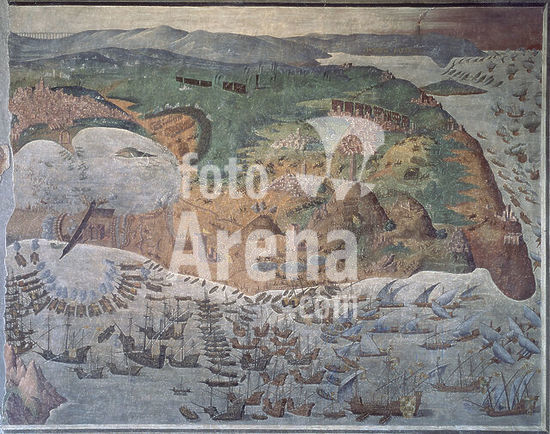
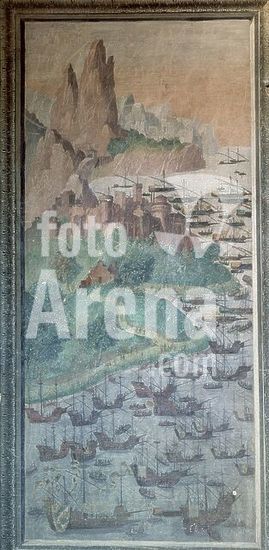
orz079932 FRESCOS BATALLA DE TUNEZ - EXPEDICION DE CARLOS V - SIGLO XVI. Author: JULIO AQUILES (?-1556) y ALEJANDRO MAYNER (?-1545). Location: ALHAMBRA-TORRE DEL PEINADOR. GRANADA. SPAIN.
DC
orz079931 FRESCOS BATALLA DE TUNEZ - EXPEDICION DE CARLOS V - SIGLO XVI. Author: JULIO AQUILES (?-1556) y ALEJANDRO MAYNER (?-1545). Location: ALHAMBRA-TORRE DEL PEINADOR. GRANADA. SPAIN.
DC
orz079930 FRESCOS DE LA BATALLA DE TUNEZ - EXPEDICION DE CARLOS V - SIGLO XVI. Author: JULIO AQUILES (?-1556) y ALEJANDRO MAYNER (?-1545). Location: ALHAMBRA-TORRE DEL PEINADOR. GRANADA. SPAIN.
DC
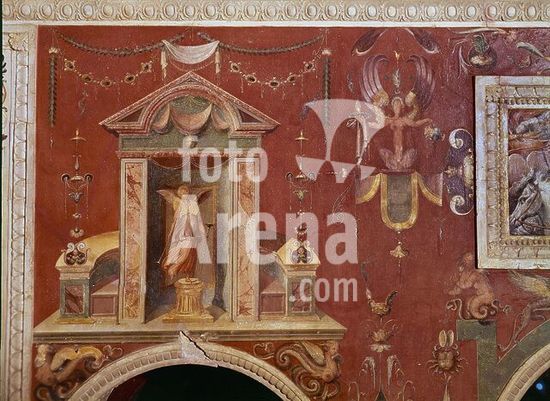
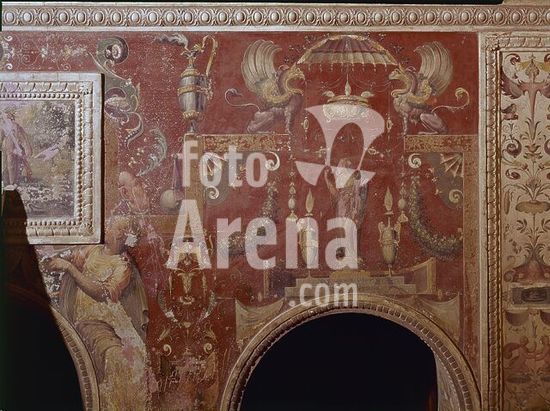
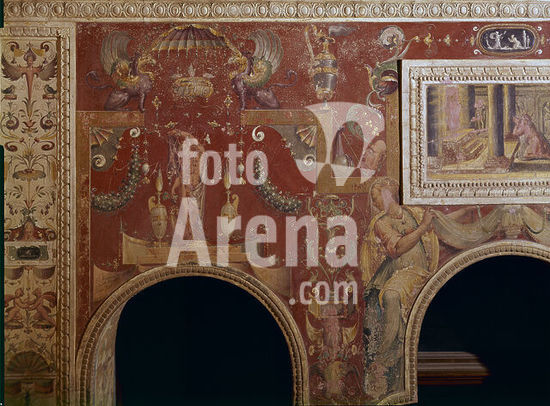
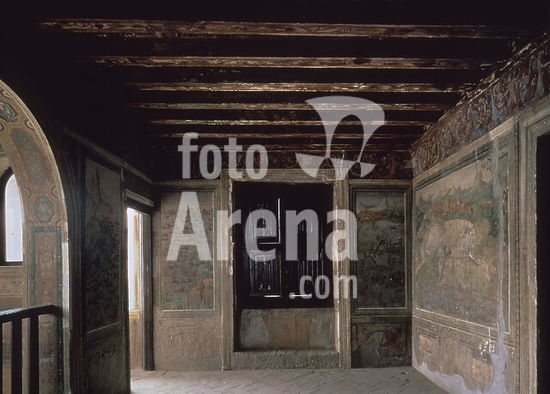
orz041329 DET PINTURA - SIGLO XVI. Author: JULIO AQUILES (?-1556) y ALEJANDRO MAYNER (?-1545). Location: ALHAMBRA-TORRE DEL PEINADOR. GRANADA. SPAIN.
DC
orz041327 DET- PINTURA MURAL - SIGLO XVI. Author: JULIO AQUILES (?-1556) y ALEJANDRO MAYNER (?-1545). Location: ALHAMBRA-TORRE DEL PEINADOR. GRANADA. SPAIN.
DC
orz041326 DET PINTURA MURAL - SIGLO XVI. Author: JULIO AQUILES (?-1556) y ALEJANDRO MAYNER (?-1545). Location: ALHAMBRA-TORRE DEL PEINADOR. GRANADA. SPAIN.
DC
alb3790832 Jan Van Eyck (Workshop of) / 'The Fountain of Grace'. 1430 - 1440. Oil on panel. Museum: Museo del Prado, Madrid, España.
DC
alb4105819 Banquet at the Crossbowmen's Guild in Celebration of the Treaty of Münster. The Celebration of the Peace of Münster, 18 June 1648, in the Headquarters of the Crossbowmen's Civic Guard (St George Guard), Amsterdam. Dating: 1648. Measurements: h 232 cm × w 547 cm. Museum: Rijksmuseum, Amsterdam. Author: Bartholomeus van der Helst.
DC
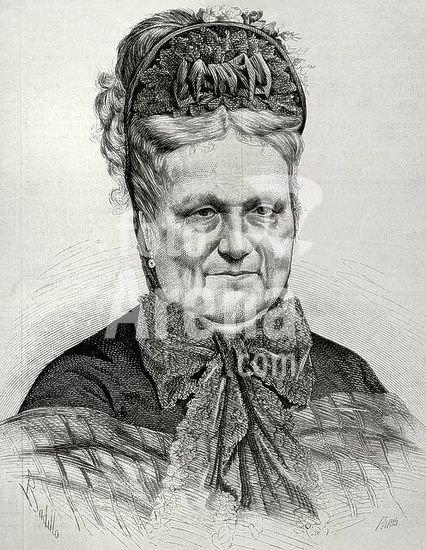
alb3909413 Maria Cristina de Borbon (1806-1878). Queen consort of Ferdinand VII of Spain (1829-1833), and queen regent (1833-1840). On the death of Ferdinand VII on September 29, 1833, she became regent with absolute power. Within a few days the First Carlist War began (1833-1840). Drawing by Badillo. Engraving by Paris. La Ilustracion Espa–ola y Americana, May 30, 1876.
DC
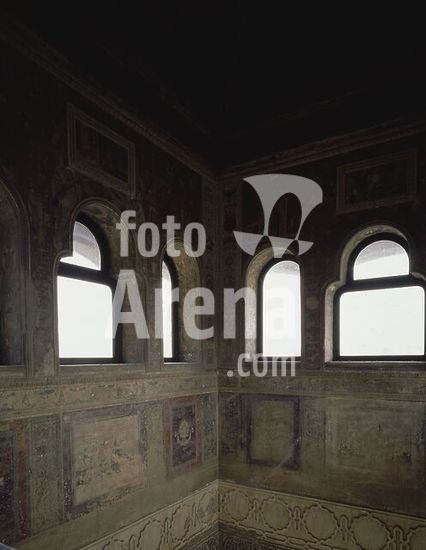
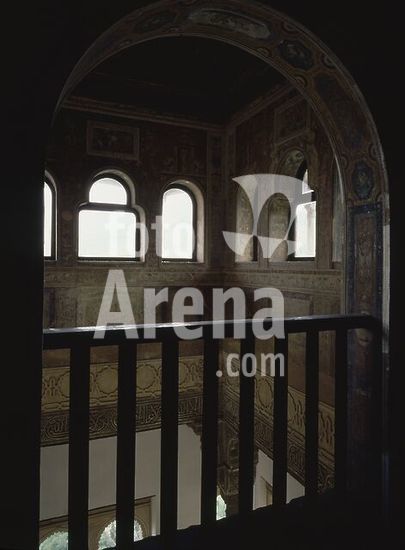
orz121471 PINTURAS DE LA TORRE DEL PEINADOR - SIGLO XVI. Author: JULIO AQUILES (?-1556) y ALEJANDRO MAYNER (?-1545). Location: ALHAMBRA-TORRE DEL PEINADOR. GRANADA. SPAIN.
DC
orz121470 PINTURAS DE LA PLANTA SUPERIOR - SIGLO XVI. Author: JULIO AQUILES (?-1556) y ALEJANDRO MAYNER (?-1545). Location: ALHAMBRA-TORRE DEL PEINADOR. GRANADA. SPAIN.
DC
orz121468 PLANTA SUPERIOR. Location: ALHAMBRA-TORRE DEL PEINADOR. GRANADA. SPAIN.
DC
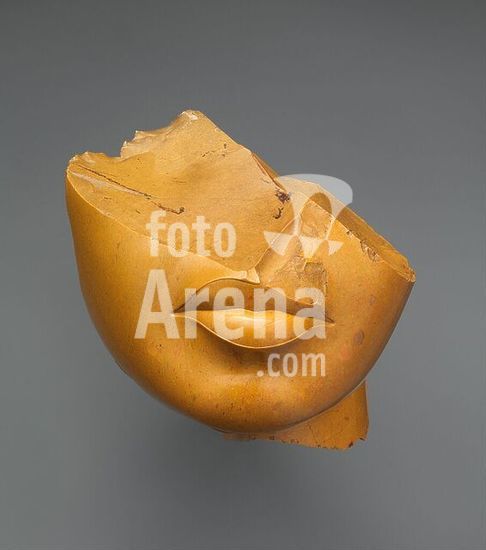
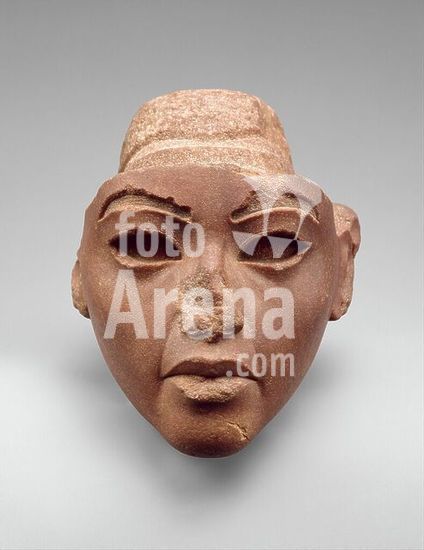
alb3636058 Fragment of a Queen's Face. Dimensions: h. 13 cm (5 1/8 in); w. 12.5 cm (4 15/16 in); d. 12.5 cm (4 15/16 in). Dynasty: Dynasty 18. Reign: reign of Akhenaten. Date: ca. 1353-1336 B.C..This striking fragment is from a statue composed of different materials. The back of the piece shows remains of the mortise that fitted onto a tenon extending from the statue's body which may have been made of Egyptian alabaster to represent a white garment. Two headdresses might have fit this head: the khat-headdress, or the Nubian wig (as seen on the canopic jar lid, 30.8.54, in the same gallery).The royal woman represented here cannot be identified with certainty. It is difficult to imagine that the already aged Queen Tiye--the mother of Akhenaten and highly respected as a wise woman at Amarna--was shown as a beauty of such sensuous character. Queens Nefertiti and Kiya, however, are both possible subjects. Museum: Metropolitan Museum of Art, New York, USA.
DC

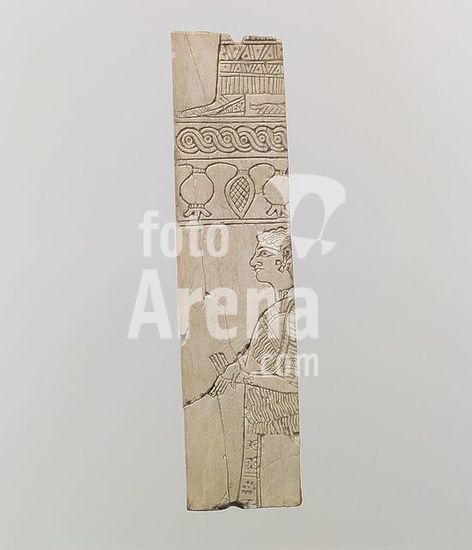
alb3642402 Incised furniture plaque with two figures in two registers. Culture: Assyrian. Dimensions: 4.17 x 0.98 x 0.2 in. (10.59 x 2.49 x 0.51 cm). Date: ca. 9th century B.C..This fragmentary rectangular panel was found in a room that has been identified as the principal suite of the royal residency at Fort Shalmaneser, a royal building at Nimrud that was probably used to store tribute and booty collected by the Assyrians while on military campaign. Two fragmentary dowel holes that pierce this piece at its upper and lower edges were probably used to fasten it to a frame or other backing that does not survive, likely as part of a piece of furniture. An ornate border with a guilloche band and a frieze of pomegranates alternating with buds divides the plaque into two registers. Above, the lower legs and sandal-clad feet of a figure wearing a fringed robe embroidered with zig-zags and dots can be seen. Below, a clean-shaven figure stands in profile with his hands clasped, wearing a shawl and a sleeved robe embroidered with a rosette and guilloche pattern. Ivories with incised decoration like this one, bearing images similar to those on the large reliefs lining the walls of the Northwest Palace, have been attributed to an Assyrian style. Certain types of dress and jewelry, including the sandals and fringed robe worn by the figure in the upper register, and the earring, rosette bracelet, and arm band worn by the figure in the lower register, are also worn by figures in the palace reliefs. Bracelets and earrings similar to the ones worn by the figure in the lower register of this plaque, made of gold and inlaid with semiprecious stones, were found in the Queens' tombs at Nimrud. In Assyrian art, both male and female figures are represented wearing jewelry, and the figure in the lower register of this plaque may in fact be a eunuch. Assyrian style ivories have been found in royal areas such as throne rooms and ceremonial or royal residential suites at Nimrud. The limited distribution of Assyrian ivories could suggest that their use and display was highly restricted.Built by the Assyrian king Ashurnasirpal II, the palaces and storerooms of Nimrud housed thousands of pieces of carved ivory. Most of the ivories served as furniture inlays or small precious objects such as boxes. While some of them were carved in the same style as the large Assyrian reliefs lining the walls of the Northwest Palace, the majority of the ivories display images and styles related to the arts of North Syria and the Phoenician city-states. Phoenician style ivories are distinguished by their use of imagery related to Egyptian art, such as sphinxes and figures wearing pharaonic crowns, and the use of elaborate carving techniques such as openwork and colored glass inlay. North Syrian style ivories tend to depict stockier figures in more dynamic compositions, carved as solid plaques with fewer added decorative elements. However, some pieces do not fit easily into any of these three styles. Most of the ivories were probably collected by the Assyrian kings as tribute from vassal states, and as booty from conquered enemies, while some may have been manufactured in workshops at Nimrud. The ivory tusks that provided the raw material for these objects were almost certainly from African elephants, imported from lands south of Egypt, although elephants did inhabit several river valleys in Syria until they were hunted to extinction by the end of the eighth century B.C. Museum: Metropolitan Museum of Art, New York, USA.
DC

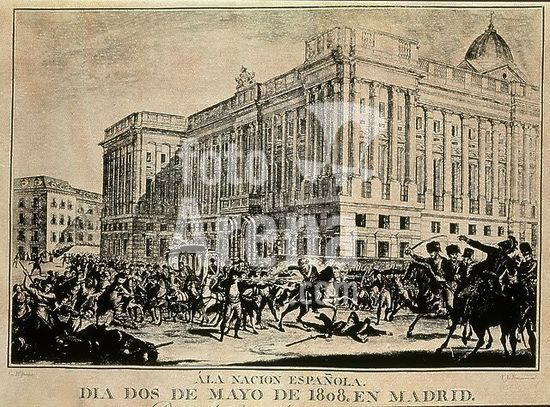
orz128216 SALIDA DE LA REINA DE ETRURIA E INFANTE FRANCISCO HACIA FRANCIA 2 MAYO 1808. Author: LOPEZ E. Location: MUSEO DE HISTORIA-GRABADOS BLANCO Y NEGRO. MADRID. SPAIN.
DC
alb3611825 Face from a Composite Statue, probably Queen Tiye. Dimensions: H. 13.3 cm (5 1/4 in.); W. 12.5 cm (4 15/16 in.); D. 12.4 cm (4 7/8 in.)H. of face 11 cm (4 5/16 in.). Dynasty: Dynasty 18. Reign: reign of Amenhotep III-Akhenaten. Date: ca. 1353-1336 B.C..This quartzite head once belonged to a composite statue made of several different materials. Based on the color of the stone (red being the conventional color for men), the owner was originally identified as Akhenaten. However, the subject seems to have worn the standard tripartite wig, which frames the face with two thick hanks of hair while a third section hangs down the back. This wig and the very close similarity of the face to known images of Akhenaten's mother, Queen Tiye, make it virtually certain that she is represented here.The sensitive modeling of the face is typical of the workshop of the sculptor Thutmose at site of Amarna. The existence of gypsum plaster casts excavated in Thutmose's studio suggests that this may have been part of a group statue depicting Akhenaten with his parents, Tiye, and Amenhotep III. Museum: Metropolitan Museum of Art, New York, USA.
DC

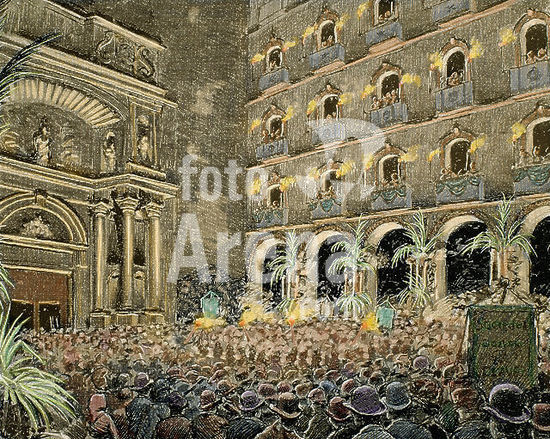
alb1464575 Serenade by Choral Societies given the night of 28 May due to the visit of the Queen Regent Maria Cristina of Habsburg-Lorraine to the Monastery of Montserrat. Catalonia. Spain. Drawing by P. Y. Valor, 1888. Colored.
DC

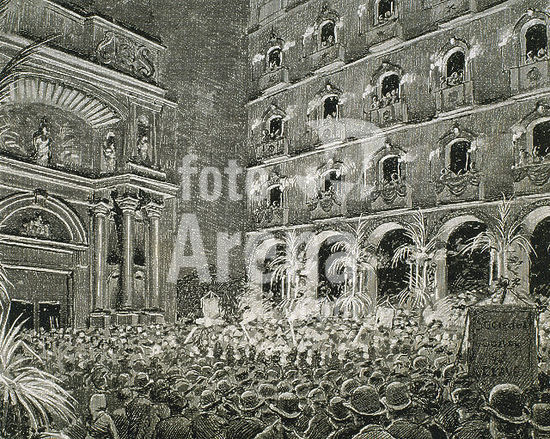
alb1467253 Serenade by Choral Societies given the night of 28 May due to the visit of the Queen Regent Maria Cristina of Habsburg-Lorraine to the Monastery of Montserrat. Catalonia. Spain. Drawing by P. Y. Valor, 1888.
DC

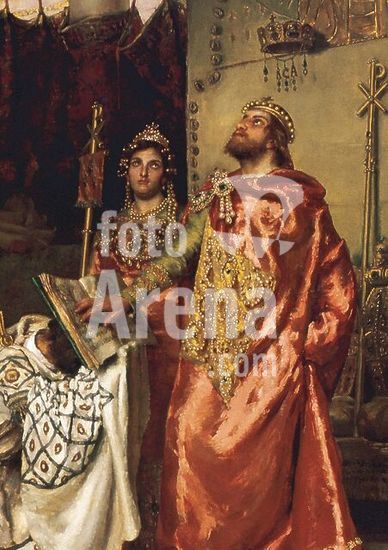
alb1744028 Reccared I (559Ð601). Visigothic King of Hispania, Septimania and Galicia (586Ð601). Reccared I renounced Arianism for Catholicism in January 587. The Third Council of Toledo (May 589) served to ratify the abjuration of Arianism of both the monarch and the dignitaries of the kingdom. Conversion of Reccared to Catholicism, by Antonio Mu–oz Degrain, 1888. Detail. Senate Palace. Madrid, Spain.
DC

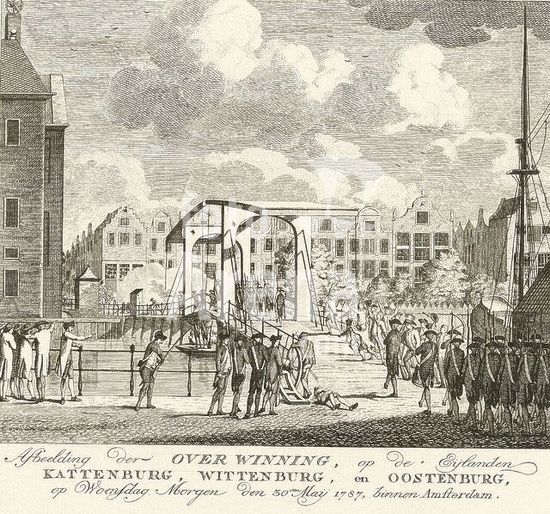
alb15771407 Conquest of the Kattenburger Bridge, 1787, Image of Victory, on the Eylanden Kattenburg, Wittenburg, and Oostenburg, on Wednesday Morning the 30th of May 1787, within Amsterdam (title on object), The capture of the Kattenburger Bridge to the island of Kattenburg from the rebellious Orangists by armed Amsterdam citizens, May 30, 1787., print, print maker: anonymous, Northern Netherlands, 1787, paper, etching, engraving, height, 202 mm × width, 255 mm.
DC
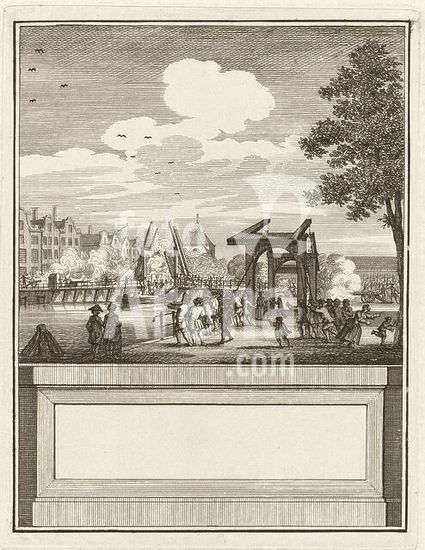
alb15546941 Noordelijke Nederlanden, Verovering van de Kattenburgerbrug, 1787, Northern Netherlands, verso - stamped, The conquest of the Kattenburgerbrug to the island of Kattenburg from the rebellious Orange supporters by the armed citizens of Amsterdam, 30 May 1787., print, prent, prints, prenten, Frederik Muller Historieplaten, height 177 mm, width 136 mm, print maker, prentmaker, 1787 - 1787, paper, papier, etching, engraving, engraving (printing process).
DC
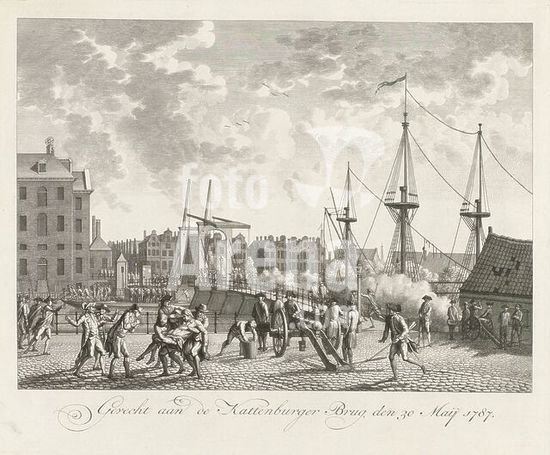
alb15548098 Northern Netherlands, Battle at the Kattenburger Bridge on 30 May 1787, Conquest of the Kattenburger Bridge, 1787, verso - stamped, The conquest of the Kattenburger Bridge to the island of Kattenburg from the rebellious Orange supporters by the armed citizens of Amsterdam, 30 May 1787. On the left a part of the Lands Zeemagazijn., print, prent, prints, prenten, Frederik Muller Historieplaten, height 262 mm, width 314 mm, print maker, printmaker, 1787 - 1787, paper, papier, etching, engraving, engraving (printing process).
DC
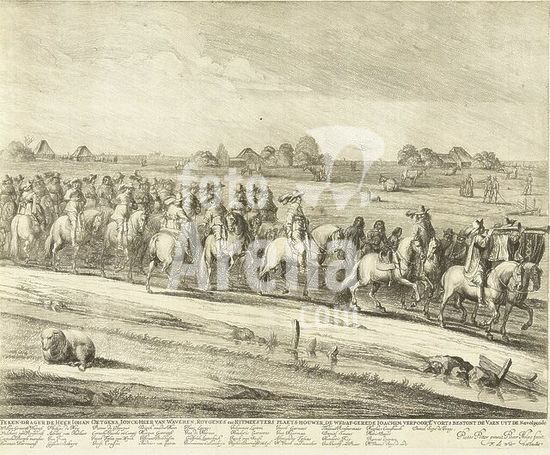
alb15772647 Procession of the militiamen along the Haarlemmertrekvaart at the arrival of Queen Henrietta Maria in Amsterdam, 1642 (right page), Image of the puyck of the citizen-ruyteren by the lord mayors meeting for the queen of Great Britain Henrieta Maria, on the 20 may have visited Amsterdam in the year 1642, to be overtaken (title on object), Procession of the militiamen along the Haarlemmertrekvaart during the arrival of English Queen Henrietta Maria in Amsterdam, May 20, 1642. Completely consisting of three pages: right page. The beginning of the procession preceded by trumpeters. In the caption a list in 10 columns with some of the names of the riders in the procession., print, print maker: Pieter Nolpe, (mentioned on object), after painting by: Pieter Symonsz Potter, (mentioned on object), publisher: Frederik de Wit, (mentioned on object), print maker: Northern Netherlands, publisher: Amsterdam, 1642, paper, etching, height, 396 mm × width, 485 mm.
DC
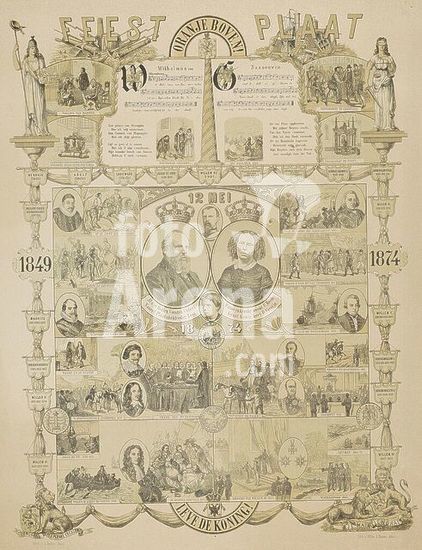
alb15772664 Memorial plaque for the 25th anniversary of the reign of King Willem III 1849-1874, Celebration plaque (title on object), Memorial plaque for the celebration of the 25th anniversary of the reign of King Willem III, May 12, 1874. Centrally the portraits of the king and queen, including the Crown Prince and Prince Alexander. Surrounding this are portraits from the House of Orange-Nassau and scenes of important historical events from the time of William of Orange to the Aceh expedition in 1873-1874. At the top some verses from the Wilhelmus, on the left the Dutch Virgin, on the right Justitia., print, print maker: anonymous, (mentioned on object), printer: Wilke & Harms, (mentioned on object), publisher: weduwe J.G. Aukes, (mentioned on object), print maker: Netherlands, printer: Amsterdam, publisher: Amsterdam, 1874, paper, height, 730 mm × width, 543 mm.
DC
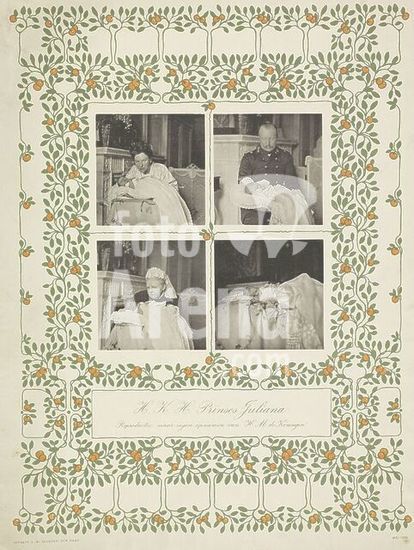
alb15772449 Portraits of Emma, Queen Regent of the Netherlands, Wilhelmina, Queen of the Netherlands, Hendrik of Mecklenburg-Schwerin and Juliana, Queen of the Netherlands, Portraits of Emma, Wilhelmina, Hendrik and Juliana with two lines of Dutch text underneath. Surrounding it are branches of an orange tree with leaves and fruits., photomechanical print, maker: anonymous, after drawing by: anonymous, after photo by: Wilhelmina (koningin der Nederlanden), (mentioned on object), maker: Netherlands, publisher: The Hague, May-1909, paper, collotype, height, 388 mm × width, 302 mm.
DC
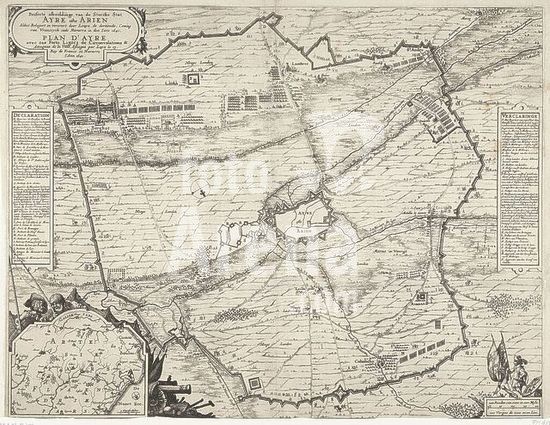
alb15449621 Amsterdam, Visscher, Claes Jansz. (II), Northern Netherlands, Schut, Pieter Hendricksz., Plan d'Ayre avec sez Forts Lignes de Circonvalations & Attacks de la Ville, Assiegée par Loys le 13. Roy de France et Navarre l'Ann 1641, Perfecte beelde van de Stercke Stad Ayre ofte Arien Aldus Besieged and conquered by Louis the thirteenth, King of France and Navarre in the year 1641, Map of the siege of Aire-sur-la-Lys, 1641, Map of the siege and conquest of Aire-sur-la-Lys (Ariën) by the French army of King Louis XIII, May - 27 July 1641. In the center a map of the city with the fortifications and the surrounding country with the circumvallation line around the city constructed by the besiegers. Left and right the legends AS in French and Dutch. Bottom left an inset with a map of the larger area. Unprinted on the back., print, map, historical print, prints, Frederik Muller Historical plates, height 400 mm, width 522 mm, Dutch, 1619 - 1660, print maker, printmaker, 1641 - 1641, second quarter 17th century, paper, etching, etchings, Northern Dutch, 1586 - 1652-06-19.
DC
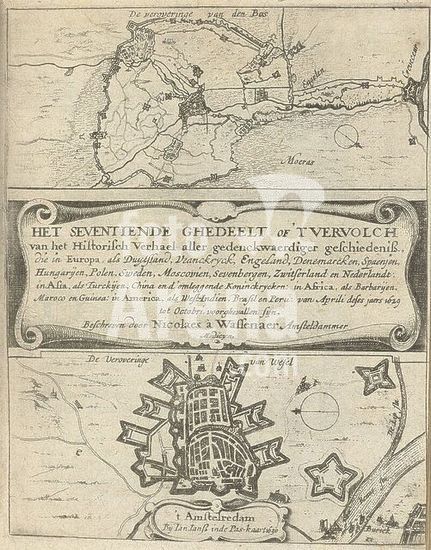
alb15599308 Title page of Historisch verhael, volume 6 (vol. 17), 1629, Het Seventiende Ghedeelt or 't Vervolch van het Historisch Verhael aller denckwaerdier histories., which in Europe, as Duytsland, Vranckryck, England (...) Nederlandt: in Asia (...) in Africa (...) in America (...) from April 1629 to Octobri, voorgheviel syn (title on object), Title page of Historical Story, volume 6 (vol. 17), 1629. Title page with two scenes. Above the siege of Den Bosch by Frederik Hendrik, May-September 1629. Below the conquest of Wezel in August 1629. In the middle a cartouche with the title., print, print maker: Gillis van Scheyndel (I), (attributed to), publisher: Johannes Janssonius, (mentioned on object), print maker: Northern Netherlands, publisher: Amsterdam, 1629 - 1630, paper, etching, height c. 185 mm × width c. 145 mm.
DC
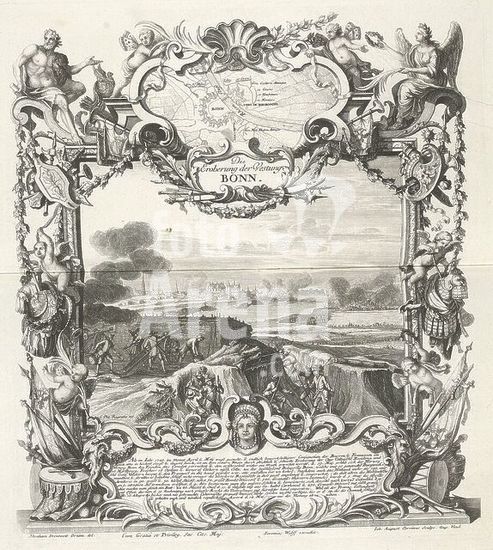
alb15591833 Capture of Bonn, 1703, Die Eroberung der Vestung Bonn (title on object), Conquest of Bonn from the French by the allies on May 15, 1703, after siege from May 5. The shelling of the city seen from the Allied trenches. Depiction in a richly decorated ornamental frame with a map of the city at the top. At the bottom center there is a cartouche with a description of the battles in German. Sheet in the bound collection of records released under the title: Repraesentatio belli ... Der Spanische Successions-Krieg [ca. 1720]., print, print maker: Johann August Corvinus, (mentioned on object), after drawing by: Abraham Drentwett (I), (mentioned on object), after drawing by: Georg Philipp Rugendas (I), (mentioned on object), Augsburg, 1712 - 1715, paper, etching, engraving, height c. 425 mm × width, 385 mm.
DC
alb15595923 Queen Wilhelmina and Regent Emma during the laying of the foundation stone of the Wilhelmina Gasthuis in Amsterdam under the watchful eye of a large audience., The first visit of Queen Wilhelmina and Queen Regent Emma to Amsterdam, laying of the memorial stone of the Wilhelmina Hospital by the young Queen May 28, 1891. (title on object), photograph, Gustaaf Oosterhuis, (attributed to), Pieter Oosterhuis, (mentioned on object), Amsterdam, 28-May-1891, paper, albumen print, height, 207 mm × width, 266 mm, height, 324 mm × width, 453 mm, height, 455 mm × width, 572 mm.
DC
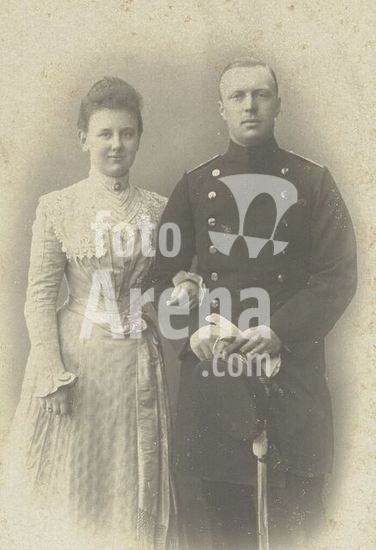
alb15598264 Engagement portrait of Queen Wilhelmina and Prince Hendrik, photograph, Wegner & Mottu, (mentioned on object), Amsterdam, after 12-May-1900, paper, height, 85 mm × width, 55 mm, height, 302 mm × width, 146 mm.
DC

Total de Resultados: 1.649

Página 1 de 17