

















































Busque também em nossas outras coleções:

Data da imagem:
Pauta
ver mais opções...
Agência
Fotógrafo
ver mais opções...
Estado
Cidade
ver mais opções...
Local
ver mais opções...
Tipo de licença
Orientação
Coleção
ver mais opções...

Total de Resultados: 790

Página 1 de 8

902_05_12323882HighRes Diagram showing the superficial nerves of the human head and neck. From Meyers Lexicon, published 1924.
DC
1016_04_47276 The image shows a posterior view of the muscles of the head and neck.
DC
981_05_LC120411_0953_2 The Sea Serpent In The Mediterranean, A Sketch From H.M. Yacht 'Osborne' Off The North Coast Of Sicily On The Second Of June; 1. The Row Of Fins As Seen At First; 2. The Head And Flappers; The Head Was Bullet-Shaped, And Quite 6 Feet Thick, The Neck Narrow, And Its Head Was Occasionally Thrown Back Out Of The Water, Remaining There For A Few Seconds At A Time. It Was Very Broad Across The Back Or Shoulders, About 15 Or 20 Feet, And The Flappers Appeared To Have A Semi-Revolving Motion, Which Seemed To Paddle The Monster Along. They Were About 15 Feet In Length.
DC
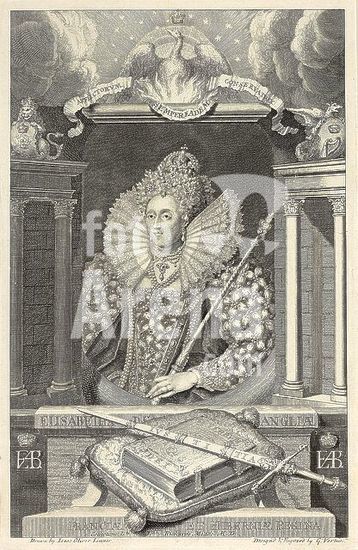
alb4140702 Queen Elizabeth I. George Vertue (English, 1684-1756); after Issac Oliver, the elder (French, before 1568-1617). Date: 1732. Dimensions: 279 × 177 mm (image); 289 × 187 mm (plate); 385 × 241 mm (sheet). Engraving in black on ivory laid paper. Origin: England. Museum: The Chicago Art Institute, USA.
DC
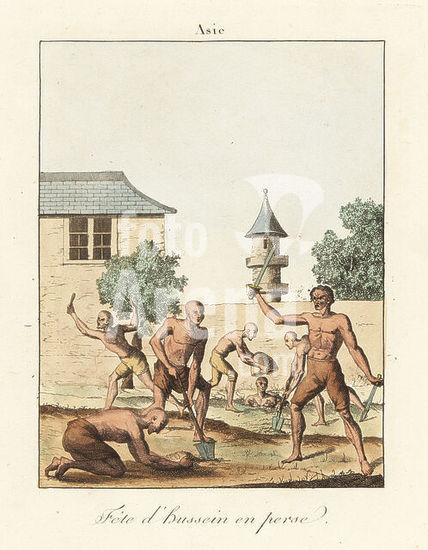
alb18719874 Rituals by Shia Muslims in Persia (Iran) to mourn the death of the third Imam, Husayn ibn Ali. Half-naked men brandish daggers and swords or smear their heads with dirt and ash. Others are buried up to the neck and covered with a vase. Fete d'Hussein en Perse. Passion d'al-Husayn. After an illustration by Jan Luyken. Handcoloured copperplate engraving from Moeurs et Coutumes des Peuples ou Collection de Tableaux représentant les usages remarquables, les mariages, funérailles, supplices et fêtes des diverses nations du monde, Manners and Customs of Peoples, Veuve Hocquart, Paris, 1811.
DC
alb4102006 Portrait of a Couple, Probably Isaac Abrahamsz Massa and Beatrix van der Laen. Portrait of a Couple in a Landscape, probably Isaac Abrahamsz Massa (1586-1643) and Beatrix van der Laen (1592-1639). Dating: c. 1622. Measurements: support: h 140 cm × w 166.5 cm. Museum: Rijksmuseum, Amsterdam. Author: FRANS HALS.
DC
alb3682369 Myologie Complette en Couleur et Grandeur Naturelle. Artist: Jacques Fabien Gautier Dagoty (French, Marseille 1716-1785 Paris). Author: Joseph Guichard Duverney (French, 1648-1730). Dimensions: 22 1/16 × 15 9/16 × 1 3/16 in. (56 × 39.5 × 3 cm). Publisher: Gautier (Paris). Date: 1746.Jacques-Fabien Gautier-Dagoty received a royal license for his technique of four-plate color printing in mezzotint, a process closely derived from the three-plate method of his teacher, Jacob Christoph Le Blon (to which Gautier-Dagoty added a plate printed in black or brown). Although he also made prints that reproduced paintings or depicted notable figures, Gautier-Dagoty's special interests lay in anatomy, botany, and zoology--fields that would be revolutionized by the publication of accurate color illustrations. He founded the first French illustrated scientific journal, and prepared large-scale publications such as Myologie complète en couleur et grandeur naturelle a treatise on the anatomy of muscles. Museum: Metropolitan Museum of Art, New York, USA.
DC
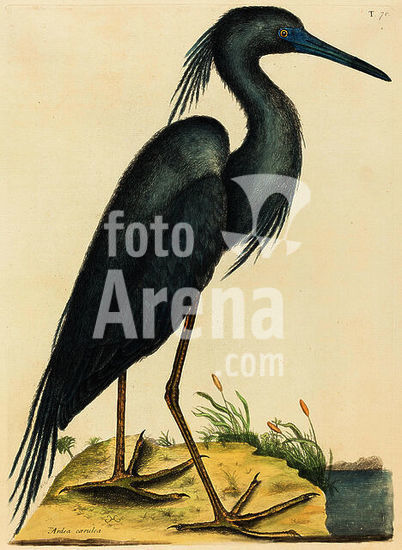
alb3740215 The Blue Heron (Ardea coerulea). Dated: published 1731-1743. Dimensions: plate: 35.6 x 25.7 cm (14 x 10 1/8 in.) sheet: 45.7 x 34.3 cm (18 x 13 1/2 in.). Medium: hand-colored engraving on laid paper. Museum: National Gallery of Art, Washington DC. Author: Mark Catesby.
DC
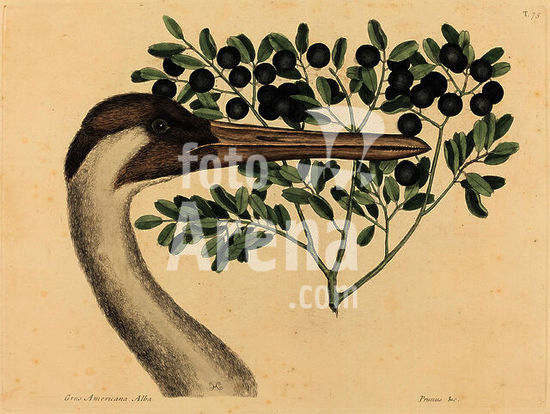
alb3727708 The Hooping Crane (Ardea Americana). Dated: published 1731-1743. Dimensions: plate: 26.2 x 35.1 cm (10 5/16 x 13 13/16 in.) sheet: 34.8 x 50.2 cm (13 11/16 x 19 3/4 in.). Medium: hand-colored engraving on laid paper. Museum: National Gallery of Art, Washington DC. Author: Mark Catesby.
DC
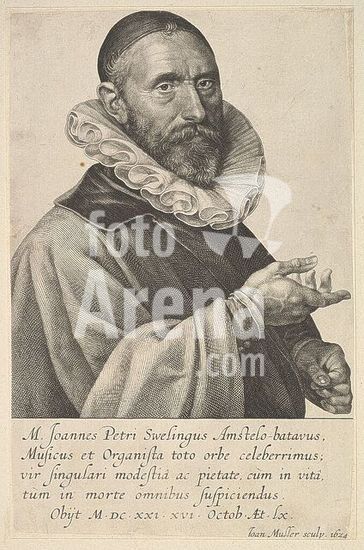
alb3643971 Portrait of Jan Pietersz Sweelinck, Organist & Musician in Amsterdam. Artist: Jan Muller (Netherlandish, Amsterdam 1571-1628 Amsterdam). Dimensions: 7 13/16 × 5 1/16 in. (19.8 × 12.9 cm). Date: 1624. Museum: Metropolitan Museum of Art, New York, USA. Author: Jan Muller.
DC
alb3617170 The Whore of Babylon, from The Apocalypse. Artist: Albrecht Dürer (German, Nuremberg 1471-1528 Nuremberg). Dimensions: sheet, 15-5/8 x 11-1/4 in. (39.5 x 28.6 cm). Date: 1498.By 1498, Dürer had published more than two dozen prints, which brought him to the attention of artists and connoisseurs not only in his native Nuremberg and other German-speaking areas but also across the Alps in Italy. It was the prodigious woodcuts of The Apocalypse, however, published in 1498, that made him enormously famous. There was a long tradition of Apocalypse illustrations in manuscripts, which continued in printed books, but nothing like Dürer's galvanizing imagination had ever been brought to bear on the text. In previous printed Bibles, illustrations had been put on pages along with the words, but Dürer gave precedence to the image, taking the entire large page of what he himself called a "superbook" for each of his fifteen subjects. This last image in the series marks the appearance of the whore of Babylon in the Book of Revelation (17:3--4): "And I saw a woman sitting on a scarlet beast, full of names of blasphemy with seven heads and ten horns. The woman was garbed in purple and scarlet, and gilded with gold, gems, and pearls, and bearing a golden goblet in her hand full of abominations and filthiness of her fornication." Babylon, the domain that embodies evil on earth, burns with huge explosions of flame and smoke in the distance, and from the upper left come the armies of heaven, led by the knight Faithful-and-True. Museum: Metropolitan Museum of Art, New York, USA.
DC
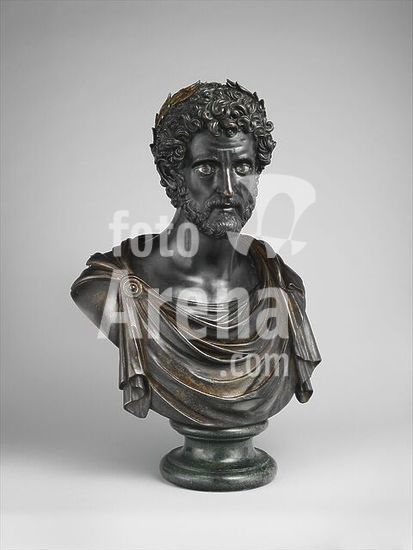
alb3627318 Emperor Antoninus Pius. Artist: Antico (Pier Jacopo Alari Bonacolsi) (Italian, Mantua ca. 1460-1528 Gazzuolo). Culture: Italian, Mantua. Dimensions: Overall without base (confirmed): H. 25 1/4 x W. 19 3/4 x D. 14 1/4 in. (64.1 x 50.2 x 36.2 cm); Height with base (confirmed): 29 7/8 in. (75.9 cm). Date: 1519-22.Working almost exclusively for the members of the Gonzaga family, frequently at their court in Mantua, Antico earned his nickname by specializing in interpretations of antique Greek and Roman sculpture. Trips to Rome on Gonzaga business afforded him occasions to see the latest discoveries of antiquities, which his patrons avidly collected; helping to acquire and repair those statues and busts gave the sculptor concrete knowledge of ancient art. His precise and elegant style owed much to the care with which he cast and chased his bronzes; this technical refinement of his work, as much as its evocation of the ancient world, appealed to generations of exacting patrons among the Gonzaga, from Gianfrancesco, to Francesco II and his famous wife Isabella d'Este, to Federico II.Isabella appears to have owned five busts by Antico dating between 1519 and 1522: Cleopatra (Museum of Fine Arts, Boston), Bacchus, Ariadne (both, Kunsthistorisches Museum, Vienna), Alexander (Liechtenstein Museum, Vienna), and Antoninus Pius, the present work. The subsequent Gonzaga ruler, her son Federico II (1500 - 1540), owned a second, later, bust by Antico of Antoninus Pius and one of his wife, Faustina, thought to be those now in the Musée du Louvre, Paris. Federico felt an affinity for this emperor and his wife and apparently had images of them integrated into the decorative scheme of the Sala di Troia in the Palazzo Ducale in Mantua.[1] Renaissance rulers frequently displayed busts of ancient leaders with whose virtues they wished to associate themselves. Astrologer Luca Gauricus called Federico a second Alexander and compared his master with other notables from Roman history.[2] Emperor Antoninus, whose sobriquet "Pius" was conferred on him by the Roman Senate in recognition of his righteousness, was known for high personal standards and was thus an appropriate exemplar for Federico. Furthermore, "Scriptores Historiae Augustae," a manuscript owned by the Gonzaga, records that the emperor was handsome and aristocratic, like Federico himself. [3] Thus, the two busts of Antoninus Pius on view in Mantua by the 1520s held slightly different connotations for their owners: for the learned and art-loving Isabella, the bust now in New York represented an exemplary figure from ancient history as well as a work of art of the highest caliber, and she displayed it with some of her other large and small bronzes on the top shelf of the grotto in her personal apartment in the Palazzo Ducale.[4] For Federico, the bust now in Paris symbolized the virtues and qualities he held dear, and evidently he displayed it in a public salon.In the 1990s the Museum's bust was linked by Ann Allison to a document of 1524 which states that the sculptor borrowed tools from the state munitions factory to finish a bust of Emperor Antoninus.[5] At that time Allison thought that the Louvre bust was made in Antico's workshop after the master's death;[6] however, a recent cleaning has revealed it to be of higher quality than previously thought, and Allison, having revised her opinion, now believes that the New York bust is the earlier of the two (1519 - 22) and that the Paris bust must be the one made in 1524. She characterizes the busts made for Isabella, including this one, as more refined than those made later for Federico. All of those in the earlier group share a scrupulous definition of the curls of hair within a flowing treatment of the whole; emphasis on the eyes through varied patinations or silvering; and strong noses and polished lips. [7]Comparison of the Museum's Emperor Antoninus Pius with ancient busts, such as one in the Munich Glyptothek, illustrates how far the artist was willing to take his interpretation. Antico's version shares the general features of its prototype, but the artist sharpened the detailing of the hair and intensified the subject's expression by graving the eyebrows and hollowing the cheeks. The deep, crisply executed locks of hair create a vibrant pattern; such technical virtuosity confirms Antico's presumed training as a goldsmith. The curls on the head join those of the beard to frame the emperor's rather pensive face. A laurel wreath crowns the head and separates the deeply worked curls from a flatter swirl of hair above the wreath. Technical examination has revealed that the head and bust were modeled separately and joined where the long neck lifts the head majestically from the shoulders. The flowing lines of the toga encircle the torso and conceal the point of juncture.[8] Confidently modeled, Antico's bust rivals the great classical portrait busts; brilliantly finished, it gives a most welcome idea of how splendid ancient examples, so often battered, must once have looked.[Ian Wardropper. European Sculpture, 1400-1900, In the Metropolitan Museum of Art. New York, 2011, no. 16, pp. 56-59.]Footnotes:[1] Ann Hersey Allison. "L'Antico e i fratelli Lombardo: Relazioni tra Venezia e le corti di Mantova e Ferrara, circa 1490-1530." In L'industria artistica del bronzo del Rinascimento a Venezia e nell'Italia settentrionale: Atti del Convegno Internazionale di Studi, Venezia, Fondazione Giorgio Cini, 23 e 24 ottobre 2007, edited by Matteo Ceriana and Victoria Avery, pp. 109-34. Verona, 2008, p. 130.[2] See E.H. Gombrich. "The Sala dei Venti in the Palazzo del Te." Journal of the Warburg and Courtauld Institutes 13, nos. 3-4 (July-December 1950), pp. 189-201, p. 200, n. 5.[3] Alessandro Luzio and Rodolfo Renier. "I Filefo e l'umanismo alla corte dei Gonzaga." Giornale storico della letteratura italiana 16 (1890), pp. 119-217, pp. 136 - 37, n. 4, notes that this manuscript was in the library of Ludovico II Gonzaga.[4] Allison 2008.[5] Ann Hersey Allison. "The Bronzes of Pier Jacopo Alari-Bonacolsi, Called Antico." Jahrbuch der Kunsthistorischen Sammlungen in Wien 89-90 (1993-94), pp. 35-310, p. 296, doc. no. 84.[6] Ibid., pp. 61, 260 - 64, no. 40. Citing a scientific study showing that the surface of the Louvre's bust has been compromised, Bernard Jestaz attributed it and the Faustina directly to Antico, dating them later, as posthumous casts, to 1536 - 39 (Jestaz in Gonzaga: La celeste galleria. Le raccolte. Exh. cat. edited by Raffaella Morselli. Palazzo Te and Palazzo Ducale, Mantua; 2002. Milan, 2002, pp. 353 - 54, no. 137). Marc Bormand (in Bonacolsi, l'Antico: Uno scultore nella Mantova di Andrea Mantegna e di Isabella d'Este. Exh. cat. edited by Filippo Trevisani and Davide Gasparotto. Palazzo Ducale, Mantua; 2008-9. Milan, 2008, pp. 266 - 68, nos. vii.5, 6) noted the better quality of the Louvre bust of Antoninus as revealed by conservation and its similarity to the New York bust.[7] James David Draper in Die Bronzen der fürstlichen Sammlung Liechtenstein. Exh. cat. by James David Draper, Johanna Hecht, and Olga Raggio. Liebieghaus, Frankfurt am Main; 1986-87. Frankfurt am Main, 1986, p. 260.[8] For a full discussion of Antico's technique, see Richard E. Stone. "Antico and the Development of Bronze Casting in Italy at the End of the Quattrocento." Metropolitan Museum Journal 16 (1981), pp. 87-116. Museum: Metropolitan Museum of Art, New York, USA.
DC
alb2069770 El Greco / 'The Nobleman with his Hand on his Chest', ca. 1580, Spanish School, Oil on canvas, 82 cm x 66 cm, P00809. Museum: MUSEO DEL PRADO, MADRID, SPAIN.
DC
alb4139694 Neck Muscles, plate three from Complete musculature in Natural Size and Color. Jacques Fabien Gautier D'Agoty; French, 1710-1781. Date: 1746. Dimensions: 400 × 320 mm (image/plate); 560 × 392 mm (sheet). Color mezzotint with touches of engraving on cream laid paper, varnished. Origin: France. Museum: The Chicago Art Institute, USA. Author: JACQUES FABIEN GAUTIER D'AGOTY.
DC
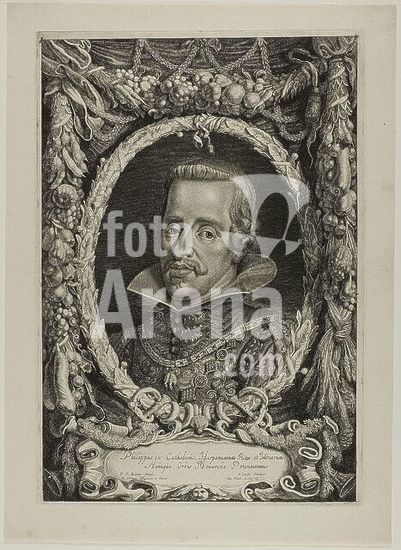
alb4137226 Philip IV, King of Spain, plate 12 from Duces Burgundiae (Dukes of Burgundy). Jacob Louys (Flemish, 1595-after 1644); after Peter Paul Rubens (Flemish, 1577-1640); border engraved, and print published, by Pieter Claesz. Soutman (Dutch, c. 1580-1657). Date: 1644. Dimensions: 407 × 280 mm (plate); 463 × 334 mm (sheet). Engraving and etching in black on ivory laid paper. Origin: Flanders. Museum: The Chicago Art Institute, USA.
DC
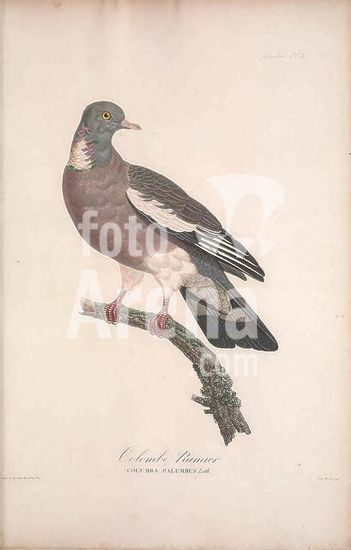
alb15339815 Les pigeons, par Madame Knip, née Pauline de Courcelles, le texte par C.J. Temminck, Paris, Chez Mme. Knip, [1838-1843?], pictorial works, pigeons, birds, A beautifully illustrated depiction of a pigeon perched on a branch. The bird showcases a mix of soft grays and subtle purples, with distinct feather patterns. Its head features a striking eye and a hint of iridescence around the neck, drawing attention to its elegant form. The naturalistic details of the feathers, combined with the delicate rendering of the branch, capture the essence of this graceful creature. Below the image, the scientific name 'Columba palumbus' is elegantly inscribed, highlighting its classification within the avian world.
DC
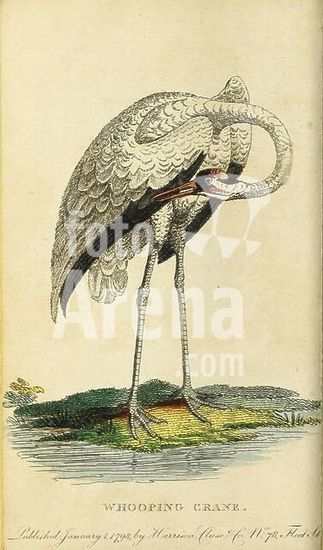
alb15337050 The Naturalist's Pocket Magazine, or Compleat Cabinet of the Curiosities and Beauties of Nature, London., A gracefully poised whooping crane stands on one leg, its long neck curved elegantly as it preens its feathers. The bird features striking plumage with a mix of white and subtle grey tones, along with distinct black markings around its head and face. Positioned by a serene water's edge, the crane's reflection is visible in the tranquil water below. This illustration is labeled "Whooping Crane" and includes a publication date of January 1797, indicating its historical significance in ornithological studies. The serene setting showcases the crane's natural habitat, highlighting the lush greenery and gentle ripples of the water.
DC
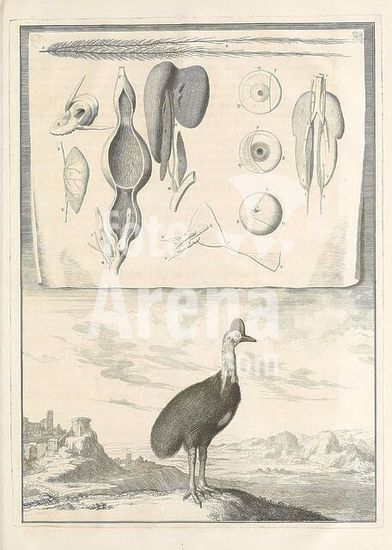
alb15331590 Memoires pour servir a l'histoire naturelle des animaux, A Paris, De l'Imprimerie royale, MDCLXXVI 1676, anatomy, comparative, animals, early works, pre-Linnean works, zoology, birds, bird anatomy, The illustration features a detailed depiction of a large bird standing on a rocky shoreline, showcasing its distinctive profile and features. The bird, with prominent wings, a long neck, and a unique head, appears to be in a natural setting with rolling hills and a distant castle-like structure in the background. Above the bird, various anatomical sketches and diagrams illustrate components of avian structure, including wings and other skeletal elements, offering insights into the bird's anatomy and function. This combination highlights both the beauty of the bird and the scientific exploration of its physical characteristics.
DC
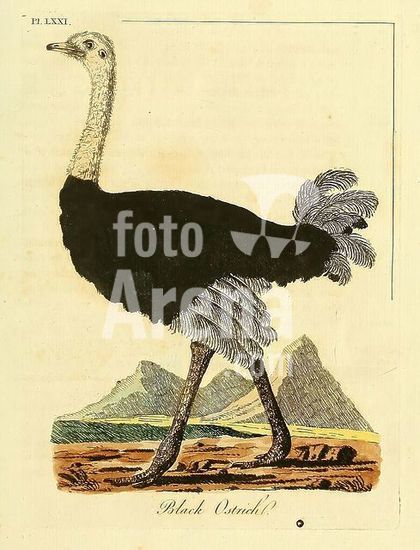
alb15338964 A general synopsis of birds. London, Printed for Benj. White, 1781-1785, Birds, Classification, Pictorial Works, A striking illustration of a black ostrich, depicted in profile with its elongated neck and distinctive long legs. The plumage on the body is illustrated in rich, dark hues, while the feathers on the neck and head are left lighter, creating a contrast that highlights the bird's unique features. In the background, rolling hills and mountains add a sense of environment and scale, inviting viewers to appreciate the majesty of this large flightless bird. The title 'Black Ostrich?' is elegantly inscribed below, suggesting a curious inquiry into the nature of this remarkable creature.
DC
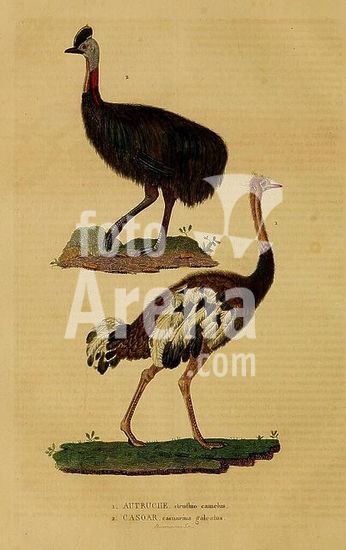
alb15338627 Dictionnaire classique des sciences naturelles, Brussels, Meline, Cans et Ce, 1853, Natural History, Dictionaries, The illustration depicts two distinct bird species: at the top is the cassowary, characterized by its striking black plumage, tall stature, and a prominent casque on its head, standing on a grassy patch. Below it, the ostrich is shown, notable for its long neck and legs, with a unique pattern of feathers that includes a mix of dark and light tones. Both birds exhibit their distinctive features prominently, highlighting their adaptations and differences as flightless birds. The background has a subtle texture that emphasizes the detailed illustrations of the birds.
DC
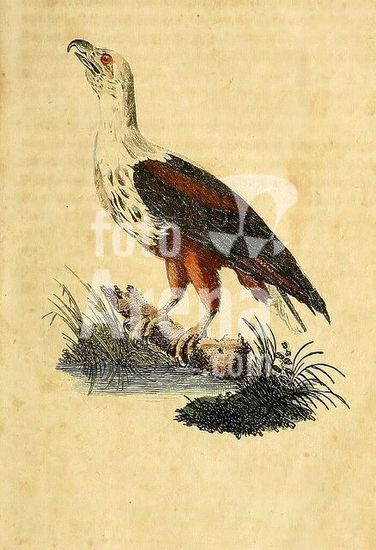
alb15338690 F. le Vaillant's Naturgeschichte der afrikanischen Vögel, Halle, Bey Fried. Christoph Dreyssig, [1798]. Africa, Birds, A detailed illustration of a bird perched on a small log near the water's edge. The bird features a predominantly white head and neck with distinct red eyes. Its body exhibits rich brown plumage with striking white and dark chestnut accents. The surrounding environment is gently detailed with grassy tufts, enhancing the natural habitat feel. This representation emphasizes the bird's keen presence, capturing the essence of its elegance and poise in the wild. The numbering at the top suggests it may be part of a series or collection related to ornithology or nature studies.
DC
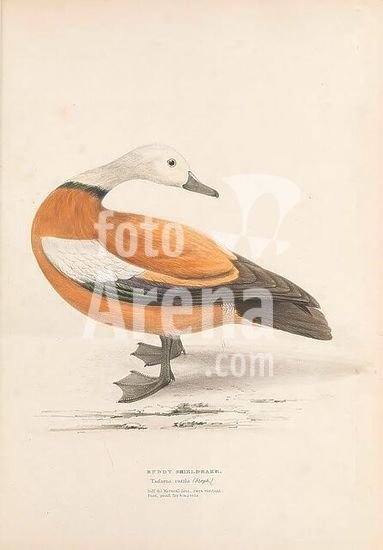
alb15336756 A detailed illustration of a duck, showcasing its distinctive features and vibrant plumage. The bird stands elegantly on one leg, highlighting its intricate feather patterns. The head is primarily white, transitioning to rich orange and brown hues on the body, with darker tones on the wings and tail. The duck's slender neck and pointed bill give it a graceful appearance, while its webbed feet reflect its aquatic nature. This depiction emphasizes the beauty and diversity found within avian species.
DC
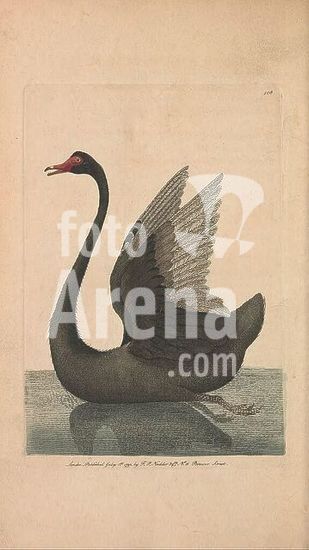
alb15336764 The Naturalist's Miscellany, or Coloured Figures of Natural Objects. London, Printed for Nodder & Co, 1789-1813. Animals, Pictorial Works, George Shaw, Black Swan, Birds, A beautifully rendered illustration of a black swan, showcasing its elegant posture and distinctive features. The bird is depicted with glossy black feathers, a long neck, and a gracefully arched head, accentuated by a striking red bill. The wings are partially extended, revealing a hint of the intricate feather details. The composition includes gentle ripples on the water's surface, enhancing the serene atmosphere of the scene. This artistic representation highlights the swan's regal nature and the delicate beauty of its form.
DC
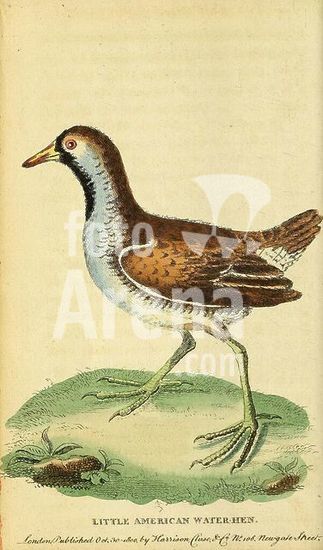
alb15332096 The Naturalist's Pocket Magazine or Complete Cabinet of the Curiosities and Beauties of Nature. London., A depiction of the little American waterhen, showcasing its distinctive features. The bird stands upright with a slender body, exhibiting a combination of rich brown and lighter patterned feathers. Its elongated neck leads to a delicate head, adorned with a contrasting yellow and black beak. The legs are thin and well-proportioned, indicating its agility in marshy environments. The background features a subtle representation of grassy terrain, emphasizing the waterhen's natural habitat. The overall illustration captures the elegance and unique characteristics of this aquatic bird.
DC
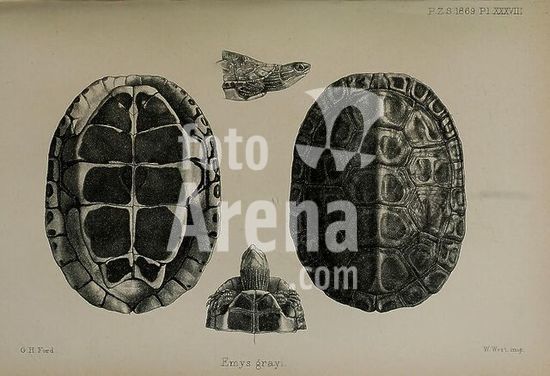
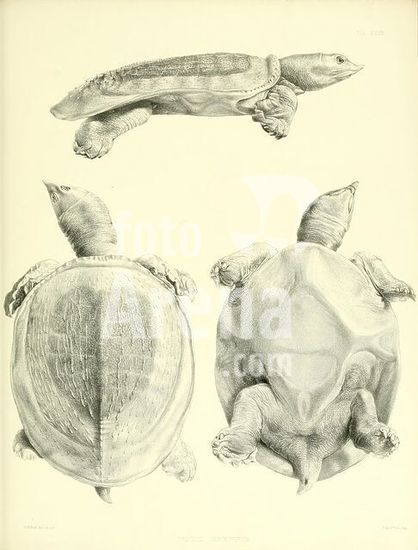
alb15332214 Proceedings of the Zoological Society of London London, Academic Press, 1833-1965 Periodicals Zoology Mauremys caspica, This illustration features a detailed study of a turtle, displaying various perspectives. The arrangement includes a top view, showcasing the distinct pattern of its shell, a side profile highlighting the shape of its head and neck, and a view of the plastron, which shows the underside of the shell. The intricate lines and textures capture the unique features of the turtle's anatomy, emphasizing the contrast between the upper carapace and the lower plastron. The overall design reflects a scientific approach to understanding this species, highlighting the importance of these features in identification and classification.
DC
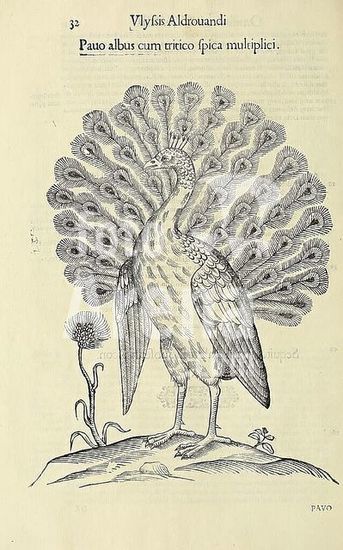
alb15338121 Vlyssis Aldrovandi, philosophi ac medici Bononiensis, historiam naturalem in gymnasio Bononiensi profitentis, Ornithologiae, hoc est, De avibus historiae libri XII, Bononiae, Apud Franciscum de Franciscis Senensem,MDXCIX-MDCXXXVII [1599-1637], An elegantly illustrated peacock stands majestically on a patch of ground adorned with a thistle, showcasing its extravagant plumage. Each feather radiates outwards in a fan-like display, embellished with intricate eye patterns that draw the viewer's attention. The peacock's slender neck holds its head high, exuding an air of pride. Above the illustration, text referencing 'Pavo albus cum tritico spica multiplicit' suggests a connection to the species and its environment. This artwork combines natural beauty with a touch of scientific study, capturing the regal essence of this magnificent bird.
DC
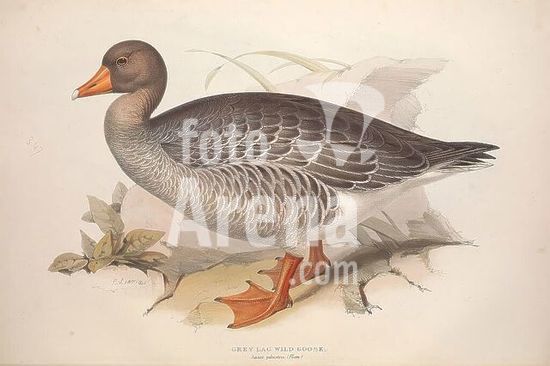
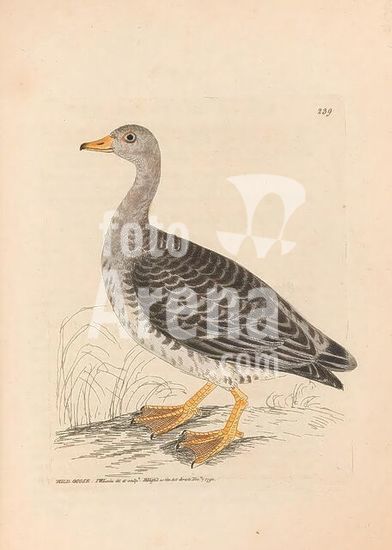
alb15338132 The Birds of Europe London Printed by R. and J.E. Taylor Published by the author 1837 Birds Europe Pictorial Works Edward Lear, A detailed illustration of a Gray Lake Wild Goose stands prominently, showcasing its elegant body and distinct features. The bird has a robust form with beautifully patterned feathers, transitioning from gray to a rich, darker tone on its back. Its head is adorned with a subtle mix of browns, featuring a bright orange bill that contrasts sharply against its plumage. The goose's eyes are keen and alert, set above a delicate sheen on its neck. Its webbed feet, vividly colored in orange, firmly grip the ground as it poses gracefully among soft, green foliage. This depiction captures both the majesty and the natural beauty of this wild goose species.
DC
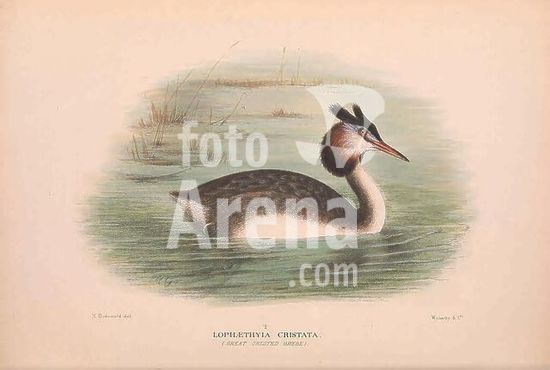
alb15337548 The Birds of Australia, London, Witherby & Co, 1910-1927, Australia, bibliography, birds, Birds Australia, pictorial works, bird, Mathews, Australia, Gregory Mathews, ornithology, Lophaethyia cristata, taxonomy: trinomial = Podiceps cristatus australis, great crested grebe, A beautifully illustrated depiction of a bird, showcasing its elegant neck and distinctive plumage. The creature stands in water, its long neck gracefully arched, with intricate details highlighting its features. Vivid colors accentuate the bird's head, contrasting with the muted tones of its body. Surrounding the bird, hints of natural vegetation create a serene environment, emphasizing the harmony between the species and its habitat. This artwork captures the majesty and beauty of the avian world.
DC
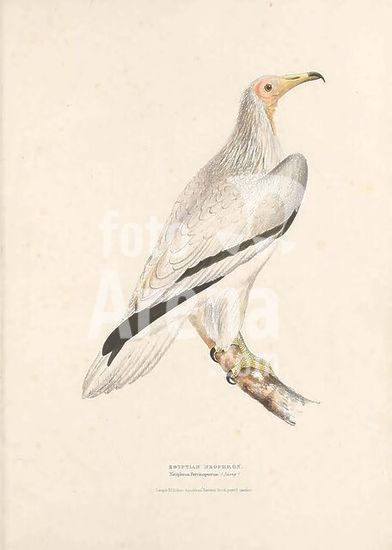
alb15333287 Illustrations of British Birds London 1837-1844 Birds Great Britain Nests Pictorial Works, A detailed depiction of a majestic bird perched gracefully on a branch. The bird features a predominantly white plumage that transitions to a muted gray, with a striking black band along its wings. Its long neck supports a distinctively shaped head, characterized by a pale coloration and a sharp, curved beak. The branch it rests on highlights the natural setting, suggesting a serene habitat. Below the illustration, there is a label identifying the species, along with credit to the illustrator, reflecting an artistic representation inspired by nature.
DC
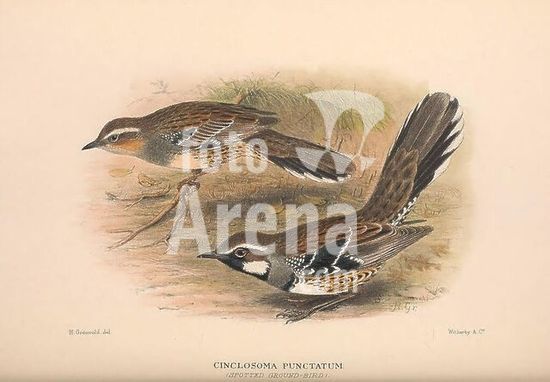
alb15336297 The Birds of Australia, London, Witherby & Co, 1910-1927, Australia, bibliography, birds, birds Australia, pictorial works, bird, Australia, Gregory Mathews, ornithology, The illustration features two birds from the genus Cinclus, showcasing their distinct details and plumage. The first bird, perched on the ground, has a notable pattern of brown and tan feathers, while the second bird, slightly leaning forward, displays contrasting markings on its head and neck. The natural setting hints at a habitat rich in greenery, likely near water, emphasizing the birds' connection to their environment. This artwork captures the essence of these species, highlighting their unique features and the intricate beauty of avian life.
DC
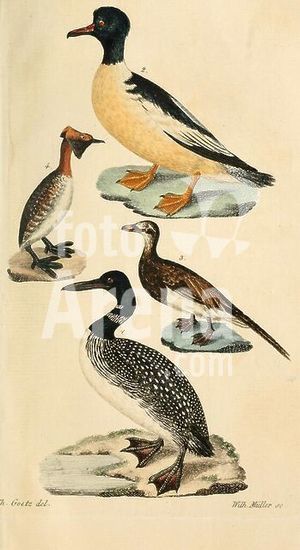
alb15339582 Handbuch der Naturgeschichte aller Vögel Deutschlands, Ilmenau, Bernh. Friedr. Voigt, 1831, birds, Germany, This illustration features a collection of four distinct bird species, each represented in a detailed and artistic manner. The first bird, positioned at the top, showcases a sleek body with a vibrant yellow chest and dark head, indicative of its aquatic nature. Below it, the second bird has a slender appearance with a striking head shape, characterized by a long neck and elegant posture. The third bird displays mottled plumage that hints at its adaptability in various environments, while the fourth bird, notable for its striking black and white speckled pattern, possesses a strong, streamlined build, perfect for diving underwater. Each bird is depicted standing on rocky terrain, demonstrating their natural habitats and providing a glimpse into the diversity.
DC
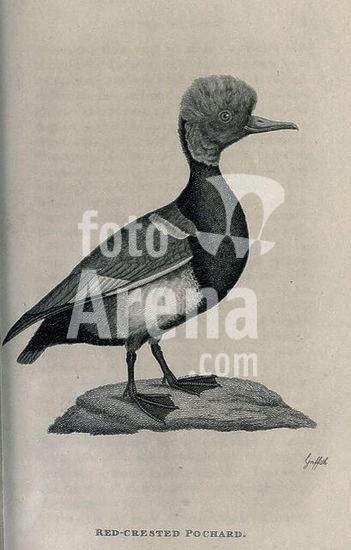
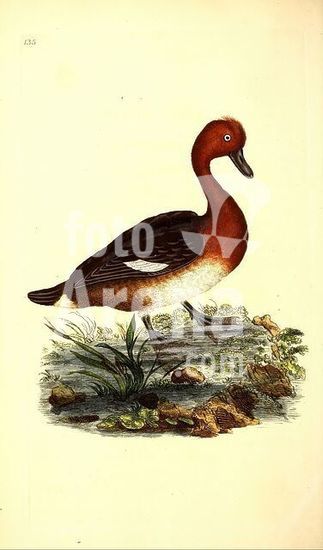
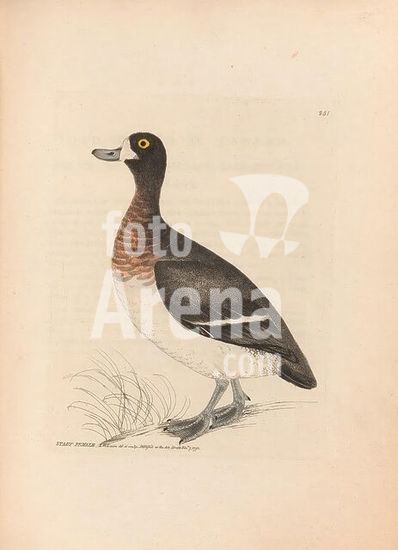
alb15331954 General Zoology, or Systematic Natural History, London, Printed for G. Kearsley, 1800-1826, pictorial works, zoology, A detailed illustration of a Red-Crested Pochard, showcasing its distinctive features. The bird is depicted standing upright, highlighting its rounded crest atop the head and the contrasting colors of its plumage. The body exhibits a blend of dark tones on the chest and lighter shades toward the flanks, complemented by a striking white patch on the wings. The slender neck and sharp beak emphasize its elegant profile, while the solid, sturdy base it stands on adds an element of natural realism to the representation, showcasing the bird's impressive stature and unique characteristics.
DC
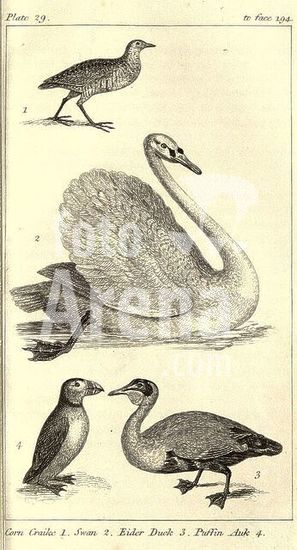
alb15338410 Natural history of animals. London, Harvey and Darton, 1842., The illustration features four different bird species, each labeled with a corresponding number for identification. 1. The first bird, positioned at the top left, resembles a small shorebird, characterized by its slender body and long legs, often found along coastlines. 2. The second bird is a graceful swan, depicted with its long neck elegantly arched and massive wings partially spread, showcasing its majestic form. 3. The third entry illustrates an eider duck, notable for its rounded body and distinctive head shape, often recognized for its soft down feathers. 4. The final bird, situated at the bottom right, depicts a puffin auk, featuring a robust body and a colorful beak.
DC
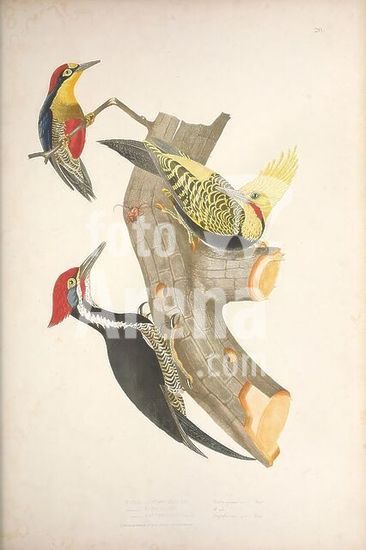
alb15330038 Ornithologie Bresilienne, ou, Histoire des oiseaux du Bresil, Rio de Janeiro, Editeur, Thomas Reeves, [1854-1856], birds, Brazil, pictorial works, Picus erythrogaster, Campephilus rubricollis, red necked woodpecker, Picus flavescens, Celeus flavescens, woodpeckers, blond crested woodpecker, Picus erythrocepalus, Melanerpes erythrocephalus, red headed woodpecker, The artwork features three vividly illustrated woodpeckers perched on a textured tree branch. The first woodpecker, adorned with a striking red cap and colorful plumage, leans gracefully to the side, while the second, showcasing an elegant yellow crest and intricate black and yellow markings, occupies the upper branch. Below, a bold black woodpecker with a pronounced bill is depicted, highlighting the rich details of its feathers and the natural imperfections of the branch. The background is lightly sketched, emphasizing the vibrant colors and dynamic poses of these fascinating birds, bringing the scene to life with intricate details and a sense of movement.
DC
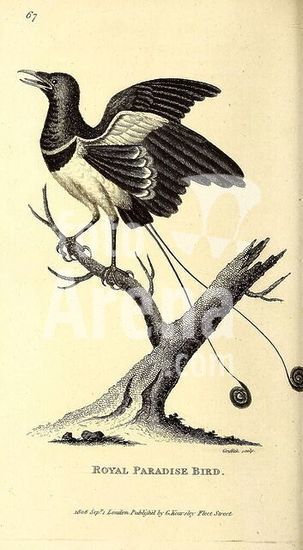
alb15331899 General zoology, or Systematic natural history London, Printed for G. Kearsley, 1800-1826. Pictorial works, zoology, bird, A beautifully illustrated depiction of the Royal Paradise Bird perched on a gnarled branch. The bird features long, elongated wings spread wide, showcasing its distinct plumage. Its body is sleek, with a slender neck extending to a delicate head, accentuated by a slightly open beak. Below the branch, a coiled vine adds an element of detail to the natural setting. The composition highlights the elegance and unique characteristics of this species, inviting admiration for its intricate design and graceful posture. A label at the bottom identifies the subject, reinforcing its significance in ornithological studies.
DC
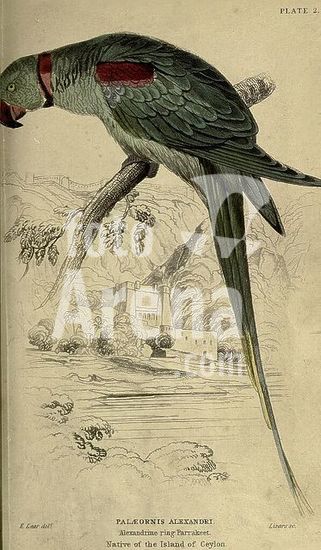
alb15331857 Parrots London Chatto & Windus [1845?] m Parrots Daubenton Louis Jean Marie, A vividly illustrated depiction of the Alexandrine parakeet, showcasing its distinct green plumage and striking red marks around the head and neck. The bird is perched gracefully on a branch adorned with leaves, set against a backdrop that hints at a serene landscape, possibly near a historical structure or castle. The detailed artistic rendering highlights the parakeet's long tail and unique features, emphasizing its charm and the natural beauty of its habitat. Below the illustration, identifying text notes the parakeet's full name and its native origin from the Island of Ceylon.
DC
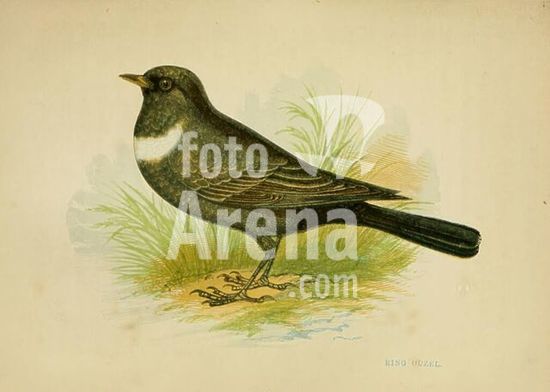
alb15337487 Our native songsters London Printed for the Society for Promoting Christian Knowledge 1853 Great Britain birds Turdus torquatus, A detailed illustration of a bird featuring a distinctive dark plumage and a prominent white patch on its throat. The bird is depicted in a poised stance, with its head slightly tilted downwards as if foraging on the ground. Surrounding the bird, gentle strokes of green suggest grassy surroundings, enhancing the natural setting. The intricate details showcase the texture of the feathers and the structure of the bird's body, emphasizing its elegance and the beauty of its environment. The overall composition captures a moment in the bird's life, inviting viewers to appreciate its grace and poise in nature.
DC
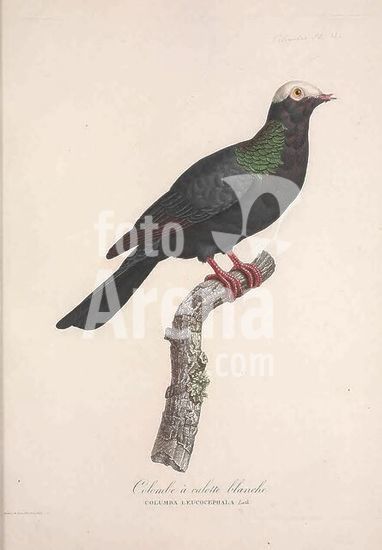
alb15332988 Les pigeons, par Madame Knip, nee Pauline de Courcelles, le texte par C.J. Temminck, Paris, Chez Mme. Knip, 1838-1843, pictorial works, pigeons, birds, A detailed illustration of a bird perched on a twisted branch, showcasing its striking features. The bird displays a predominantly dark plumage with a hint of green iridescence on its neck. Its head is adorned with a distinctive white crown, creating a contrast with the darker tones of its body. The branch it stands on is textured and gnarled, providing a rustic setting that highlights the elegance of the bird. Below the illustration, a scientific name indicates its classification, suggesting it belongs to the Columbidae family, known for its various species of pigeons and doves.
DC
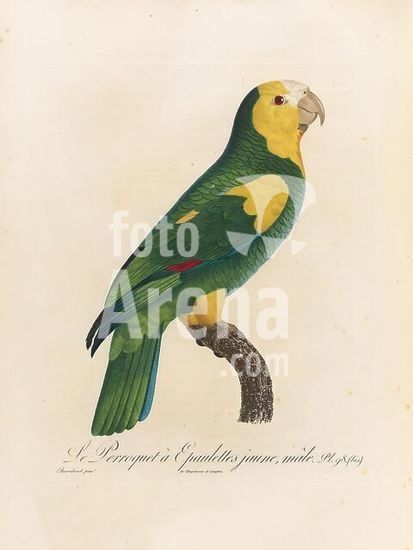
alb15331203 Histoire naturelle des perroquets, A Paris, chez Levrault, an IX (1801)-an XIII (1805), Amazon, Barbados, Amazon, Barbados., A beautifully illustrated parrot perched on a branch, showcasing a striking blend of vibrant colors. The parrot features a predominantly green body, accented with bright yellow highlights on its head and throat, along with red markings beneath its wing. This detailed representation emphasizes the intricate textures of the feathers and the parrot's expressive eyes, providing a glimpse into the natural beauty of this avian species. The surrounding background remains subtle, allowing the parrot's vibrant plumage to take center stage, making it a captivating portrayal of avian life.
DC
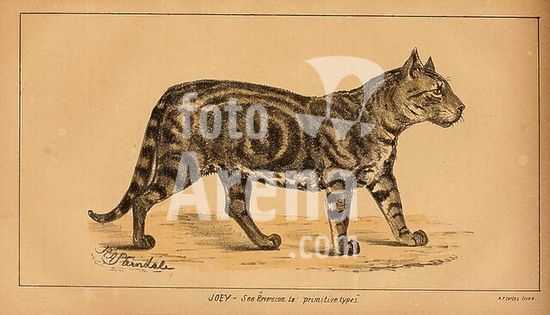
alb15334296 The, Journal, of, the, Bombay, Natural, History, Society, Bombay, The, Society, India, Natural, History, Periodicals, Woods, Hole, Cat, Robert, Armitage, Sterndale, A detailed illustration of a standing domestic cat, characterized by its distinct tabby coat featuring a series of bold stripes and spots. The cat is depicted in a proud posture, with its neck elongated and head turned slightly, showcasing its alert expression. Its ears are perked up, indicating curiosity or attentiveness. The background is minimal, focusing attention on the detailed texture of the cat's fur and the elegant curve of its body. Below the illustration, there is a signature that adds an artistic touch, lending authenticity to the portrayal of this beautiful feline.
DC
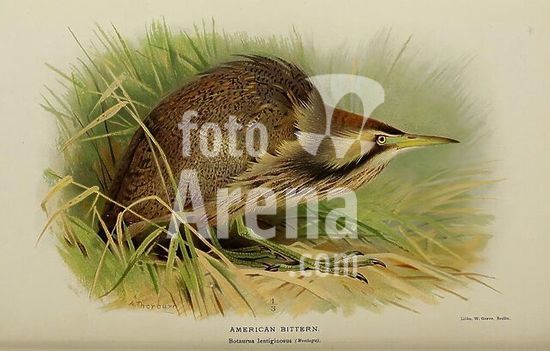
alb15336411 Coloured figures of the birds of the British Islands, issued by Lord Lilford. London, R. H. Porter, 1885-1897, Great Britain, bird, birds, ornithology, pictorial works, Botaurus lentiginosus, American bittern, Museum of Comparative Zoology, A detailed illustration showcases a bird, identified as an American Bittern, perched among tall grasses. The bird is depicted in a natural pose, with its head tilted upward, showcasing its distinctive long neck and speckled plumage. Surrounding it, the lush green grasses provide a habitat setting, emphasizing the bird's camouflage and connection to its environment. The meticulous detailing highlights the textures of the feathers and the organic elements of the habitat, creating a vivid representation of this intriguing species in its natural surroundings.
DC
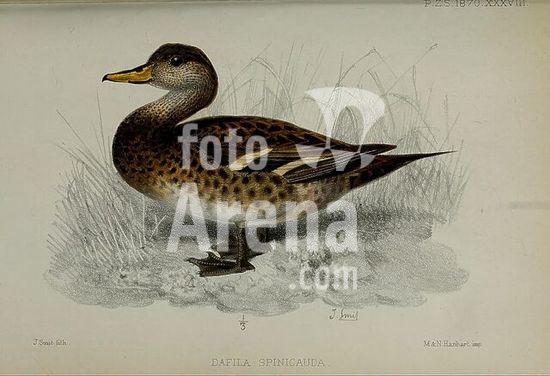
alb15337711 Proceedings of the Zoological Society of London, London, Academic Press, periodicals, zoology., A detailed illustration of a duck, showcasing its distinctive features. The bird is depicted in profile, highlighting its elongated neck and rounded body. Its feathers display a speckled pattern, varying from light to darker shades, while the duck's head features a pronounced beak with a slight curve. The surrounding area includes hints of grass, providing context to its natural habitat. The overall composition emphasizes the beauty and intricacy of the duck's anatomy and plumage.
DC
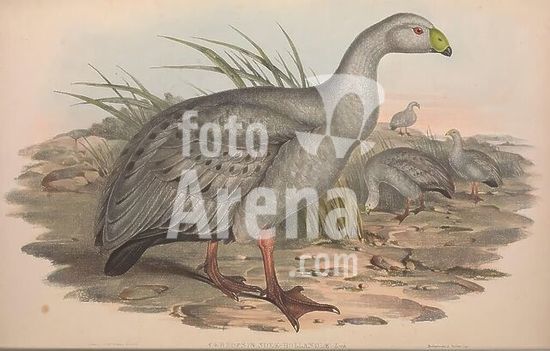
alb15334003 The birds of Australia London, Printed by R. and J. E. Taylor pub. by the author 1840-1848 Australia Birds Pictorial works Australia Gould John Gould Ornithology Gould Gould Australia Cereopsis novaehollandiae Cape Barren goose, A beautifully illustrated depiction of a large waterfowl, showcasing its distinct features such as a striking gray plumage and a prominent, rounded head. The bird stands proudly on one leg, with its elongated neck extending gracefully. Its expressive eye, bold bill, and intricate wing patterns are highlighted, along with the lush greenery in the surrounding environment. In the background, additional waterfowl are seen in a serene habitat, adding to the tranquil scene. This artwork captures the elegance and charm of these avian creatures in their natural setting.
DC
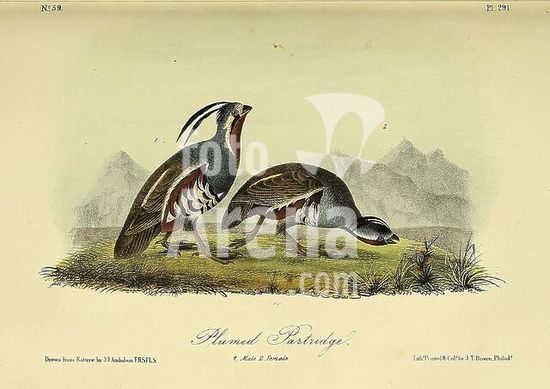
alb15334683 The, birds, of, America, New York, G.R. Lockwood,1871, c1839, birds, north, america, pictorial, works., The artwork features two elegantly posed birds, each displaying intricate feather patterns and distinct coloration on their heads and bodies. They are set against a softly rendered background suggesting a natural habitat, with hints of grass and gentle slopes that imply a serene environment. The birds, likely a representation of a specific species, exhibit characteristics such as prominent markings and elongated necks, accentuating their graceful profile. A caption below identifies them as 'Plumed Partridge,' referencing the meticulous scientific observation typical of ornithological illustrations from the era.
DC
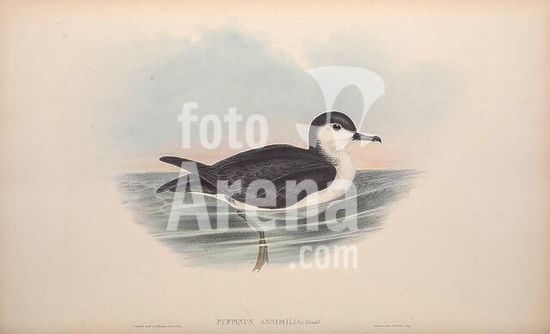
alb15334699 The birds of Australia. London, Printed by R. and J. E. Taylor pub. by the author 1840-1848. Australia, Birds, Pictorial Works, Australia, Gould, John Gould, Ornithology, Gould, Gould Australia, Puffinus assimilis, Little Shearwater, Taxonomy: Trinomial= Puffinus assimilis assimilis, A detailed illustration of a bird perched gracefully on a rocky surface, facing slightly to the side. The bird features a striking black and white plumage, with a distinctive black cap on its head and white extending down its neck and chest. Its wings are folded neatly at its sides, showcasing a sleek body and pointed beak, suggesting a predatory nature. The background features gentle waves, hinting at a coastal habitat, with soft hues that imply twilight or dawn. The overall composition reflects a serene moment in nature, emphasizing the bird's elegance and adaptability to its environment.
DC
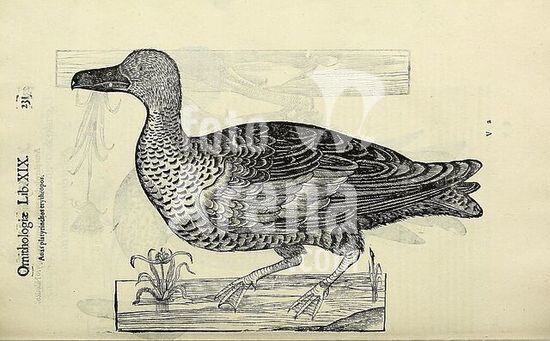
alb15339714 Vlyssis Aldrovandi philosophi ac medici Bononiensis historiam naturalem in gymnasio Bononiensi profitentis, Ornithologiae, hoc est, De avibus historiae libri XII Bononiae, Apud Franciscum de Franciscis Senensem, MDXCIX-MDCXXXVII, An intricate illustration of a bird, showcasing its distinctive features. The bird is depicted in profile, with a prominent long neck and a stout body covered in detailed feather patterns. Its head is tilted upwards, revealing a sharp beak. Surrounding the bird are stylized tree branches, adding to the natural setting. This artwork is part of a larger collection on ornithology, emphasizing the study and classification of birds. The craftsmanship highlights both the anatomy and the elegance of the avian subject, reflecting the artistic styles of the time.
DC
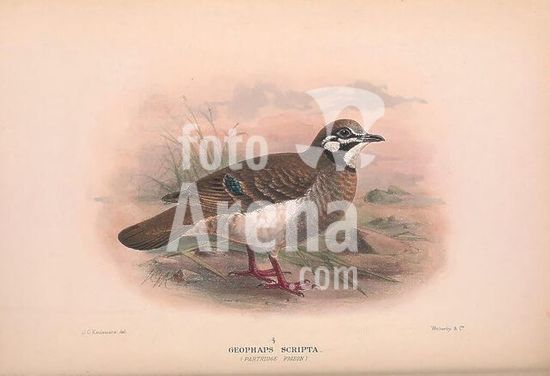
alb15339716 The Birds of Australia, London, Witherby & Co, 1910-1927, Australia, bibliography, birds, birds Australia, pictorial works, bird, Mathews, Australia, Gregory Mathews, ornithology, Geophaps scripta, squatter pigeon, A detailed illustration of a bird, showcasing its distinct features. The bird exhibits a brown plumage with various shades and subtle patterns that highlight its texture. Its head is adorned with a striking contrast of colors, including white and black markings around the eyes. The bird is depicted in a slightly angled pose, providing a clear view of its slender neck and distinctive beak. Bright red legs contrast with its earthy tones, while soft grasses and subtle elements of its natural habitat are illustrated in the background, enhancing the overall scene. The artwork captures the elegant posture and intricate details of the bird, making it a captivating study of avian beauty.
DC
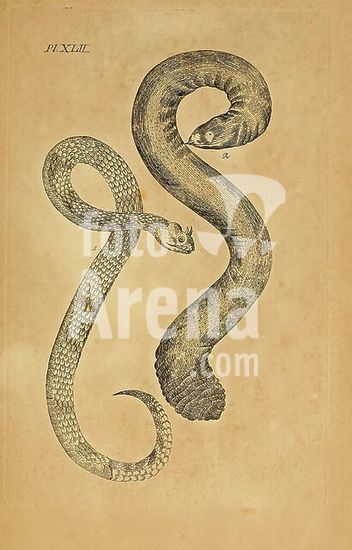
alb15334591 Icones amphibiorum, Hafniae, C. Steen, 1835, amphibians, reptiles, pictorial works, The illustration features two distinct snake specimens, each displayed in a unique pose that showcases their differing physical characteristics. The upper snake is depicted with a smooth, elongated body adorned with a patterned texture, suggesting a scale structure that emphasizes its slender, agile form. Its head is discernible with a slightly raised neck, giving it an alert pose. In contrast, the lower snake presents a thicker, more robust body, characterized by a rounded shape that suggests a greater girth. The texture appears more rugged, possibly indicating a different species or habitat adaptation. Both snakes are shown in a side view, allowing for a clear comparison of their shapes and sizes, with labeled annotations indicating specific features for identification purposes. The.
DC
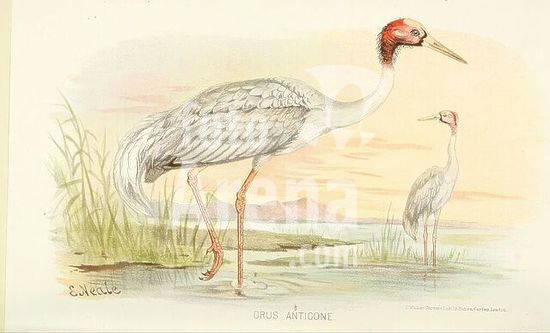
alb15334592 Indian sporting birds, London, Francis Edwards, 1915. Birds, Game and Game Birds, India, The illustration features two elegant cranes standing in a serene marshland. The first crane, depicted prominently in the foreground, showcases a long neck and striking plumage with intricate details in its feathers. Its head is adorned with a vivid red crown, contrasting beautifully with its soft gray and white body. The second crane, slightly behind and to the right, also displays similar features but is rendered smaller, creating a sense of depth in the composition. The subtle hues and delicate lines capture the tranquil beauty of their natural habitat, surrounded by soft grasses and a hint of reflective water, evoking a sense of peaceful coexistence in nature.
DC
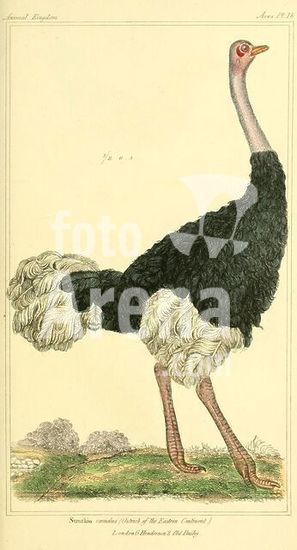
alb15331181 The animal kingdom Arranged according to its organization Serving as a foundation for the natural history of animals v.1 plates London G. Henderson 1834-1837 Animals Classification Pictorial works Zoology Georges Cuvier Struthio camelus Common ostrich, An illustration featuring a large bird known for its distinctive physical characteristics, including a long neck, elongated legs, and a full body covered in black feathers with a white plumed tail. The bird's head is highlighted by a reddish area around the eye and a lighter skin tone on the neck, enhancing its unique appearance. It stands confidently on a patch of grass, surrounded by a soft landscape, showcasing its impressive stature and elegant form.
DC
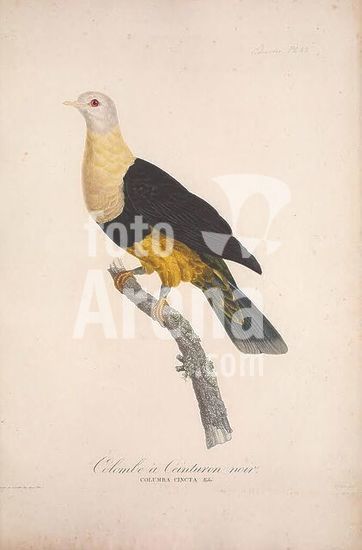
alb15337957 Les pigeons, par Madame Knip, née Pauline de Courcelles, le texte par C.J. Temminck, Paris, Chez Mme. Knip, [1838-1843?], pictorial works, pigeons, birds, A beautifully rendered illustration of a bird perched on a branch, featuring a striking combination of colors in its plumage. The bird displays a cream-colored neck and chest that transitions into a rich golden-yellow abdomen, contrasting with deep black wings. Its head is adorned with soft white feathers, accented by striking red eyes that add to its distinctive appearance. The branch on which it rests is detailed with textured bark, complementing the elegance of the avian subject. This artwork encapsulates the grace and vibrancy of wildlife in a refined manner.
DC
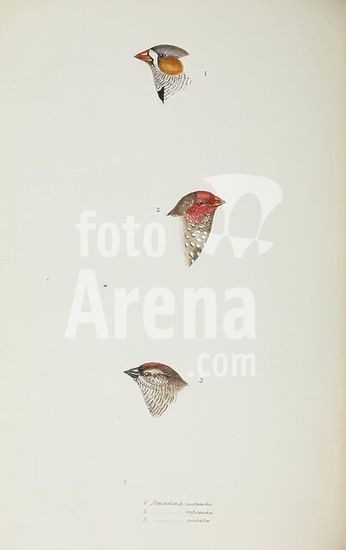
alb15337985 A synopsis of the birds of Australia, and the adjacent Islands. London: John Gould, 1837. Australia, Birds, Museum Victoria, Gould, Amadina castanotis, Amadina ruficauda, Amadina modesta, Elizabeth Gould, Artist:, Taeniopygia guttata, Australian Zebra Finch, Neochmia ruficauda, Star Finch, Plum-headed Finch, Neochmia modesta, Australia, Gould, Gould AU, Ornithology, John Gould, Elizabeth Gould, Women in Science, The illustration depicts three distinct bird heads, each intricately detailed and labeled with corresponding numbers. The top bird features a conical yellow and gray beak with a striking pattern, while the middle head showcases a rich red hue and unique speckling on its neck. The bottom bird presents a more subdued head with a distinctive shape and coloration. Each head reveals specific characteristics, emphasizing the diversity in avian species. The meticulous rendering highlights the intricate details of plumage and beak structure, inviting close examination of these fascinating creatures.
DC
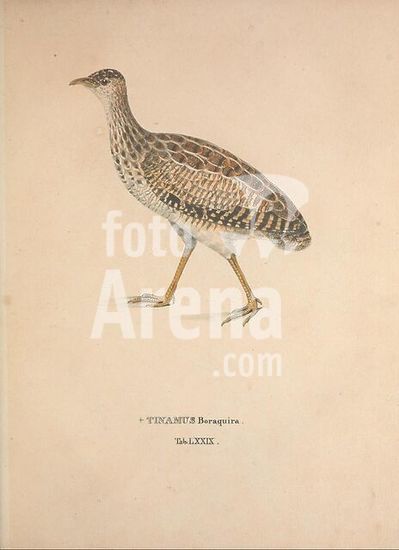
alb15330646 Avium species novae, quas in itinere per Brasiliam annis MDCCCXVII-MDCCCXX, Monachii, Typis Franc. Seraph. Hübschmanni, 1824-1825. Brazil, birds, tax, pictorial works, description and travel, Nothura boraquira, Tinamus boraquira, A detailed illustration of a bird, specifically the Pitaranotur borarquinus, presented in a side profile view. The bird exhibits a unique plumage pattern characterized by intricate designs in earthy tones, which include stripes and spots that enhance its natural camouflage. Its long, slender legs are depicted in a light golden hue, providing a striking contrast to the bird's body. This avian species showcases a rounded belly and a prominent neck, with the head held high, presenting a curious demeanor. Accompanying the illustration is a labeled title indicating the species name, adding to the scholarly feel of the representation.
DC
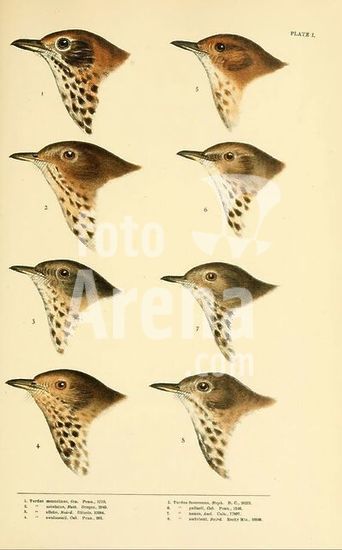
alb15381323 A history of North American birds Boston Little Brown 1905 birds North America, A detailed illustration displaying various angles and features of a bird's head. The depiction showcases the intricate patterns and textures on the feathers, emphasizing the bird's distinct coloration around the eyes and throat. Each numbered section highlights subtle differences in anatomy, helping to understand the bird's structure. The labels indicate specific species and provide scientific classification information, enriching the viewer's knowledge of avian diversity.
DC
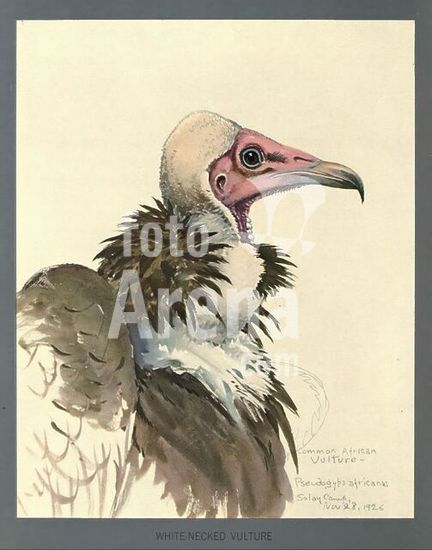
alb15381651 Album of Abyssinian birds and mammals Chicago, Field Museum of Natural History, 1930 birds, Ethiopia, mammals, pictorial works, Urbana, Champaign, Necrosyrtes monachus, Louis Agassiz Fuertes, Pseudogyps africanus, Gyps africanus, arthropod, Louis Agassiz Fuertes, white-backed vulture, Ethiopia, ornithology, This illustration features a White-necked Vulture, showcasing its distinctive features with a focus on the head and upper body. The bird exhibits a striking contrast of colors, with a prominent bare pink head and neck, surrounded by dark feathers that extend from the shoulders to the wings. Its beady eyes are intense and observant, adding to its imposing presence. The soft, textured detailing of the feathers highlights the vulture's unique characteristics, while the careful shading provides depth to the anatomy. An inscription notes the species name, *Pseudogyps africanus*, along with the date, November 28, 1926, hinting at its historical context and significance in ornithological study.
DC
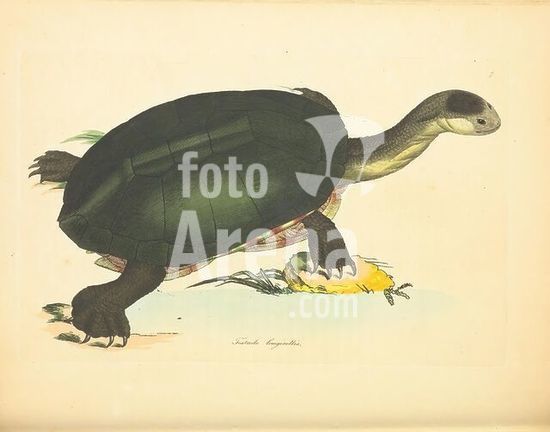
alb15385168 Zoology of New Holland, Vol. 1, London, Printed by J. Davis, published by J. Sowerby, 1794, animals, Australia, pictorial works, zoology, Museums Victoria, James Sowerby, Testudo longicollis, eastern long-necked turtle, Chelodina longicollis, Australia, A detailed illustration depicts a turtle oriented in a unique pose, showcasing its rounded, textured shell with a rich green hue and prominent ridges. Its head, characterized by an elongated neck, stretches out towards the viewer, while the turtle's legs are extended, suggesting movement. Clutched in its front limb is a bright yellow creature resembling a tooled pineapple, featuring spiky details and vibrant coloration. The background subtly fades to a lighter hue, allowing the turtle and its intriguing catch to stand out dramatically, emphasizing the harmony of nature and its diverse inhabitants.
DC
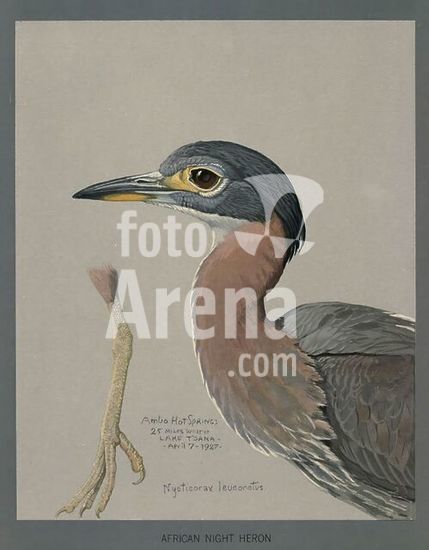
alb15385554 Album of Abyssinian birds and mammals Chicago, Field Museum of Natural History, 1930. birds, Ethiopia, mammals, pictorial works, Urbana, Champaign, Gorsachius leuconotus, Louis Agassiz Fuertes, Nycticorax leuconotus, blat10, Louis Agassiz Fuertes, White-backed Night Heron, Ethiopia, ornithology, A beautifully rendered study of the African Night Heron, showcasing its distinct features and plumage. The illustration captures the bird's striking head with piercing eyes and a delicate neck, highlighting the intricate details of its feathers. To the side, a detailed depiction of one clawed foot emphasizes the unique structure and form of its toes. Below the illustration, the date 'April 7, 1927,' and the location 'Amilo Hot Springs, 25 miles from Tarzana' are noted, providing context to this elegant portrayal of wildlife. The artist's meticulous attention to the bird's anatomy and environment reflects both scientific observation and artistic skill.
DC
alb15385208 The birds of Great Britain, 1795-1801, museum of comparative zoology,, The illustration depicts a tall bird with a slender neck and a long, pointed beak. Its body features a blend of light and dark feather patterns, with a prominent white chest that contrasts against the darker plumage on its back. The bird stands in a poised position, with its head held high, showcasing a distinctive red eye that adds a touch of vibrancy. The surrounding area is softly shaded, emphasizing the elegance and grace of the bird's form. The image captures the essence of natural beauty, illustrating the intricate details of the bird's anatomy and plumage.
DC
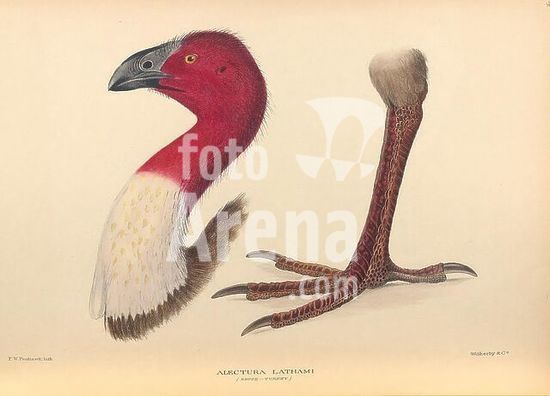
alb15385226 The birds of Norfolk & Lord Howe Islands and the Australasian South Polar quadrant, London, H.F. & G. Witherby, 1928, Antarctica, birds, Lord Howe Island NSW, Norfolk Island, Museums Victoria, Gregory M. Mathews, Gregory Mathews, ornithology, Alectura lathami, Australian Brush-turkey, The illustration features a detailed depiction of a bird's head and a foot. The head displays vibrant colors, including rich reds and whites, with a prominent beak that suggests a strong feeding adaptation. The neck transitions smoothly into fluffy plumage, emphasizing the bird's distinctive features. Below, the foot showcases intricately designed claws that suggest the bird is adapted for a particular habitat or hunting method, indicating its ecological niche. The overall composition highlights the anatomical details and showcases the beauty of avian diversity.
DC
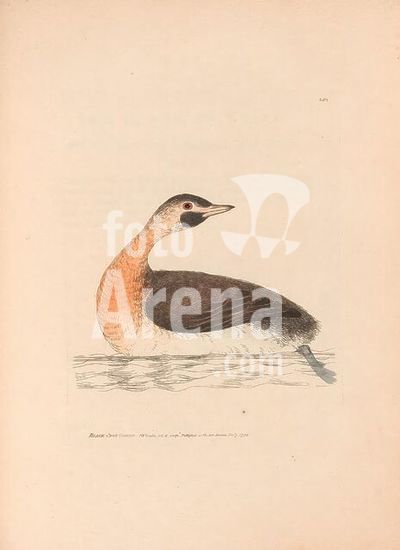
alb15386381 The birds of Great Britain, 1795-1801, Museum of Comparative Zoology, The illustration features a detailed depiction of a waterfowl, showcasing its graceful profile. The bird's head is elegantly shaped with a slender neck leading to a plump body. Its plumage transitions from a warm, reddish-brown on the chest to a darker shade on the back. The bird is partially submerged in water, with gentle ripples around it, adding to the serene nature of the scene. Fine lines and delicate shading capture the texture of the feathers, while a soft outline highlights the bird's features. The background remains subtle, allowing the focus to remain on the waterfowl's striking appearance.
DC
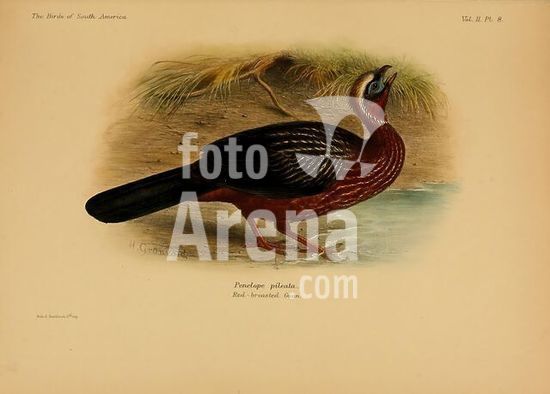
alb15387090 The birds of South America London, R. H. Porter [etc, 1912] South America, birds, guan, Penelope pileata, A detailed illustration of a Red-breasted Goose (Penelope piletata), displaying its striking plumage. The bird stands upright beside a water source, showcasing a rich and vibrant chestnut breast contrasted by dark, iridescent feathers on its back and wings. The head features distinct coloring, with a highlighted neck area that draws attention. The surrounding environment includes hints of grassy texture, indicating a natural habitat. This depiction captures the elegance and distinct characteristics of this fascinating species.
DC
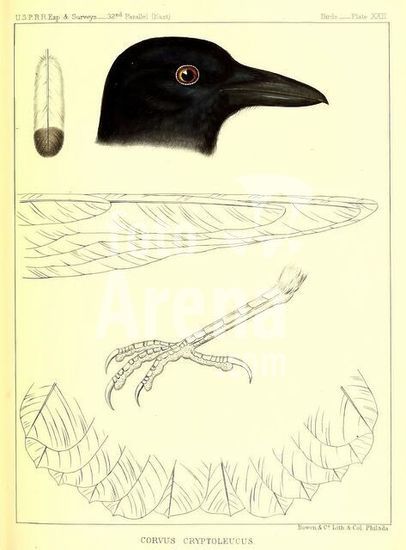
alb15388645 The birds of North America Philadelphia, J.B. Lippincott & Co, 1860, birds, North America, ornithology, bird feathers, Corvus cryptoleucus, white-necked crow, Chihuahuan raven, This illustration features an ornithological study of the Corvus cryptoleucus, commonly known as the white-necked raven. At the top, a detailed depiction of the raven's head showcases its piercing black eye and the smooth texture of its feathers. Below, an elegantly rendered wing displays the intricate patterns of its plumage, highlighting the curvature of the feathers. To the side, a close-up of a bird's claw reveals the sharp talons designed for gripping, with delicate lines capturing its texture. This intricate artwork serves as a scientific reference, emphasizing the beauty and anatomical features of this avian species.
DC
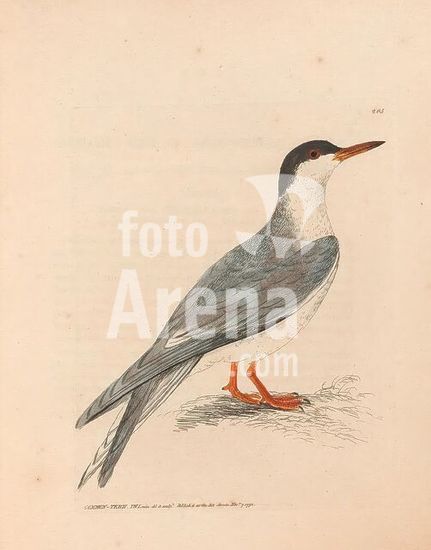
alb15386780 The birds of Great Britain, 1795-1801, Museum of Comparative Zoology, A detailed illustration of a bird featuring a slender body with a prominent long beak. The bird showcases a striking combination of light gray and soft blue feathers on its back, while the underparts are a clean white. Its head is characterized by a distinctive black cap, contrasting with a white face and throat. The legs are a vibrant orange, and the bird stands poised atop a small nest-like structure on a subtle textured background. The illustration captures the elegance and grace of this avian species, emphasizing its natural beauty and unique coloration.
DC
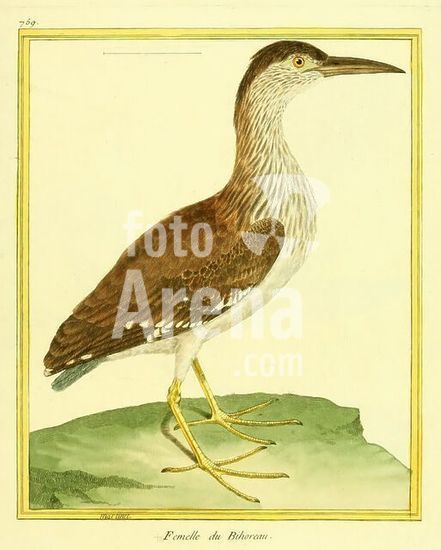
alb15383335 Planches enluminées d'histoire naturelle, Paris?, s.n, 1765-1783?, birds, pictorial works, zoology, This illustration features a striking bird characterized by its elongated neck and slender body. Its plumage displays a rich brown color on the wings and back, complemented by intricate patterns of lighter shades. The bird stands on long, slender yellow legs atop a small green rock formation, emphasizing its elegant stature. The head is adorned with fine stripes, highlighting its sharp, pointed beak which is well-suited for foraging. The overall composition showcases the bird in a side profile, allowing for a clear view of its distinctive features and posture. The caption includes the name 'Fémelle du Bihoreau,' indicating its identification in a scientific context.
DC
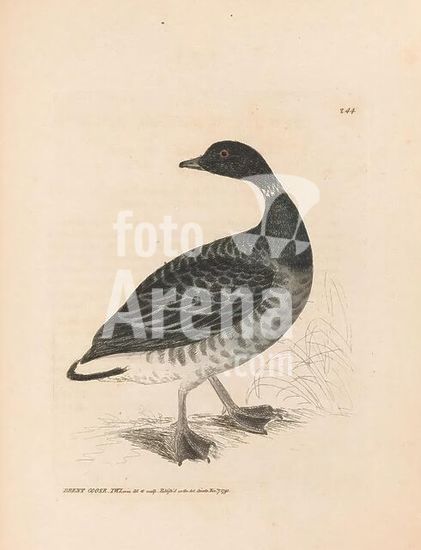
alb15382085 The birds of Great Britain, 1795-1801, Museum of Comparative Zoology,, A detailed illustration of a bird known as the 'Hen Goose,' characterized by its distinctive plumage featuring shades of gray and black. The bird stands upright, showcasing its slender neck and stout body. Its head displays a subtle eye, while the intricate pattern of its feathers highlights the artistry of ornithological studies. The background hints at natural elements, emphasizing the bird's habitat, offering a glimpse into its environment. This study captures the elegance and form of the Hen Goose, contributing to the understanding of avian species.
DC
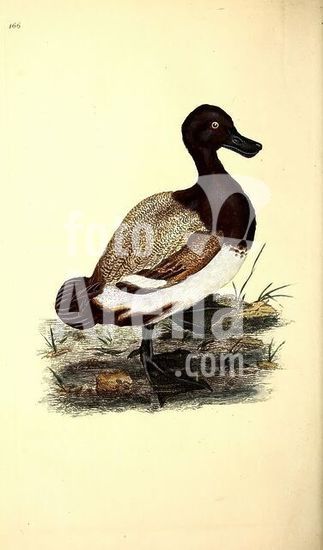
alb15389642 The Natural History of British Birds Or A Selection of the Most Rare Beautiful and Interesting Birds Which Inhabit This Country London Printed for the Author And for F. and C. Rivington 1794-1819 Birds Great Britain Identification, A beautifully illustrated depiction of a duck, showcasing its distinctive features. The bird displays a rich chestnut and brown plumage on its head and neck, contrasting with its lighter body, which has intricate feather patterns. Its eye is bright and prominent, adding to its expressive appearance. The duck stands gracefully on a patch of grass, with its feet firmly planted on the ground, suggesting a sense of alertness and poise. This representation captures the essence of the species with meticulous attention to detail, highlighting the natural beauty of its form.
DC
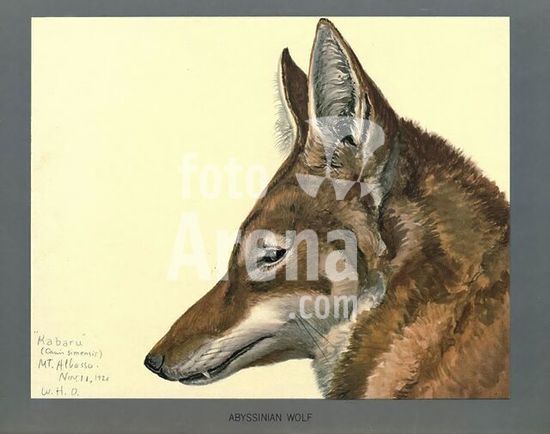
alb15389640 Album of Abyssinian Birds and Mammals Chicago, Field Museum of Natural History, 1930, birds, Ethiopia, mammals, pictorial works, Urbana, Champaign, canissimensis, Louis Agassiz Fuertes, Earth Day, arthropod, Louis Agassiz Fuertes, Ethiopian Wolf, Ethiopia, A detailed illustration of an Abyssinian wolf, showcasing its prominent features in profile. The animal is depicted with a streamlined head and elongated ears, emphasizing its keen sense of hearing. The fur is rendered in warm shades, highlighting a rich mix of browns and subtle cream accents along the muzzle and neck. The background is kept simple, allowing focus on the wolf's expressive eyes and sharp facial structure. Accompanying the artwork, handwritten notes provide the species name, "Kabaru (Canis simensis)," along with the date of November 11, 1922, and the initials of the artist, adding a historical context to this captivating representation of the Abyssinian wolf.
DC
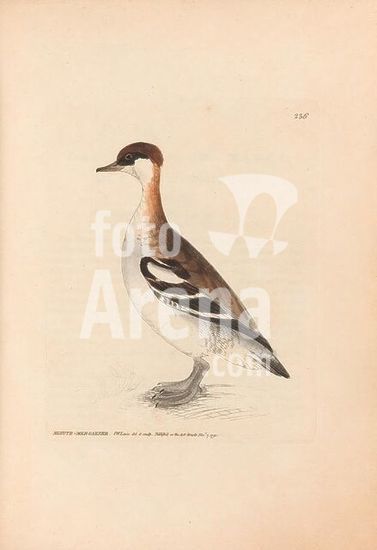
alb15389470 The natural history of British birds, or A selection of the most rare, beautiful and interesting birds which inhabit this country, London, Printed for the author and for F. and C. Rivington, 1794[-1819], birds, Great Britain, identification, A beautifully illustrated waterfowl stands prominently, showcasing its striking features. This bird exhibits a rich reddish-brown plumage on its head and neck, transitioning to darker shades on its body. The wings are adorned with a distinct white patch, contrasting elegantly with the overall coloration. It is poised on a rocky terrain with lush green vegetation that adds a touch of natural beauty to the scene. The detail in the feathers and the surrounding elements reflects a keen observation of the bird's habitat, emphasizing its graceful stance and the intricate textures of both the bird and the landscape.
DC
alb15388794 Catalogue of shield reptiles in the collection of the British Museum, London, 1855-1872, England, London, turtles, reptiles, crocodilians, Testudinidae, Amphisbaenia,, Chelonia genus, The illustration features a detailed study of a turtle, showcasing three distinct views: a top view highlighting its shell and limbs, a side profile that captures its elongated neck and unique head shape, and a bottom view emphasizing the texture of its shell and feet. Each perspective is meticulously rendered, allowing for a comprehensive understanding of the turtle's anatomy and structure. The emphasis on detail brings attention to the intricate patterns on its shell and the positioning of its limbs, reflecting the creature's adaptation to its environment.
DC
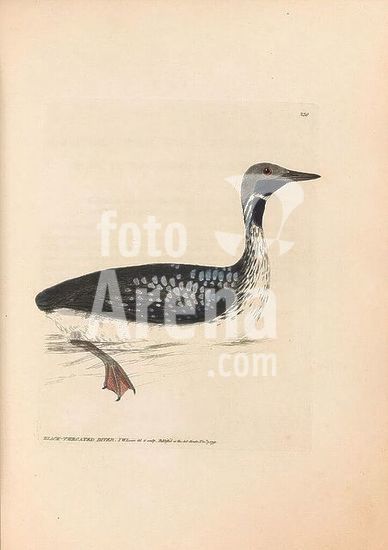
alb15381046 The birds of Great Britain, 1795-1801, Museum of Comparative Zoology., A detailed illustration of a bird, showcasing its elegant profile. The bird features a long neck, a slender body, and a striking plumage marked by a contrast of deep black and iridescent blue spots. Its head is adorned with a subtle gray hue, highlighting the sharp, piercing red eye. The bird's slender legs are partially visible, suggesting grace and agility, while the depiction captures the essence of its natural habitat. Text accompanying the illustration provides information about the species, adding context to its environment and characteristics.
DC
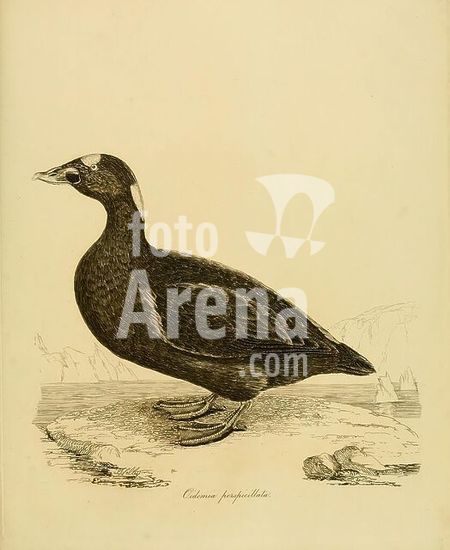
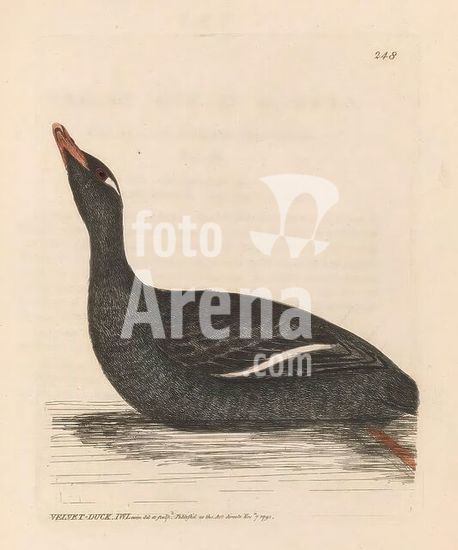
alb15380942 Sir William Jardine's illustrations of the duck tribe. Dumfries, N.B, Privately printed at the expense of the author [1840?]. Ducks, surf scoter, pictorial works, Melanitta perspicillata, A detailed illustration of a duck-like bird, showcasing its distinctive features. The creature stands with a stout body, short neck, and a rounded head, highlighting a prominent white marking on the front of its head. Its plumage is predominantly dark, displaying subtle textural details that suggest a glossy sheen. The bird's beak is short and slightly curved, perfect for its feeding habits. Below, the setting includes a rocky shoreline and hints of water, suggesting a coastal habitat where this species might thrive. The scientific name, 'Calidris pusilla,' is elegantly inscribed beneath the depiction, indicating its classification.
DC
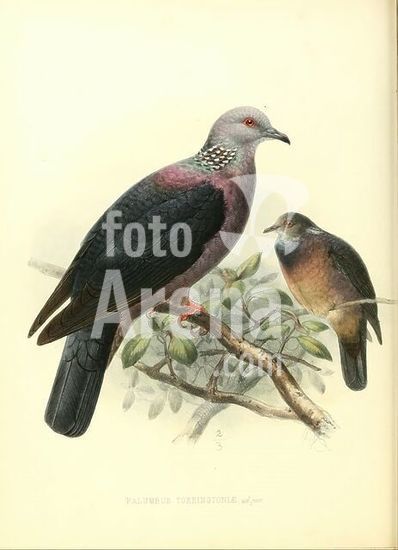
alb15386981 A history of the birds of Ceylon, London, Published by the author 1880 (i.e. 1878-1880), birds, Sri Lanka, Ceylon, Palumbus torringtoniae, A detailed illustration of two pigeons perched on a branch, showcasing their unique plumage. The larger bird on the left displays a blend of iridescent colors, with a purplish body, dark wings, and a distinctive spotted neck. Its stance is elegant, with a slight tilt of the head, suggesting alertness. Next to it, a smaller pigeon features a more subdued color palette, with muted tones that complement its counterpart. Both birds are surrounded by delicate foliage, enhancing the natural setting. The illustration is labeled 'Palumbus torringtoniae,' indicating the species name, and reflects a meticulous attention to detail in the portrayal of their features and the textures of the leaves.
DC
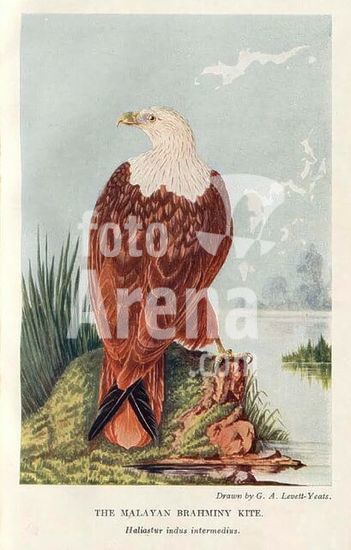
alb15384897 The, birds, of, Singapore, Island, Singapore, Printed, at, the, Govt, Print, Office, by, W. T. Cherry, Govt, Printer, 1927, birds, Singapore, bird, Asia, hlat10, Gerald, Aylmer, Levett, Yeats, taxonomy, trinomial, haliastur, indus, intermedius, 8, A majestic Malayan Brahminy Kite stands prominently on a rocky ledge, its impressive wings folded gracefully against its body. The bird's striking plumage showcases a transition from deep chestnut to creamy white on its head and neck. In the foreground, a small hunting trophya fishlies beside the kite, hinting at its role as a skilled predator. The serene waters and lush greenery in the background create a tranquil setting, emphasizing the kite's regal presence and natural habitat. Below the illustration, the title identifies the bird and includes its scientific classification, adding an informative touch to this representation of wildlife.
DC
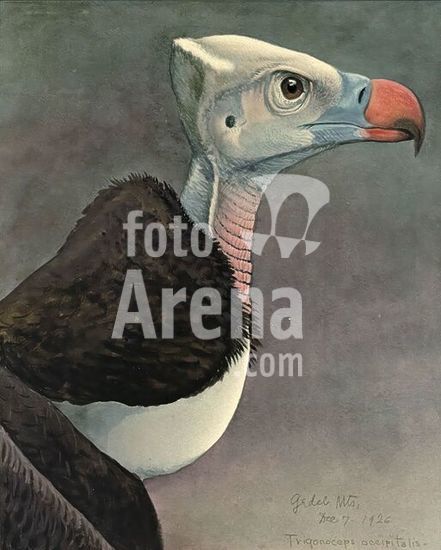
alb15384827 Album of Abyssinian birds and mammals Chicago Field Museum of Natural History 1930 birds vulture Ethiopia mammals pictorial works, A detailed illustration of a large vulture with a distinctive profile. The bird displays a robust body covered in dark feathers, while its head is notably striking with a pale, elongated beak that curves downward. The vulture's skin around the neck and head has a pinkish hue, contrasting with the deep black of its plumage. The background is softly shaded, enhancing the vulture's regal stance and unique features. Below the illustration, there's a date inscribed, "Dec. 7, 1926," along with the scientific name, "Trigonoceps coarctatus," indicating the species known for its remarkable adaptation to scavenging.
DC
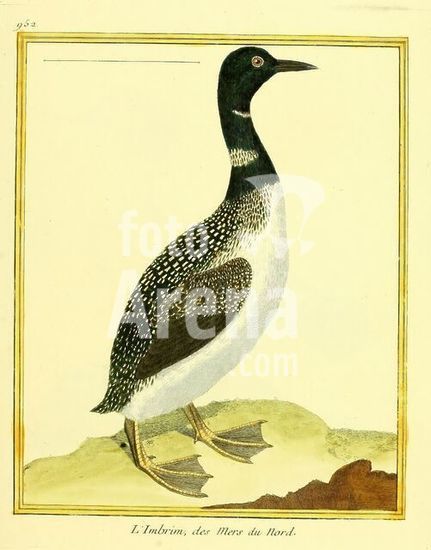
alb15388538 Planches enluminées d'histoire naturelle, Paris, s.n, 1765-1783, birds, pictorial works, zoology, A striking depiction of a bird characterized by its long neck and distinctive markings. The body features a blend of rich black and white hues, with intricate detailing that highlights the texture of its feathers. The head showcases a vivid eye set against a dark crown, and the throat transitions to a lighter shade, enhancing its elegant profile. The bird stands on a textured surface resembling rocky terrain, adding depth to the composition. Below the illustration, the caption identifies this species as 'L'Imbrin, des Mers du Nord,' suggesting its connection to northern marine environments. The artwork combines scientific observation with artistic expression, capturing the essence of this avian subject.
DC
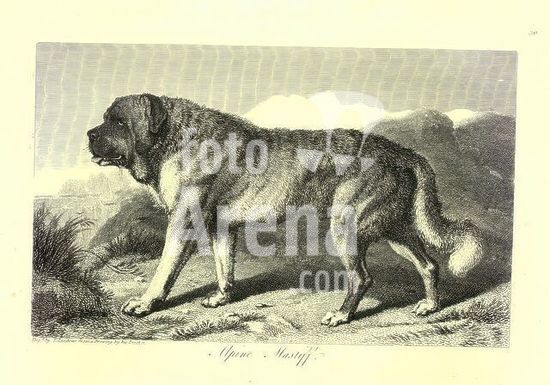
alb15388542 Engravings of lions, tigers, panthers, leopards, dogs, &c. London, H. G. Bohn, 1853. Animal painting and illustration, animals, pictorial works, taxonomy: trinomial = canis lupus familiaris, alpine mastiff, dog, dogs, canis lupus familiaris, dog breed, dog breeds, mammal, mammals, zoology, A large, strong dog stands confidently in profile, showcasing its muscular build and sturdy legs. The breed is characterized by a broad head and a thick neck, with fur that appears dense and coarse. Its expression is alert yet calm, exuding a sense of loyalty and strength. The background features a rugged landscape, hinting at an outdoor environment with rolling hills, which complements the dog's robust stature and heritage. The overall composition conveys the impressive presence of this noble canine.
DC
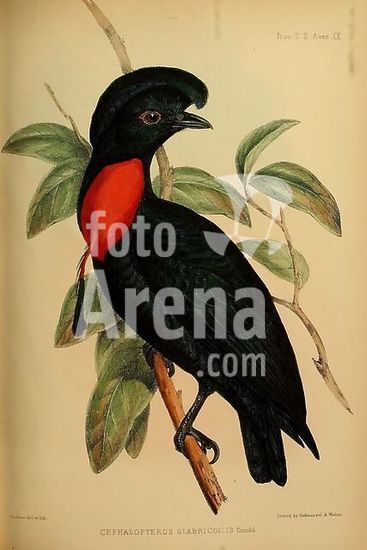
alb15381455 Proceedings of the Zoological Society of London, London, Academic Press Periodicals, Zoology, Museum of Comparative Zoology, A beautifully illustrated bird perched on a branch, showcasing striking features. The bird's plumage is predominantly black, with a vibrant red patch at the throat, adding a vivid contrast to its sleek appearance. Its head is notably adorned with a rounded crest, giving it a distinguished look. The surrounding foliage includes green leaves that complement the bold colors of the bird, creating a harmonious natural scene. This depiction captures the elegance and unique characteristics of the species, emphasizing its status in the avian world.
DC
alb15386205 The Birds of Great Britain, 1795-1801, Museum of Comparative Zoology, A detailed illustration of a North American waterfowl, showcasing its slender form and distinctive features. The bird stands upright, displaying a smooth neck and a blend of rich brown, white, and black plumage. The head is characterized by a striking contrast between the brown crown and a white cheek patch, while the body features elongated wings that hint at its graceful flight. Its legs are positioned firmly on the ground, emphasizing its readiness for movement. The background includes subtle detailing that enhances the focus on this elegant creature, which is depicted with precision and care, highlighting both its physical traits and natural grace.
DC
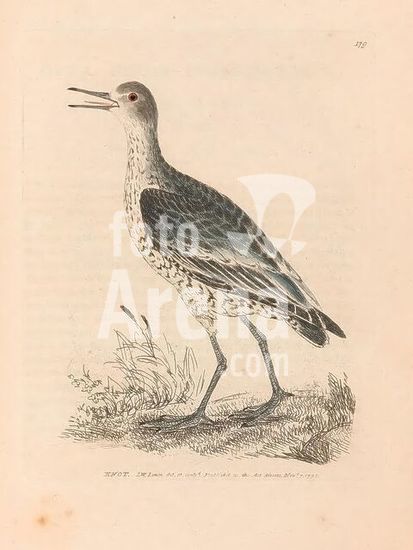
alb15386272 The birds of Great Britain, 1795-1801, museum of comparative zoology, The illustration features a wading bird characterized by its slender body and long legs, standing gracefully on a patch of grass. Its plumage exhibits a mix of speckled patterns and subtle shades, providing effective camouflage among natural environments. The bird's head is slightly turned, showcasing a distinctively pointed beak and a series of small, dark spots along its throat. The background is minimally detailed, allowing the focus to remain on the bird, which appears attentive and poised, possibly in search of food or surveying its surroundings. The edges of the illustration are slightly weathered, hinting at its history and the artistic hand that created it.
DC
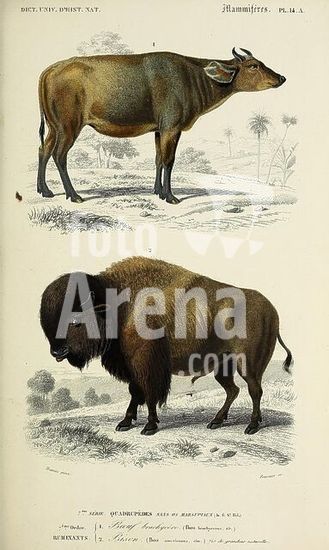
alb15381952 Dictionnaire universel d'histoire naturelle, Paris, Chez les editeurs MM. Renard, Martinet et cie, rue et Hotel Mignon, 2 (quartier de l'École-de-Médecine), 1847-1849, Botany, Dictionaries, Natural History, Pictorial Works, Science, Zoology, Mammal, The illustration features two distinct mammals set against a natural backdrop. On the left, a tall and slender creature resembling a giraffe stands gracefully, its long neck and shaped head prominent. Its body is adorned with patches that blend into the serene landscape, which includes faint trees and grass. On the right, a robust figure depicts a bison, characterized by its muscular build and distinctive hump. The bison's shaggy coat is detailed with texture, while its strong horns jut outward, giving it a fierce demeanor. The contrasting features of these two animals emphasize the diversity in the mammalian kingdom, highlighting their unique adaptations to their environments.
DC
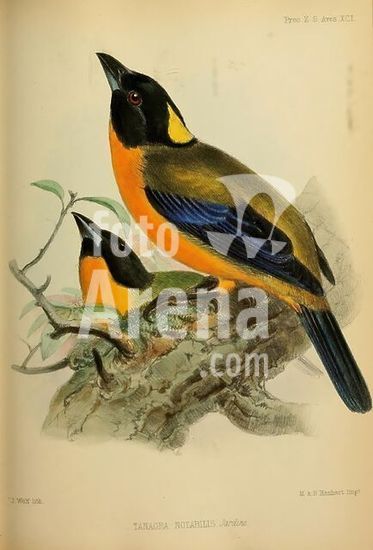
alb15388474 Proceedings of the Zoological Society of London, London, Academic Press periodicals, zoology, Museum of Comparative Zoology, birds, A vibrant depiction of two beautifully illustrated birds perched on a branch. The upper bird showcases a striking combination of bright yellow and deep blue plumage, highlighted by a contrasting black head and throat. Its companion, slightly lower, displays similar colors but with a more subdued appearance. The surrounding foliage hints at their natural habitat, enhancing the overall scene of avian elegance and tranquility. This artwork captures the intricate details of their feathers and the delicate textures of the branch they occupy, showcasing the beauty of these songbirds in nature.
DC
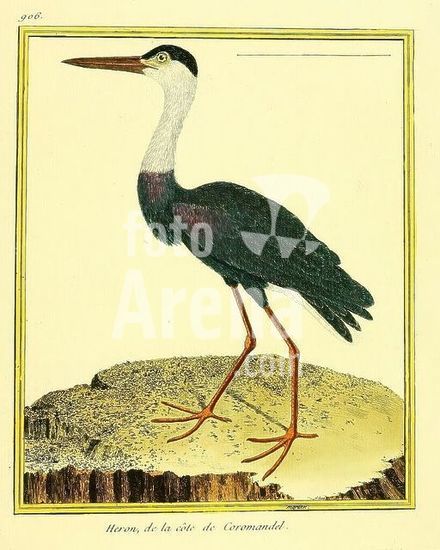
alb15380076 Planches enluminées d'histoire naturelle Paris Pictorial works Zoology Birds, A striking illustration of a heron, showcasing its elegant silhouette and distinctive features. The bird stands tall on a rocky surface, exhibiting a long neck and slender legs, painted in a combination of deep blues and purples. Its head is adorned with a stark white face and a black cap, while the long, pointed beak adds to its graceful appearance. The detailed depictions of the feathers highlight the heron's natural beauty, making it a captivating representation of this shore-dwelling species. The caption notes its origin, referring to the specific region it inhabits, further emphasizing its environmental context.
DC
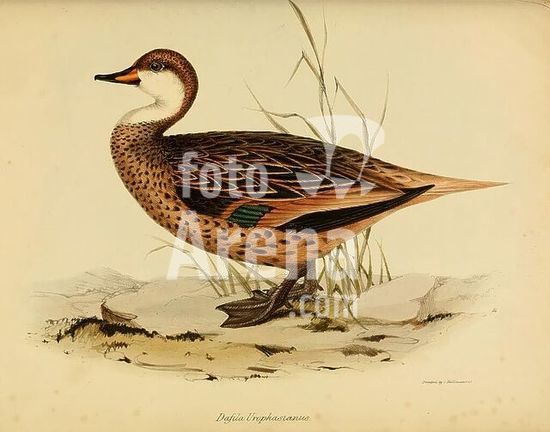
alb15380060 A monograph on the Anatidae, or duck tribe, London, Longman, Orme, Brown, Green, & Longman and Eddowes, Shrewsbury, 1838, Anatidae, Anas bahamensis,, A beautifully illustrated waterfowl depicted in a poised position, showcasing intricate feather patterns that vary in shades of brown and chestnut. The bird's long neck and distinctive head, featuring a white patch and dark crown, highlight its elegant form. Surrounding the duck, delicate grasses and natural elements enhance the overall composition, suggesting its habitat. This artwork captures the essence of the species, emphasizing both its grace and the detailed artistry of the representation.
DC
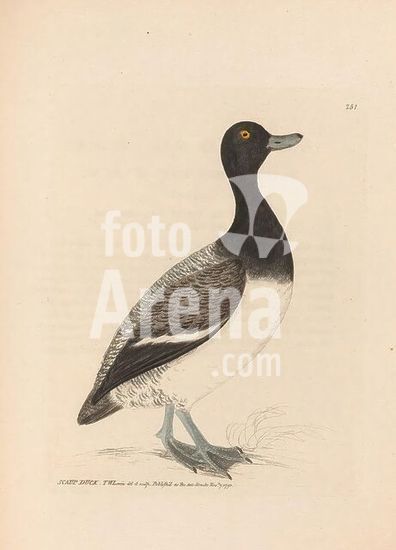
alb15389393 The birds of Great Britain, 1795-1801, museum of comparative zoology, A detailed illustration of a duck, prominently featuring its elegant form and distinct coloration. The bird stands upright, showcasing its slender neck and defined body. The head is dark with a striking yellow eye that draws attention, while the rest of the plumage exhibits a mix of textures and shades. The chest is predominantly white, contrasting with the darker tones of the back and wings. The webbed feet are slightly elevated, indicating the bird's readiness to move. This artistic representation captures the grace and beauty of the duck, surrounded by a hint of natural elements at its base.
DC
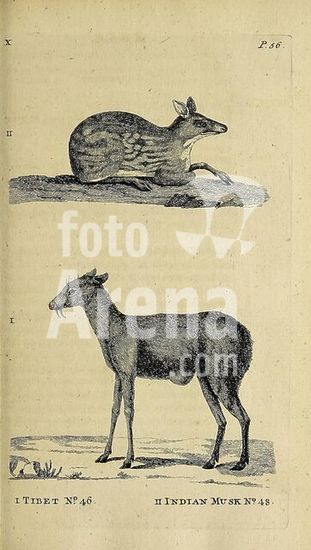
alb15383003 Synopsis of quadrupeds, Chester, Printed by J. Monk, MDCCLXXI [1771], early works, mammals, musk deer, The illustration features two distinct depictions of deer-like animals. The upper section shows a small, stocky creature resting on its front, characterized by its spotted fur and short legs. Its body posture conveys a sense of calmness. The lower section presents another species, standing upright with a more elongated body and prominent features. This second animal has a sleek appearance, with a slightly elongated neck and a smaller head compared to its body. The background is minimal, focusing attention on the anatomical details of each animal. Below the illustrations, labels indicate the respective identities of the creatures as 'Tibet N° 46' for the upper animal and 'Indian Musk N° 48' for the lower one.
DC
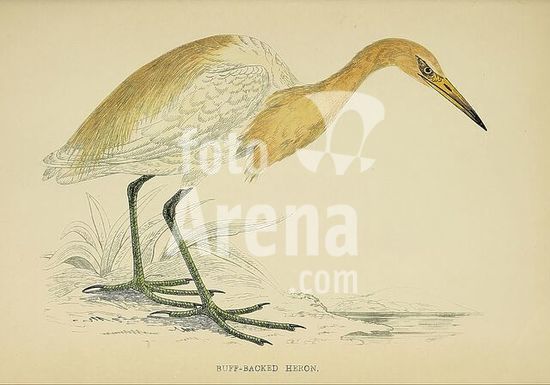
alb15383057 A history of British birds.1863-1866?, birds, Great Britain, bird, The illustration showcases a graceful bird, characterized by its elongated neck and sharp beak, set against a simple background. The creature features a predominantly white plumage, with distinctive soft golden hues accentuating its neck and head. Its posture conveys elegance as it gazes into the distance. In the foreground, a cluster of slender green vegetation adds a touch of nature, enhancing the serene ambience of the composition. The artist's attention to detail is evident in the feather textures and the careful rendering of the bird's form.
DC
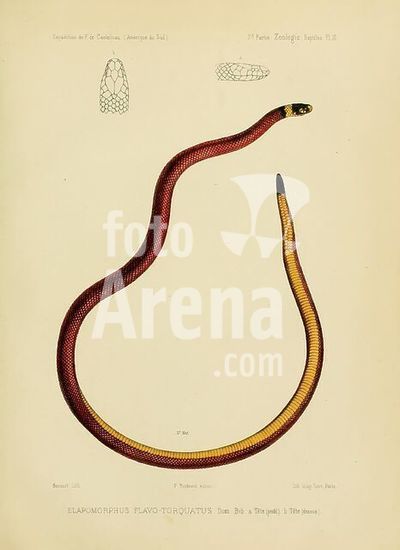
alb15386067 Expédition dans les parties centrales de l'Amérique du Sud, Paris, Chez P. Bertrand, 1850-1859., A detailed illustration of a snake species, showcasing its elongated body and distinctive coloration. The snake features a striking pattern of bright red and black bands, emphasizing its unique morphology. The head is elegantly shaped, tapering off into a slender neck, with the eyes clearly defined. Accompanying the illustration are scientific labels detailing its classification: 'Elapomorphus flavo-torquatus' and reference to its habitat in South America. The image also includes an outline of an egg, likely belonging to the species, emphasizing aspects of its reproductive biology.
DC
alb15386019 Illustrations of ornithology, Dublin, Longman, Rees, Orme, Brown, & Green, and S. Highley, 1826-1835, birds, pictorial works, collection and preservation, arsenic compounds, The illustration features a elegant aquatic bird known for its long neck and slender body, depicted in a graceful pose. Its plumage showcases intricate detailing that emphasizes the texture and patterns on its feathers, particularly around the neck and wings. The bird stands on a textured surface, hinting at its natural habitat, which typically includes lakes and rivers. The slender, elongated neck leads to a delicate head with a pointed beak, ideal for catching fish. This species is often associated with its distinctive diving abilities and is captured in a moment of poised stillness, representing the beauty of avian life.
DC
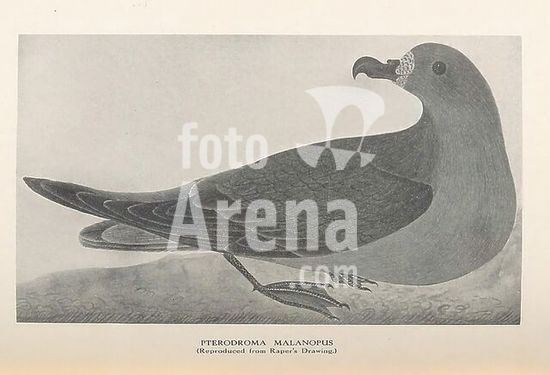
alb15386533 The, birds, of, Norfolk, &, Lord, Howe, Islands, and, the, Australasian, South, Polar, quadrant, London, H.F. & G. Witherby,1928, antarctica, birds, Lord Howe Island NSW, Norfolk Island, Museums Victoria, Gregory M. Mathews, Gregory Mathews, ornithology, Pterodroma malanopus, Melanopus, Pterodroma solandri, Providence Petrel, Pterodroma malanopus, The illustration features a detailed depiction of a bird, notable for its distinct shape and features. The bird is shown perched elegantly on a branch, with its head tilted slightly, giving it a contemplative pose. Its plumage is finely rendered, showcasing a smooth, rounded head that transitions into a sleek neck and body. The wings are depicted with intricate detailing, suggesting texture and movement. The bird's eye is prominent, indicating an alert expression, while its beak curves sharply, adding to its unique profile. Surrounding the bird, subtle elements of foliage enhance the natural setting of this captivating avian representation.
DC
alb15388020 A detailed illustration of a large, elegant bird standing on a patch of grass. The bird displays a long neck and a distinctively shaped head, featuring a small crest atop. Its plumage is rendered with intricate shading, showcasing a mix of dark and lighter feathers that create a striking contrast. The legs are slender and elongated, contributing to the bird's graceful appearance. This illustration captures the essence of the species, highlighting its unique physical characteristics and natural posture.
DC
alb15388082 The, birds, of, Great Britain, 1795-1801, museum of comparative zoology, A detailed illustration depicting a side view of a duck-like bird, characterized by its elongated neck and distinct plumage. The body is mostly dark with hints of a lighter stripe running along the wing, while the head features a striking red-orange bill. The bird is positioned gracefully against a plain background, exuding a sense of calmness and elegance in its pose. The surrounding environment suggests a habitat close to water, capturing the essence of the species' natural behavior. The overall composition highlights the intricate details of the bird's features and colors, making it a captivating representation of avian life.
DC
alb15382988 The birds of Great Britain, 1795-1801, Museum of Comparative Zoology, A detailed illustration of a waterfowl, characterized by its slender neck and a mottled gray plumage. The bird stands upright on a grassy bank, showcasing its distinct orange legs and webbed feet. Its head features a subtle gray hue with a lighter patch on the side, while the body is adorned with intricate patterns, highlighting the feathers' texture. This depiction emphasizes the bird's natural habitat, suggesting a serene, aquatic environment. The artwork appears to be part of an illustrated guide, likely focusing on avian species.
DC
alb15387634 The birds of Great Britain, 1795-1801, Museum of Comparative Zoology, A detailed illustration of a duck, showcasing its distinct features. The bird stands upright, displaying a sleek body with a striking contrast between its brownish chest and the lighter underbelly. The head features a prominent yellow eye that draws attention, while the neck leads down to a rounded body. The wings are partially folded, revealing a subtle pattern of dark and light shades, and the feet are webbed, ready for aquatic movement. Surrounding the duck is a hint of grass, suggesting a natural habitat by the water's edge, emphasizing its environment. The overall composition highlights the elegance of this waterfowl species.
DC
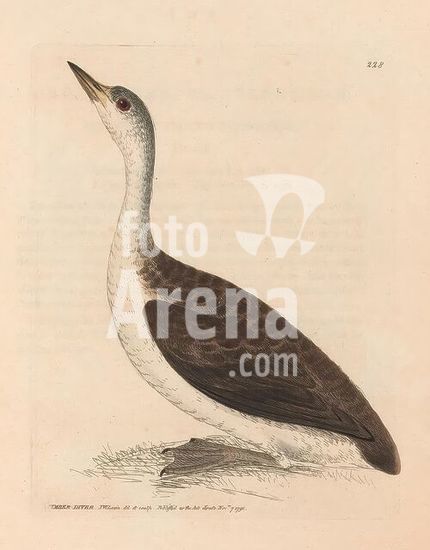
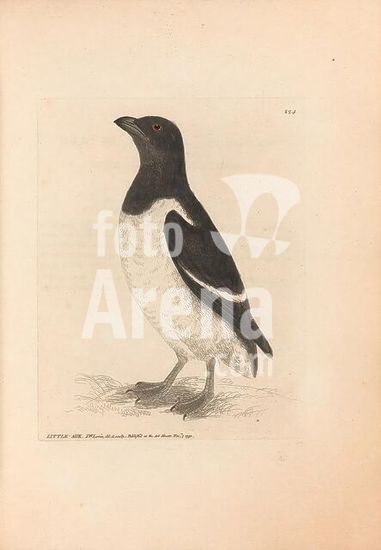
alb15388321 The birds of Great Britain, 1795-1801, Museum of Comparative Zoology, A detailed illustration of a Little Auk, showcasing its distinctive features. The bird has a predominantly white body with a prominent black head and wings. Its round, compact shape is highlighted by the slight curve of its neck. The eyes are striking with a vivid red hue, drawing attention to the bird's alert expression. The illustration captures the texture of the plumage, emphasizing the contrast between the black and white colors. This depiction is part of a larger work related to ornithology, providing insight into the characteristics of this species. The background is minimal, focusing attention on the Little Auk itself.
DC
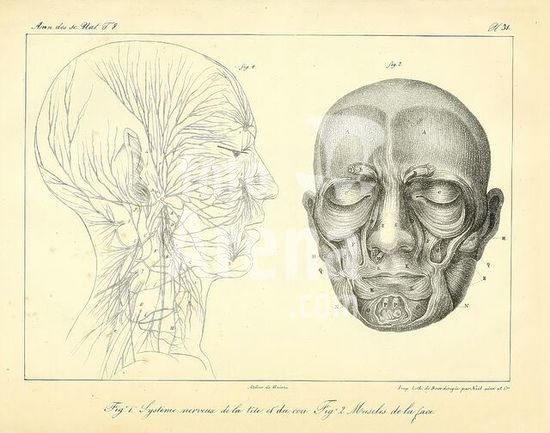
alb15385053 Annales des Sciences Naturelles Paris Crochard Anatomy Science Periodicals, This illustration features a detailed anatomical study of the human skull and facial structure. The upper section showcases a three-dimensional view of the skull, highlighting the internal components, including the brain and cranial cavities. Various labeled features indicate specific parts of the anatomy. The lower section presents a side profile of a human head, focusing on the intricate network of nerves that extends throughout the face and neck. Each part is meticulously detailed, with annotations to guide the viewer in understanding the relationship between the skeletal structure and the nervous system.
DC
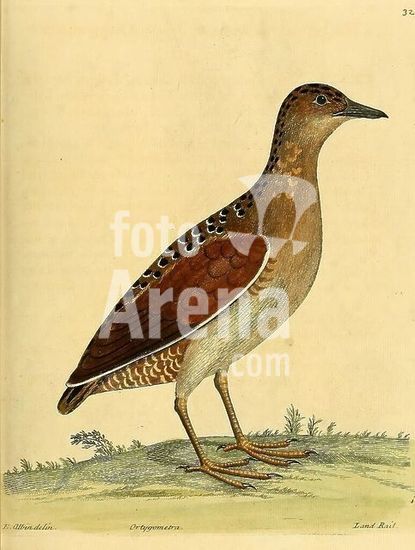
alb15380165 A natural history of birds, London, Printed for the author and sold by William Innys in St. Paul's Church yard, John Clarke under the Royal-Exchange, Cornhill, and John Brindley at the King's Arms in New Bond-Street, MDCCXXXI-MDCCXXXVIII [1731-1738], birds, pictorial works, crex crex, corncrake, Eleazar Albin, artist VZQ347904, ornithology, This illustration depicts a bird characterized by its distinctive elongated neck and slender body. The plumage features a blend of rich browns and tans, with intricate patterns of spots along the wings and back. Its facial features include a pointed beak and a delicate, rounded head, giving it an elegant appearance. The background highlights a grassy terrain, emphasizing the bird's natural habitat. This species is likely known for its ground-dwelling habits and may be associated with wetlands or marshy areas.
DC
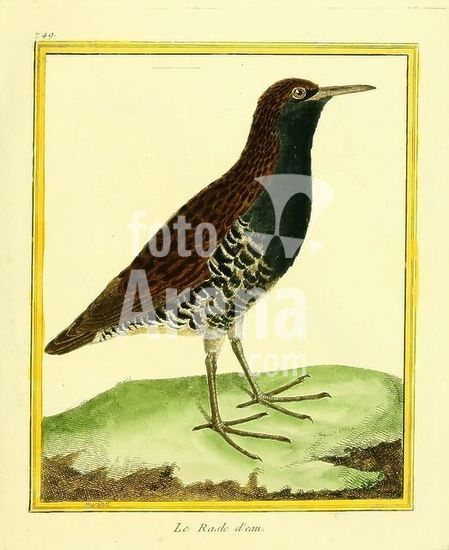
alb15380452 Planches enluminées d'histoire naturelle Paris Pictorial works Birds Zoology, A detailed illustration of a water rail, depicted with distinctive features such as a dark brown head and neck, transitioning to a vibrant chestnut plumage. The body showcases intricate patterns with streaks and spots, emphasizing its unique coloration and texture. The bird stands on slender legs, positioned on a lush green surface that accentuates its natural habitat. Its elongated beak is pointed forward, indicative of its foraging behavior. The overall composition highlights the elegant form and distinctive markings of this aquatic bird, capturing its essence in a naturalistic style.
DC
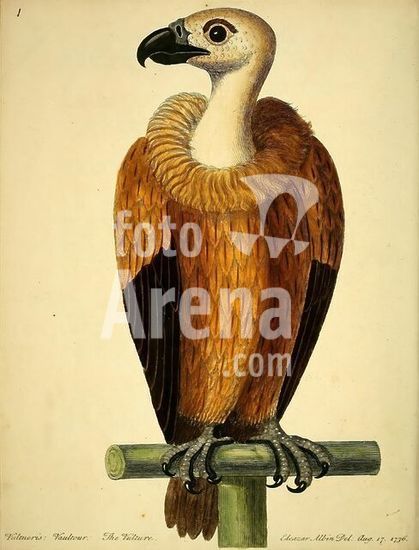
alb15387794 A, natural, history, of, birds, London, Printed, for the, author and, sold, by, William, Innys, in, St. Paul's, Church yard, John, Clarke, under, the, Royal-Exchange, Cornhill, and, John, Brindley, at, the, King's, Arms, in, New, Bond-Street, MDCCXXXI-MDCCXXXVIII [1731-1738], birds, vulture, pictorial, works, gyps, fulvus, griffon, vulture., A detailed illustration of a vulture perched on a wooden pole, showcasing its impressive plumage. The bird features a distinctive, feathered body with shades of rich browns and a contrasting lighter, downy neck collar. Its head is characterized by a bold, hooked beak and a notable lack of feathers, giving it a unique appearance. The vulture's sharp, dark eyes and strong talons suggest a sense of keen observation and readiness. Below the illustration, the title reads 'Vulturis: Vultur. The Vulture,' along with the date 'Edward M. Goll. Aug. 17, 1756,' indicating its historical significance.
DC
alb15384038 A Natural History Of Birds London Printed For The Author And Sold By William Innys In St Paul's Church Yard John Clarke Under The Royal Exchange Cornhill And John Brindley At The King's Arms In New Bond Street MDCCXXXI MDCCXXXVIII 1731 1738 Birds Pictorial Works Bantam Cock, A vividly illustrated rooster stands proudly, showcasing its striking plumage. The feathers exhibit a gradient of rich reds and vibrant oranges along its neck and body, while the tail feathers fan out dramatically, displaying a sleek black sheen. The comb on its head is prominent and bright red, complementing its cheerful expression. The backdrop features simple grass-like elements, enhancing the focus on this majestic bird. The detailed artistry captures the rooster's grandeur, reflecting its significance as a symbol of resilience and vitality.
DC
alb15384017 Planches enluminées d'histoire naturelle, Paris?, s.n, 1765-1783?, birds, pictorial works, zoology, A vibrantly colored parrot perched on a branch, showcasing a striking combination of hues. The bird features a glossy green body contrasted by a chestnut-brown head and a bright orange collar around its neck. Its beak is stout and curved, with a pale pink tone, while its tail displays a gradient of blue at the tips. This species is characteristic of tropical regions, and the illustration highlights its unique plumage and natural habitat. Below, the name 'Perroche à tête noire, de Guyane' suggests its identification and origin, reflecting the richness of wildlife in French Guiana.
DC

Total de Resultados: 790

Página 1 de 8