






















































Busque também em nossas outras coleções:

Data da imagem:
Pauta
ver mais opções...
Agência
Fotógrafo
ver mais opções...
Pais
Estado
ver mais opções...
Cidade
ver mais opções...
Local
Tipo de licença
Orientação
Coleção
ver mais opções...

Total de Resultados: 523

Página 1 de 6

975_05_SOV-B-H03020114N1 1969 leipzig spring fair, march 3, 1969, delegates of the ussr and gdr watching a demonstration of the first long-distance data transmission leipzig-moscow-leipzig (2,000km in each direction) using transmission equipment newly developed by the rafena enterprise in radeberg (gdr), a numerically controlled processing center which was directly connected via the telecommunication network with the computer center of the institute for machine tool engineering (enims) in moscow, seated in the first row (r to l) are v,a, kirillin, deputy chairman of the council of ministers and chairman of the committee of the ussr council of ministers for science and technology; walter ulbricht, first secretary of the central committee of the socialist unity party of germany (sed) and gdr state council chairman; lotte ulbricht; willi stoph, gdr prime minister; ussr ambassador to gdr, p,a, abrassimov; friedrich ebert, sed cc politbureau member; and rudi georgi, minister for verarbeitungsmaschinen und fahrzeugbau of the gdr.
DC

925_07_MW023380 The Lotus Temple is a very recent architectural marvel of the Bahai faith in Delhi, India
DC
925_07_MW023378 The Lotus Temple is a very recent architectural marvel of the Bahai faith in Delhi, India
DC
955_24_413923 Wooden board with holes fitting shapes of farm animals, house and tractor, numbers from one to ten underneath.
DC
925_07_MW018248 The Shiva Temple, at the Puthia Rajbari complex, in Puthia, about 18 miles east of the Northern district town of Rajshahi, in Bangladesh
DC
925_07_MW018247 The Shiva Temple, at the Puthia Rajbari complex, in Puthia, about 18 miles east of the Northern district town of Rajshahi, in Bangladesh
DC
925_02_MW020190 A boy cleaning the windshield of a bus in Caracas, the capital city of Venezuela
DC
925_09_MW018894 Adult education program of the women's cooperative Shaptagram in Pangsha, Faridpur, Bangladesh
DC
925_09_MW018893 Adult education program of the women's cooperative Shaptagram in Pangsha, Faridpur, Bangladesh
DC
925_09_MW018892 Adult education program of the women's cooperative Shaptagram in Pangsha, Faridpur, Bangladesh
DC
925_09_MW018890 Adult education program of the women's cooperative Shaptagram in Pangsha, Faridpur, Bangladesh
DC
925_09_MW018883 Adult education program of the women's cooperative Shaptagram in Pangsha, Faridpur, Bangladesh
DC
925_09_MW018816 A girl child learning numbers at a class of a non formal school, setup by CONCERN, in a village, in Bangladesh
DC
925_13_MW019868 The Kaziranga National Park is the oldest national park in the northeastern Indian state of Assam
DC
925_13_MW019866 The Kaziranga National Park is the oldest national park in the northeastern Indian state of Assam
DC
925_09_MW022707 A teacher giving a class in a BRAC Non Formal Primary School, in the village of Hai Police, in Torid
DC
925_09_MW022674 A boy learns to write numbers on a blackboard, on their first day at a BRAC Non Formal Primary School, in Manderia village, in Torid
DC
925_09_MW022673 A boy learns to write numbers on a blackboard, on their first day at a BRAC Non Formal Primary School, in Manderia village, in Torid
DC
925_09_MW022672 A boy learns to write numbers on a blackboard, on their first day at a BRAC Non Formal Primary School, in Manderia village, in Torid
DC
925_09_MW022671 A boy learns to write numbers on a blackboard, on their first day at a BRAC Non Formal Primary School, in Manderia village, in Torid
DC
925_13_MW019869 The Kaziranga National Park is the oldest national park in the northeastern Indian state of Assam
DC
925_07_MW020196 A carnival parade in Caracas, the capital city of Venezuela
DC
925_02_MW019867 The Kaziranga National Park is the oldest national park in the northeastern Indian state of Assam
DC
925_02_MW019865 The Kaziranga National Park is the oldest national park in the northeastern Indian state of Assam
DC
925_01_MW019864 The Kaziranga National Park is the oldest national park in the northeastern Indian state of Assam
DC
925_01_MW009070 A poor shantytown community near Manilas port area populated mostly by migrant workers
DC
948_05_01252823 Egypt is the most fertile country in the world , when it has water. There have therefore since the earliest times, the rulers tried to control the irrigation of the country other than the annual Nile flood. Numerous channels, often of vilen hundred kilometers through the country, but first they all serve their purpose, since it is managed by the dam the system to deliver even in the dry period water. The British deserve the credit for this gigantic work, since it was built from 1898 to 1902 at a cost of 75 million francs. The length of the dam is 1960m, it is 40m high and 30m wide and tapers upwards to 7m . The lake formed by the dam summarizes 1 billion and 65 million cubic meters of water and dammed the Nile water 20 m high on. The effect on the development and utilization of the underlying country has been one enormous, more than ½ million acres of land were again arable, even larger tracts could now be sprinkled throughout the year. In our image we see the water bubbling and foaming escapes his prison, from which it is discharged through 180 Torschleusen.
DC
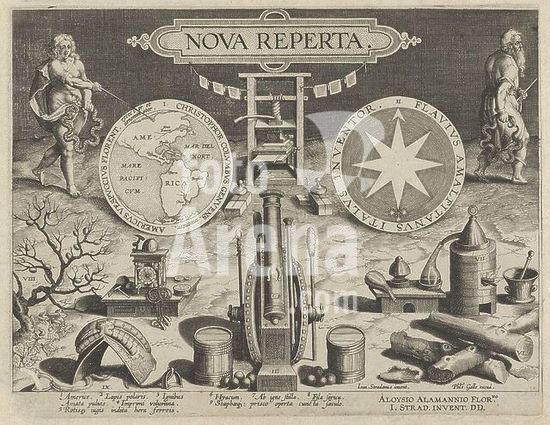
alb3617433 New Inventions of Modern Times [Nova Reperta], Title Plate. Artist: Jan Collaert I (Netherlandish, Antwerp ca. 1530-1581 Antwerp); After Jan van der Straet, called Stradanus (Netherlandish, Bruges 1523-1605 Florence). Dimensions: sheet: 10 5/8 x 7 7/8 in. (27 x 20 cm). Publisher: Published by Philips Galle (Netherlandish, Haarlem 1537-1612 Antwerp). Date: ca. 1600.Title plate from a print series entitled Nova Reperta (New Inventions of Modern Times) consisting of a title page and 19 plates, engraved by Jan Collaert I, after Jan van der Straet, called Stradanus, and published by Philips Galle. The title is printed at the top of the plate just above an image of a printing press. There are 2 medallions also at the top: the medallion at left depicts the continents of America and Africa, and the medallion at represents a compass. On the left a woman represents the future and points to the map and on the right a man represents the past and walks out of the picture plane. At the bottom of the scene nine other inventions or discoveries of the post-classical age are depicted: the silk worm, the stirrup, the clock, the canon, distillation tools and guaiacum, each corresponding with a print in the series. Each object is assigned with a roman numeral that corresponds to a description inscribed at the very bottom of the plate. Museum: Metropolitan Museum of Art, New York, USA. Author: Jan Collaert I. After Jan van der Straet, called Stradanus.
DC
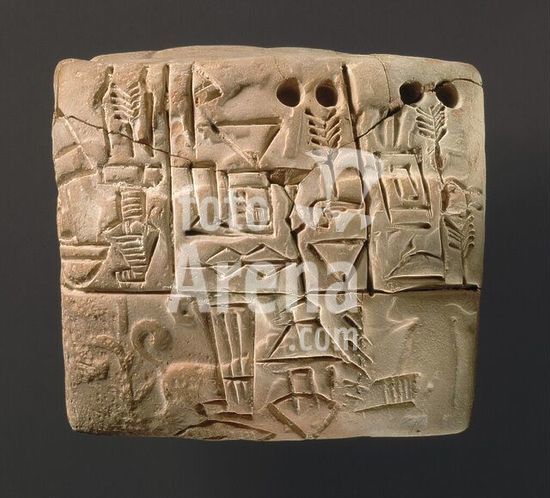
alb3681147 Cuneiform tablet: administrative account of barley distribution with cylinder seal impression of a male figure, hunting dogs, and boars. Culture: Sumerian. Dimensions: 2.17 x 2.36 x 1.63 in. (5.5 x 6 x 4.15 cm). Date: ca. 3100-2900 B.C..Of the many legacies left by the ancient civilizations of southern Mesopotamia, the invention of writing is paramount. At the end of the fourth millennium B.C., written language developed in the region, first as pictographs and then evolving into abstract forms called cuneiform. The pictographs, like the ones on this tablet, are called proto-cuneiform and were drawn in the clay with a pointed implement. Circular impressions alongside the pictographs represented numerical symbols. Cuneiform (meaning wedge-shaped) script was written by pressing a reed pen or stylus with a wedge-shaped tip into a clay tablet. Clay, when dried to a somewhat hardened state, made a fine surface for writing, and when fired the records written on it became permanent.Early writing was used primarily as a means of recording and storing economic information. This tablet most likely documents grain distributed by a large temple, although the absence of verbs in early texts makes them difficult to interpret with certainty. In addition to the writing that appears on this tablet, the imagery of the cylinder seal, which was incompletely impressed on both faces and the edges of the tablet before it was inscribed, also records information. This seal apparently has not survived. The seal impression depicts a male figure guiding two dogs on a leash and hunting or herding boars in a reed marsh. He is the so-called priest-king, a male figure who can be identified by his dress and pose. Here he appears in his role as the good shepherd who protects flocks from wild predators.Adapted from, Art of the Ancient Near East: A Resource for Educators (2010). Museum: Metropolitan Museum of Art, New York, USA.
DC
alb5577601 Artist's concept illustrating Beings we know as Greys, on an alien world. A familiar structure on the surface of this world is Stonehenge, depicting the possibility of some of our own ancient structures being alien in origin. We are not the only ones interested in exploring the universe. Alien Beings have been visiting numerous worlds, and some would say this includes the Earth.
DC
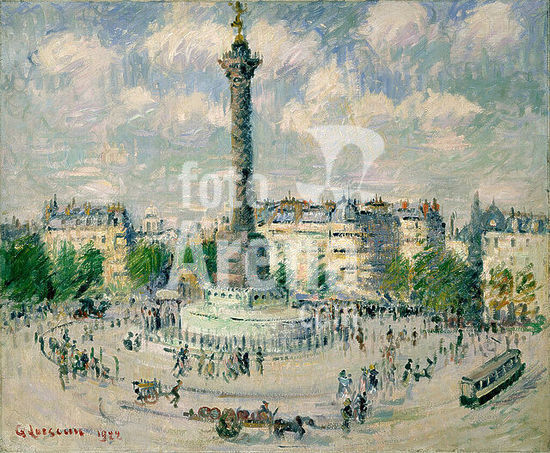
alb3677399 La Place de la Bastille. Artist: Gustave Loiseau (French, 1865-1935). Dimensions: 24 in. x 28 3/4in. (60.5 x 73cm). Date: 1922.Loiseau followed Gauguin to Pont Aven in 1890 and was attached to various of the Post-Impressionists. However he soon developed his own style, characterized by interlocking, quick brush-strokes that create an intricate, lattice-like surface. He became famous as a great voyager and painted numerous, diverse landscapes. In spite of these travels, his native Paris remained a constant subject for him. Here the Place de la Bastille is shown on a summer day with the glittering surfaces of the bronze column, the pavement, and the brilliant blue sky. Museum: Metropolitan Museum of Art, New York, USA.
DC
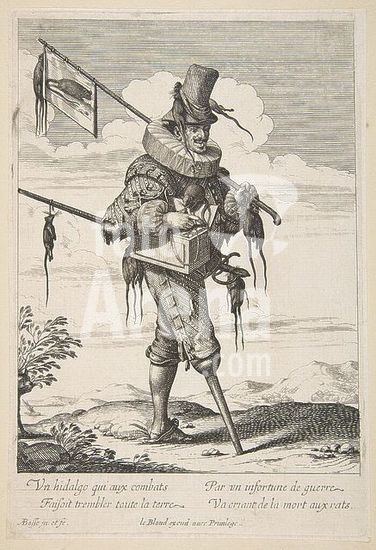
alb3670624 The Ratcatcher. Artist: Abraham Bosse (French, Tours 1602/1604-1676 Paris). Dimensions: Sheet: 8 9/16 × 5 7/8 in. (21.8 × 14.9 cm)Plate: 8 3/8 x 5 11/16 in. (21.3 x 14.4 cm). Series/Portfolio: Cries of Paris(Les Cris de Paris). Date: mid to late 17th century."A noble gentleman who in combat made the whole earth tremble,Through a misfortune of war goes crying death to rats."Bosse, who wrote a treatise on etching based on the innovations of Jacq"ues Callot-with whom he had worked-and who developed a new means of perspective construction that he taught in the French Royal Academy for over a decade, is best known for his numerous prints of everyday Parisian life. In his series of twelve itinerant tradesmen, the crisp and controlled etched line and the precisely defined spatial settings lend polish to the figures, even to the ragged, peg-legged rat catcher. Museum: Metropolitan Museum of Art, New York, USA.
DC
alb20222046 numerous high-voltage towers, Tagong (Lhagang), Garzê Tibetan Autonomous Prefecture, Sichuan, China.
DC
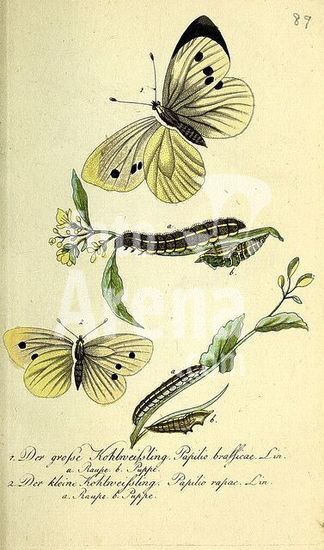
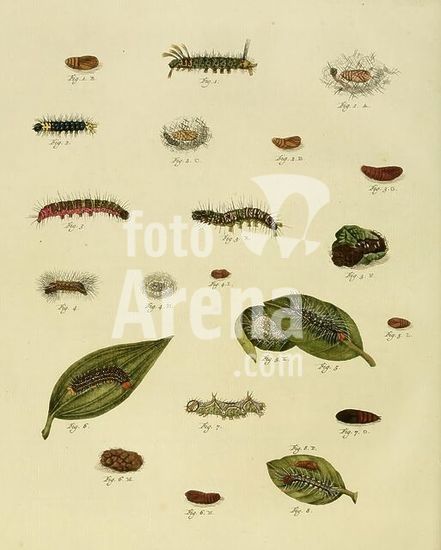
alb15337109 Getreue Abbildungen naturhistorischer Gegenstände in Hinsicht auf Bechsteins kurzgefasste gemeinnützige Naturgeschichte des In- und Auslandes Nürnberg In der Schneider und Weigelschen Kunst- und Buch- handlung [1793-1809] naturalhistory pictorial works insect, The illustration features a detailed depiction of the life cycle of butterflies, showcasing various stages of development. At the top, a beautifully detailed butterfly displays intricate wing patterns and coloration. Below it, a caterpillar is shown in a realistic green and yellow coloration, nestled among leaves that provide a natural habitat. The lower section includes another butterfly, complementing the top illustration, and a small plant with delicate yellow flowers. Each stage is labeled numerically, emphasizing the transformation from caterpillar to butterfly, highlighting the fascinating metamorphic process.
DC
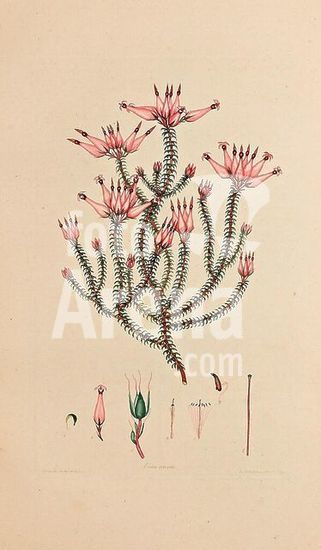
alb15335507 Coloured Engravings of Heaths London Published by the Author Printed by T. Bensley 1802-09 [1830?] 1802 19th Century Botany England Erica Ericaceae Etching Graphic Media Hand-colored History Pictorial Works, This illustration features a striking botanical composition showcasing a vibrant flowering plant with delicate pink blossoms. The plant's slender, spiky branches are adorned with numerous buds and fully opened flowers, creating a lush and textured appearance. Below the main plant, smaller detailed depictions highlight different stages of the flower's development, including unbloomed buds and leaves. The artwork captures the intricate beauty of the plant, emphasizing its unique structure and the elegance of its blooms against a subtle, soft background.
DC
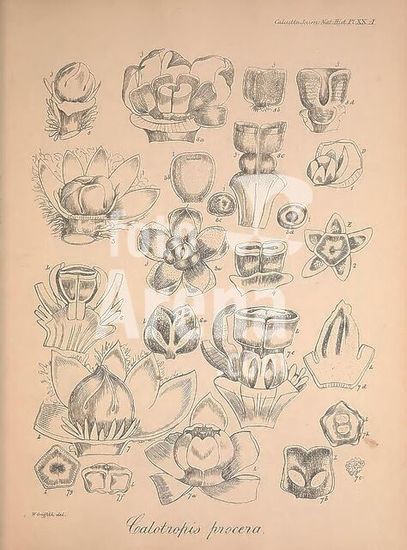
alb15332892 Icones plantarum asiaticarum, Calcutta, Bishop's College Press, 1847-54, Asia, Botany, An illustrated collection showcasing the various forms and structures of Calotropis procera. The arrangement features detailed scientific drawings of the plant's flowers, including different perspectives and stages of development. Each sketch is labeled with numerical identifiers, highlighting the intricate designs of the petals, sepals, and reproductive parts. The illustrations reflect the botanical characteristics unique to this species, offering a visually rich study for enthusiasts and researchers alike. The caption at the bottom identifies the subject as 'Calotropis procera,' emphasizing its significance in botanical studies.
DC
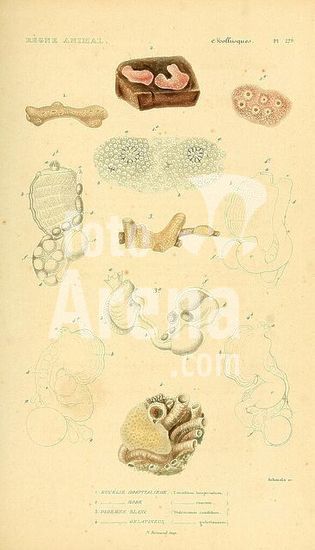
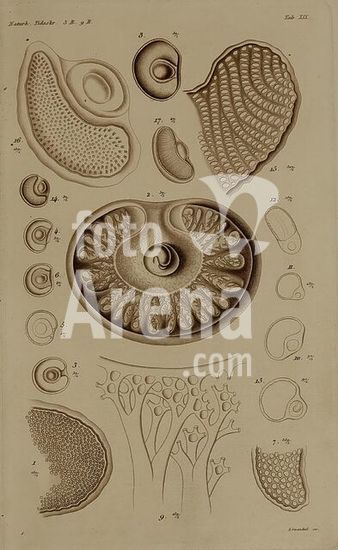
alb15333983 Les mollusques, Paris, 1836-1845, classification, mollusks, pictorial works, shells, sealife, This illustration features a series of intricate biological forms, showcasing various cellular structures and organisms. At the top, two oval shapes suggestive of embryos are accompanied by detailed depictions of diverse microscopic life forms below. Each figure is meticulously labeled with numerical references, presenting a study of anatomy that highlights the complexity of living organisms. The arrangements include various textures and shapes, reflecting the fascinating diversity found in the natural world. This educational piece draws attention to the study of zoology, and specifically the nuances of animal development and cellular composition.
DC
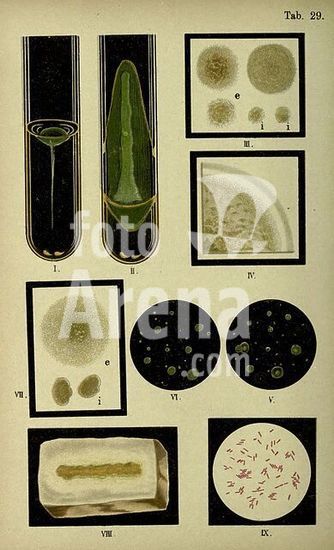
alb15330896 Atlas and essentials of bacteriology, New York, William Wood & Co, 1897, bacteria, atlases, bacteriological, technics, The illustration presents a detailed study of various microorganisms and cellular structures. Each section is meticulously labeled with Roman numerals and letters, showcasing distinctive specimens: - **I** and **II** depict elongated, filamentous organisms, highlighting their structural features. - **III** displays a comparison of cellular shapes, demonstrating diversity among microorganisms. - **IV** features a close-up view of circular and oval organisms with noticeable textural details. - **V** presents petri dish cultures showing various colonies of microorganisms, emphasizing growth patterns. - **VI** illustrates multiple circular forms, possibly highlighting different species or stages of development. - **VII** contains a layered slide with organisms, while **VIII** showcases an arrangement.
DC
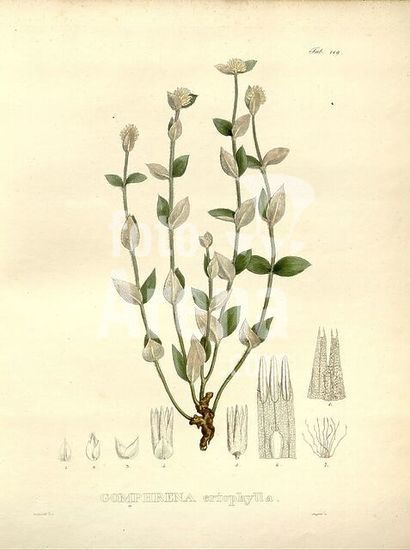
alb15335767 Nova, genera, et, species, plantarum. Monachii [Munich], Impensis, Auctoris, 1824-1829 [i.e. 1824-32]., The illustration showcases the plant Gomphrena erythophylla, featuring tall stems adorned with numerous oval-shaped leaves. The central depiction highlights multiple flowering heads that emerge from the stems, showcasing characteristic features like their unique bracts and overall structure. Below the main representation, various detailed sketches display different stages of the flower's development, including closed and partially opened blooms, alongside anatomical renderings that highlight the plant's distinctive characteristics. The meticulous attention to detail demonstrates the botanical accuracy and serves as a valuable reference for understanding this particular species.
DC
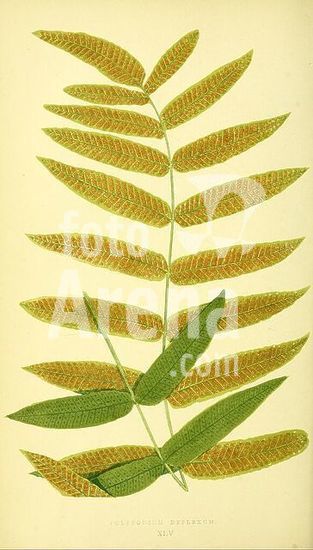
alb15338137 Ferns: British and exotic. 1856-60, ferns, Polypodium deflexum, Alexander Francis Lydon, Ctenitis deflexa, This illustration displays a botanical study of the Polypodium depressum, commonly known as a type of fern. The composition features elongated fronds with a vibrant array of serrated leaflets, showcasing their intricate patterns and textures. The upper sections of the fronds exhibit a golden-brown tint, indicative of spore development, while the lower parts remain a rich green, highlighting the lushness of the plant. The delicate detailing emphasizes each leaf's unique structure, contributing to the overall beauty and complexity of this fern species. An ornamental border and a numeric notation denote its classification within a botanical catalog.
DC
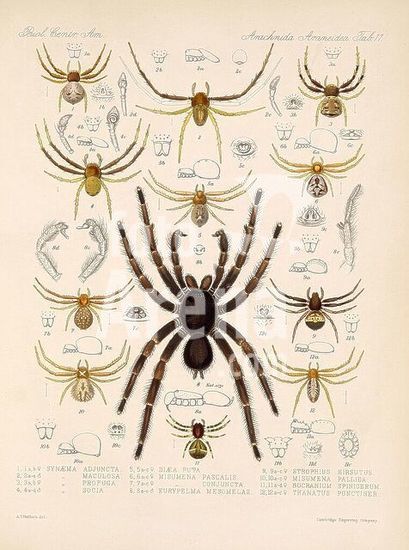
alb15339521 Biologia Centrali-Americana London, 1879-1915, archaeology, botany, Central America, description and travel, scientific expeditions, zoology, 39, arachnid, The illustration showcases a variety of spider species from the family Araneidae, prominently featuring a detailed central depiction of a large spider. Surrounding this central figure are numerous smaller illustrations highlighting distinct species, their anatomical features, and various stages of development. Each spider is meticulously rendered, showcasing unique patterns, body shapes, and markings. The labels beneath each illustration provide taxonomic information, indicating the scientific names and classifications. The composition reflects a blend of scientific illustration and aesthetic design, emphasizing the diversity and complexity of arachnids.
DC
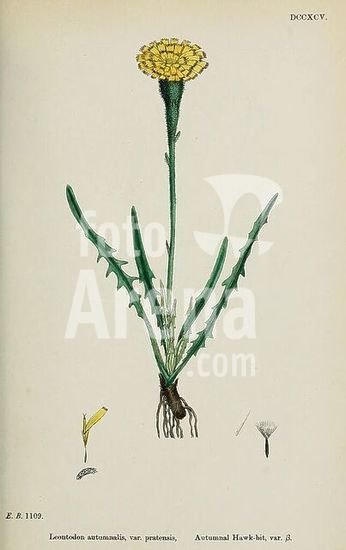
alb15337480 English, botany, Coloured figures of British plants London, R. Hardwicke, 1863-1886 Great Britain, pictorial works, plants, The illustration features a detailed botanical study of the Leontodon autumnalis, var. pratensis, commonly known as the Autumnal Hawkbit. The plant is depicted with its long green leaves characterized by jagged, serrated edges arranged in a rosette at the base. At the top, a single bright yellow flower head is shown, which is made up of numerous small disc florets radiating from the center. Accompanying the main plant are smaller drawings that highlight various stages of the flower's development, including a close-up of the flower and a depiction of its seed head. The scientific name is noted alongside the illustration, indicating its classification and variety.
DC
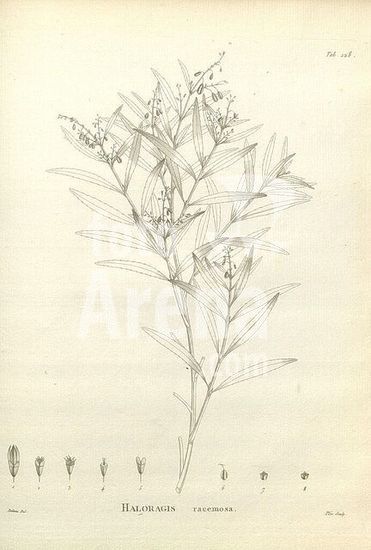
alb15336470 Novæ Hollandiæ plantarum specimen Parisiis Ex typographia Dominæ Huzard 1804-1806. Australia Botany Australia Pictorial works Haloragis racemosa Haloragis racemosa, This visual showcases a botanical illustration of Haloragis racemosa, a plant characterized by its slender, elongated leaves and small clusters of delicate flowers. The detailed depiction includes various stages of the flower's development, presented along the bottom. Each stage is numerically labeled, showcasing buds and mature seeds in a structured format. The overall composition emphasizes the plant's elegant form and intricate details, contributing to our understanding of its botanical characteristics.
DC
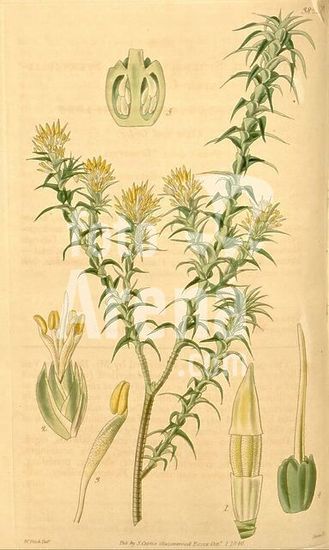
alb15337745 Curtis's Botanical Magazine, London, New York, botanical illustration, botany, periodicals, pictorial works, plants ornamental, Curtis, Australia, Cystanthes prengelioides, Richea sprengelioides, A detailed botanical illustration depicting a plant characterized by slender, upright stems adorned with yellow flowering heads. The illustration includes various stages of the plant's development, showcasing buds and flowers in detail, alongside distinct parts of the plant such as its elongated leaves and fruit structures. Annotations labeled with numerical references accompany the different sections, providing scientific insight into the plant's morphology. The overall composition highlights the intricacy of the plant's design, emphasizing both its aesthetic beauty and biological significance.
DC
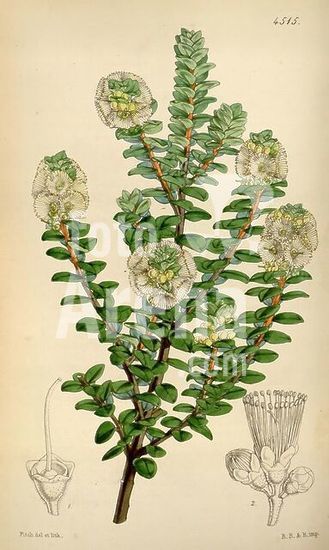
alb15339074 Curtis's Botanical Magazine, London, New York, botany, periodicals, pictorial works, Curtis, NZ Species, Metrosideros buxifolia, Metrosideros perforata, New Zealand, Bay of Islands, Akatea, Walter Hood Fitch, Curtis, The illustration features a detailed botanical representation of a flowering plant. At its center, a tall stem is adorned with elongated green leaves, showcasing a rich and textured appearance. Surrounding the stem are clusters of white and intricate blossoms, depicted with numerous filaments and a distinct central structure, likely indicating a reproductive feature. To the left, a close-up view highlights a singular flower bud and its developing components, while additional sketches provide a detailed look at the anatomy of the flower, including the stamen and pistil. This artwork exemplifies the precision and beauty of botanical studies, capturing the essence of the plant's form and structure.
DC
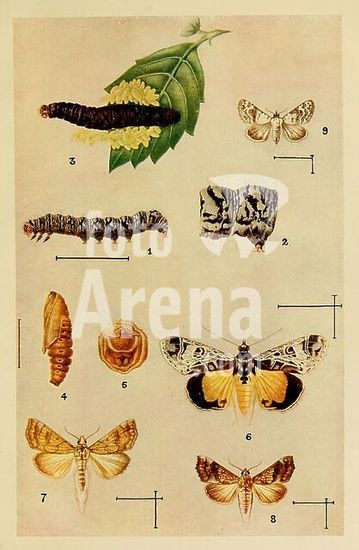
alb15339773 Indian insect life Calcutta Thacker Spink & Co. W. Thacker & Co. 2 Creed Lane London 1909 India insects Arthropoda pictorial cloth bindings binding RB Bin arthropod, An educational illustration depicting the life cycle of various moths and caterpillars. The top row features a leafy plant, showcasing a green caterpillar feeding on the leaves. Adjacent to it are illustrations of different moth species, displayed in their adult forms. The second row presents a sequence of stages in the metamorphosis of the moths, including a resting chrysalis and other transformations. Each stage is labeled numerically for identification, highlighting the intricate details and patterns on the wings of the moths, as well as the distinct characteristics of the caterpillars and pupae. The illustration serves as a visual reference for entomology and the study of insect development.
DC
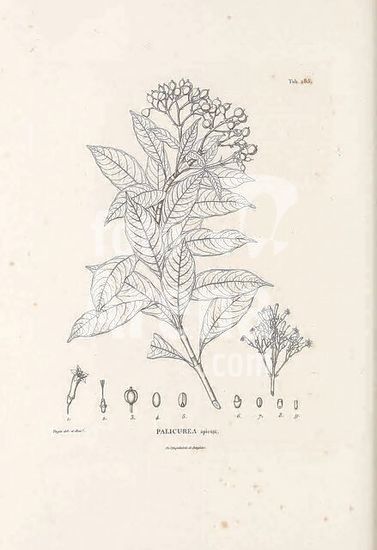
alb15331178 Nova Genera et Species Plantarum, Antverpiae, Ex Officina Christophori Plantini, 1576, botany, classification, pictorial works, plants, scientific expeditions, South America, A detailed botanical illustration depicting the plant Palicourea angustifolia. The central focus includes a flowering branch with numerous small clusters of white blooms surrounded by elongated, lanceolate leaves with prominent veins. Below the main illustration, there is a series of delicate sketches illustrating different stages of the flower's development, including a closed bud, an open flower, and the formation of seeds. Each part is carefully labeled, emphasizing the botanical characteristics and anatomy of the species, providing a comprehensive guide for identification. The overall composition captures the intricate details of this plant, highlighting its structure and forms.
DC
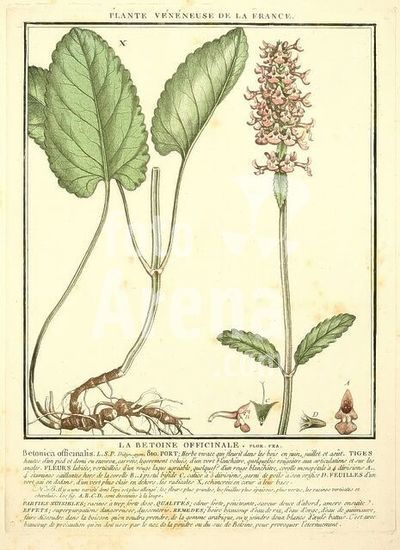
alb15388668 Herbier de la France, 1-48. Paris, Chez l'auteur, Didot, Debure, Belin, 1780-93, plants, France, fungi, medicinal plants, poisonous plants, The New York Botanical Garden, pictorial works., This botanical illustration features a detailed depiction of a flowering plant. On the left side, the plant's roots are visible, showcasing its structure and connection to the soil. The leaves are broad and have a serrated edge, adding texture to the composition. On the right side, a flowering spike rises, adorned with numerous small, pinkish flowers that cluster tightly together. Each flower exudes a delicate beauty, emphasizing the plant's reproductive structure. Below the main flower, two smaller elements suggest the presence of developing buds or seeds. The label provides the scientific name 'B. officinalis,' indicating its identity as a medicinal plant traditionally used for various health purposes.
DC
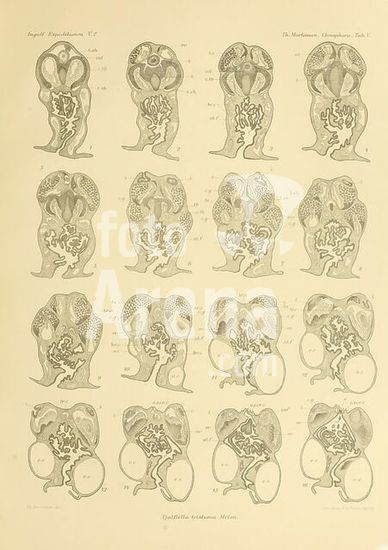
alb15387374 The, Danish, Ingolf-Expedition, Copenhagen, H. Hagerup, 1899-1928, arcticocean, scientificexpeditions., This collection features a series of detailed anatomical illustrations showcasing the developmental stages of various organisms. Each segment presents a different viewpoint or phase of growth, highlighting intricate structures and features essential for understanding biological development. The illustrations are methodically organized, allowing for comparative analysis between the specimens. Various labels and numerical indicators accompany the drawings, facilitating a deeper exploration of morphological changes and developmental processes across the selected species. These depictions serve as a valuable resource for studying anatomy, embryology, or evolutionary biology.
DC
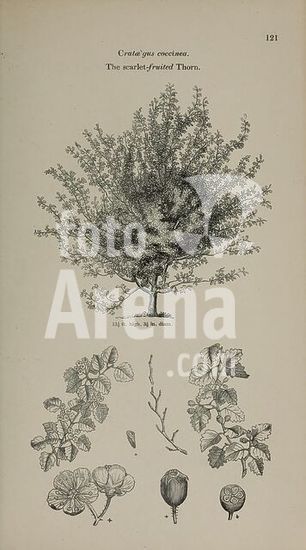
alb15389464 Arboretum et fruticetum britannicum, London, J.C. Loudon, 1844, botany, classification, Great Britain, identification, shrubs, trees, The illustration features a detailed depiction of the Crataegus coccinea, commonly known as the scarlet-fruited thorn. At the top, a stylized representation of the tree showcases its bushy silhouette, with numerous delicate branches and leaves. Below the tree, there are several botanical studies, including close-ups of the leaves and fruits. The leaves are intricately rendered, displaying their serrated edges, while the fruits are depicted in various stages of development, highlighting their round shape and distinct markings. The entire composition emphasizes the botanical characteristics of this species, combining both aesthetic appeal and scientific detail.
DC
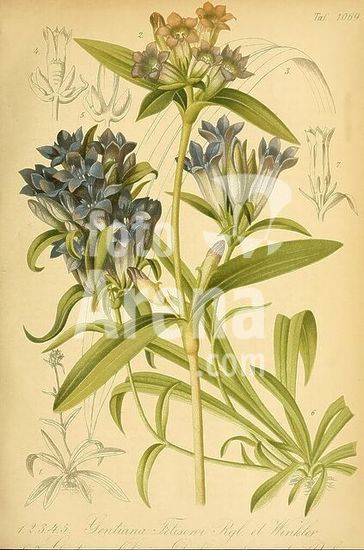
alb15381451 Gartenflora, Erlangen, F. Enke, 1852-1940, botany, gardening, Germany, periodicals, plants ornamental, plant, flower, A detailed botanical illustration showcasing Gentiana foliosa, commonly known as the leafy gentian. The main stem features multiple clusters of trumpet-shaped flowers in shades of blue and purple, surrounded by elongated green leaves that exhibit a smooth texture. In the background, smaller sketches provide additional views of the plant, highlighting various stages of flower development and leaf structure. Each part is meticulously labeled with numerals, illustrating the intricacies of this striking species. The overall composition emphasizes the delicate beauty and complexity of the leafy gentian's anatomy.
DC
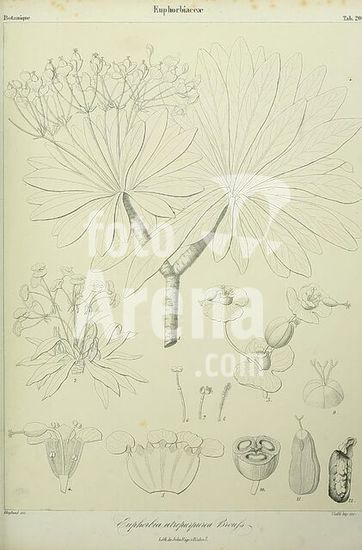
alb15386692 Histoire naturelle des Iles Canaries, Paris, Bethune, editeur, 1836-1850, botany, Canary Islands, fishes, natural history, pictorial works., The illustration features a detailed botanical study of a plant from the Euphorbiaceae family, labeled with the scientific name 'Euphorbia autralis.' At the top, two prominent branches showcase large, lush leaves with distinctive lobes, providing a clear view of their structure. Below, various labeled parts of the plant are depicted, including flowers and fruit in various stages of development. The artwork demonstrates meticulous attention to botanical accuracy, highlighting the morphology of each component, making it a valuable reference for botany enthusiasts and scholars alike. The illustration is accompanied by numeric labels corresponding to the individual elements, enhancing its educational value.
DC
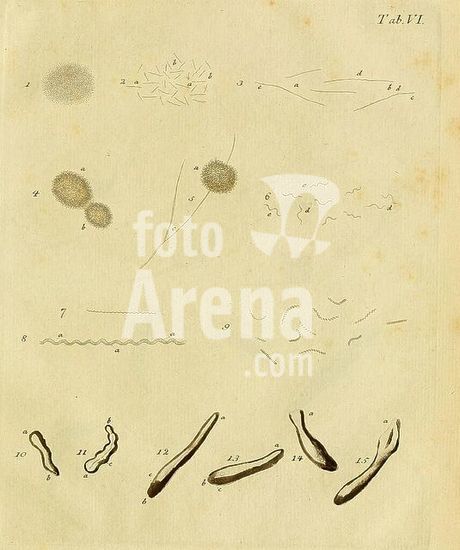
alb15325358 Animalcula infusoria fluvia tilia et marina Hauniae Typis N. Mölleri 1786 infusoria animalcules, This illustration showcases a series of microscopic organisms and their various forms, identified by numbers for reference. The arrangement includes spherical shapes, elongated filaments, and more intricate structures, each represented with precise detailing. The organisms appear to range from single-cell varieties to more complex configurations, highlighting the diversity of microscopic life. The accompanying numerical labels suggest a classification system, possibly indicating different species or stages of development. This detailed representation emphasizes the complexity and variety of microscopic forms in the natural world, inviting further exploration and study.
DC
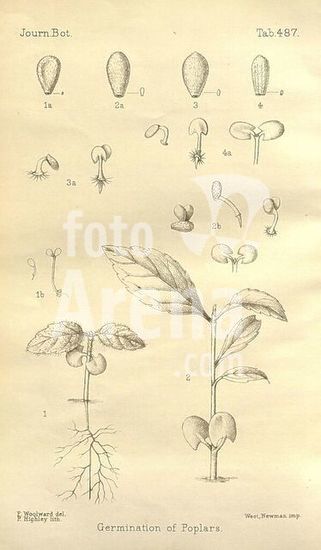
alb15324938 Journal of Botany, British and Foreign. London, Robert Hardwicke, 1863-1942. Botany, Great Britain, Periodicals, Plants, The illustration showcases the germination process of poplar trees, highlighting various stages of seed development and growth. It features detailed depictions of seeds in different orientations, showcasing their shapes and sizes, along with embryonic structures. The stages of germination are meticulously outlined, including the emergence of cotyledons and roots. Accompanying annotations provide numerical references, leading to visual representations of young seedlings that demonstrate their initial growth stages, complete with root systems and emerging leaves. The overall composition serves as an educational tool for understanding the life cycle of poplars from seed to seedling.
DC
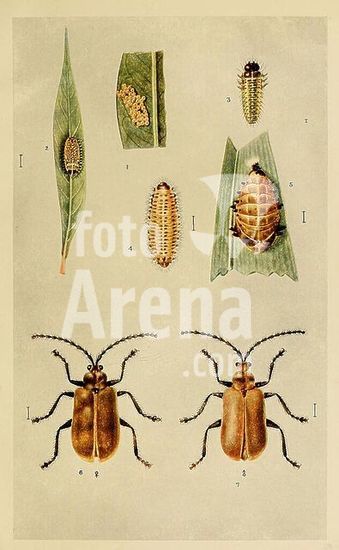
alb15328701 Indian insect life Calcutta, Thacker, Spink & Co, W. Thacker & Co, 2 Creed Lane, London, 1909. India, insects, Arthropoda, Libraries, pictorial cloth bindings binding, RBBIN, arthropod, The illustration features a detailed study of various life stages of a beetle species. At the top left, a leaf displays a small cluster of peculiar yellowish forms, possibly eggs or larvae. To the right, a segmented larva is depicted, featuring a robust, elongated body. Below it, a more advanced larval stage reveals a hardened, shell-like covering indicative of its development. The lower section showcases adult beetles, with a prominent focus on their distinct elongated bodies, long antennae, and intricate patterns on their wings. Each specimen is labeled numerically, providing a reference for identification and study within entomology.
DC
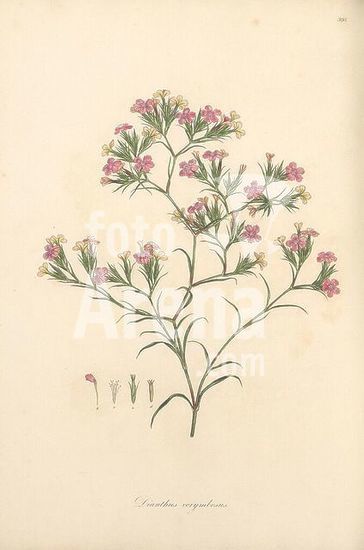
alb15328723 Flora Graeca, sive, Plantarum rariorum historia, quas in provinciis aut insulis Graeciae, Londini, Typis Richardi Taylor et socii, in Vico Shoe-Lane, MDCCCVI-MDCCCXL 1806-1840, Greece, identification, Mediterranean region, pictorial works, plants, A botanical illustration showcases a delicate cluster of flowers from the plant species Dianthus erythranthus. The main depiction features numerous vibrant pink blossoms with subtle yellow accents at the base of each petal, arranged atop slender green stems adorned with narrow leaves. Below the main bouquet, smaller sketches depict the flower's buds in various stages of development, highlighting their intricate details. The overall composition beautifully captures the elegance and charm of this flowering plant, emphasizing its natural beauty and the artistry of botanical study.
DC
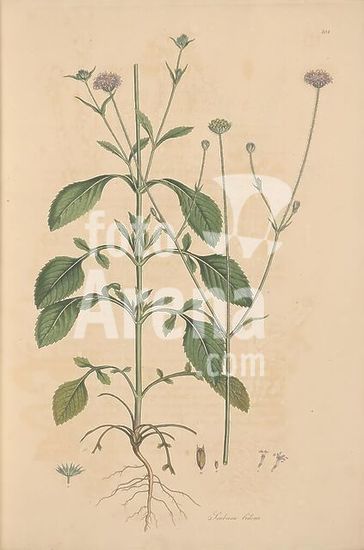
alb15329539 Flora Graeca, sive, Plantarum rariorum historia, quas in provinciis aut insulis Graeciae Londini, Typis Richardi Taylor et socii, in Vico Shoe-Lane, MDCCCVI-MDCCCXL 1806-1840 Greece, Identification, Mediterranean Region, Pictorial Works, Plants, A botanical illustration showcasing a detailed depiction of a flowering plant. The illustration features the plant's stem, leaves, and roots, providing a clear view of its structure. The leaves are broad with serrated edges, arranged alternately along the stem. Numerous small, round flower heads cluster at the top of the plant, displaying delicate petals. Various stages of the plant's development, including the root system and seeds, are also highlighted, making it a comprehensive representation for study or reference. The overall layout emphasizes the natural growth and anatomy of the species.
DC
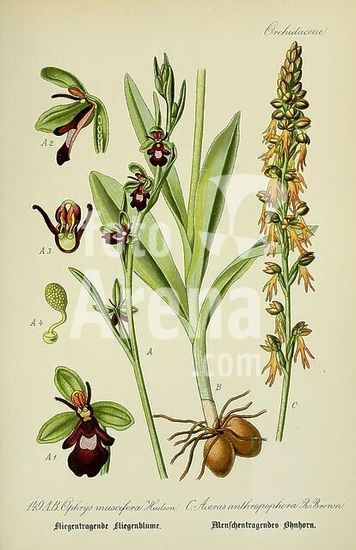
alb15328315 Flora von Deutschland, Österreich und der Schweiz. Gera, Zezschwitz, 1903-, plants, germany, austria, switzerland, floras, ophrys, insectifera, orchis, anthropophora, A detailed botanical illustration showcasing the Ophrys muscifera, also known as the fly orchid. The composition features multiple parts: on the left, the diverse stages of flower development are depicted, including the unique structure of the flowers that mimic the appearance of insects, which aids in pollination. The central part presents a flowering stem adorned with numerous blooms, characterized by their distinctive shape and coloration. At the bottom right, the orchid's bulb, which plays a crucial role in its growth and reproduction, is illustrated. The background includes labeled sections detailing the various elements of the plant, contributing to its scientific representation.
DC
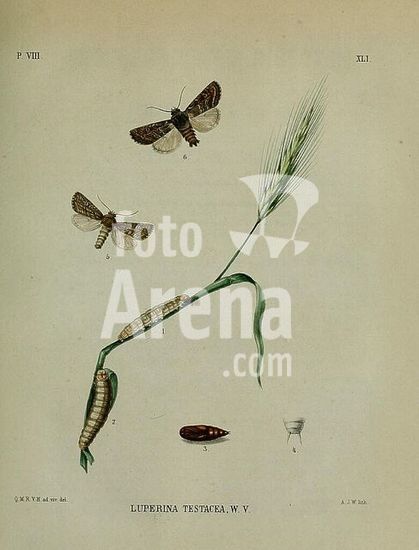
alb15322316 Beschouwing der wonderen Gods Amsterdam J.C. Sepp 1762-1860 entomology Netherlands lepidoptera luperina testacea, A detailed illustration showcases the life cycle of the moth species Luperina testacea. The artwork features several stages: adult moths are depicted in flight, displaying intricate wing patterns, while a caterpillar is illustrated in a feeding position on a green grass blade. Also included is a pupal case and other life stages, providing a comprehensive view of the insect's development. The accompanying labels numerically identify each stage, enhancing the educational aspect of the representation.
DC
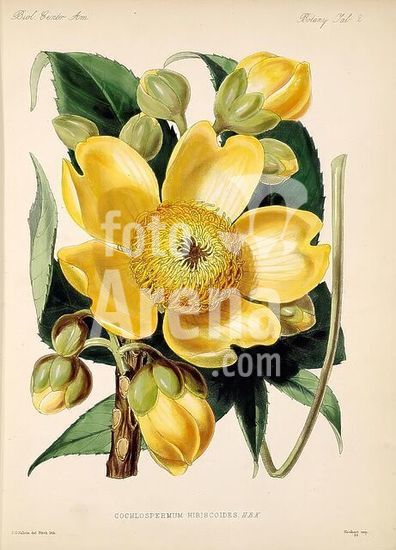
alb15320158 Biologia Centrali-Americana London, 1879-1915, Archaeology, Botany, Central America, Description and Travel, Scientific Expeditions, Zoology, Plant, Flowers, Cochlospermum hibiscoides, Cochlospermum vitifolium, Silk Cotton Tree, This artwork features an exquisite botanical illustration of the Cochlospermum fraseri plant, characterized by its striking yellow flowers and lush green leaves. The central bloom displays numerous delicate petals arranged around a prominent, fluffy center, exuding a vibrant charm. Surrounding the main flower are several buds in varying stages of development, hinting at the plant's growth cycle. The detailed rendering captures the intricate textures of the petals and the glossy surface of the leaves, showcasing the beauty of this tropical species. The overall composition emphasizes the elegance of nature and the artistry of botanical studies.
DC
alb15321115 L'Illustration horticole, Gand, Belgium, Imprimerie et lithographie de F. et E. Gyselnyck, 1854-1896, floriculture, gardening, greenhouses, horticulture, periodicals, A botanical illustration showcasing the detailed anatomy of a plant, featuring a prominent flowering top, slender leaves, and various stages of fruit or seed development. The design includes numerical labels corresponding to distinct parts: the dense cluster of blossoms at the top, elongated leaf structures arranged along the stem, and smaller pointed forms depicting the plant's reproductive elements. This composition highlights the intricate features and variations within the species, presented in an aesthetically pleasing layout.
DC
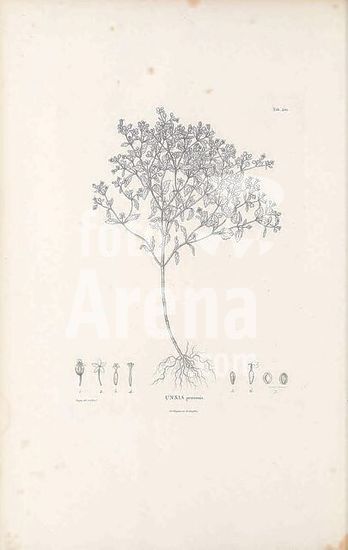
alb15326647 Nova Genera et Species Plantarum, Antverpiae, Ex Officina Christophori Plantini, 1576, botany, classification, pictorial works, plants, scientific expeditions, South America, The illustration features a delicate plant known as 'Linnea borealis,' characterized by its slender stem and small, rounded leaves that sprout from numerous branches. The plant stands upright with a detailed root system visible below. Surrounding the main depiction are various labeled illustrations of different parts of the plant, including flowers at different stages of development, leaf structures, and seeds, showcasing the botanical intricacies. Each section is meticulously rendered, emphasizing the unique characteristics of this plant variety. The overall composition highlights the beauty of botanical studies, combining scientific accuracy with artistic presentation.
DC
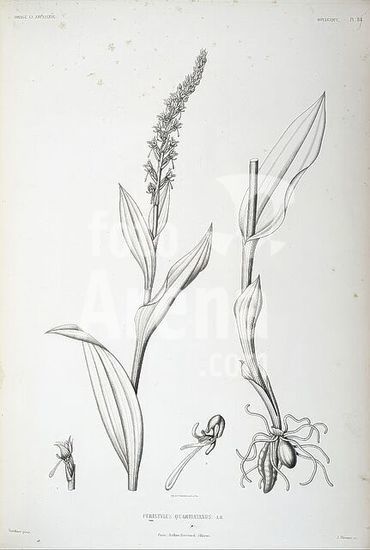
alb15324333 Tentamen Florae Abyssinicae Parisiis Arthus Bertrand 1847-1851, A botanical illustration depicting the detailed structure of a plant species, showcasing slender, elongated leaves with prominent veins. The illustration includes a flowering spike adorned with numerous small blossoms. Each flower is meticulously rendered, highlighting intricate details such as petal shapes and reproductive parts. Additional elements include a representation of the plant's root bulb at the base, along with early stages of flower development at the side. This artwork serves as an educational reference, exemplifying the beauty and complexity of plant anatomy.
DC
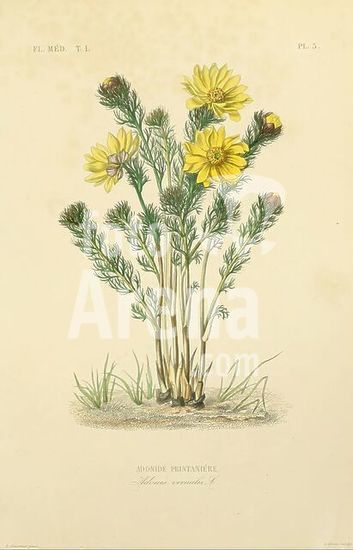
alb15320793 Le Règne végétal, Paris, L. Guérin, 1870-72, biobibliography, botany, pictorial works, plants, A delicate botanical illustration features a cluster of vibrant yellow flowers blooming atop slender green stems. The plant exhibits fine, feathery foliage that adds a touch of elegance to its appearance. Each flower showcases numerous petals radiating from a central disk, surrounded by round, budding blossoms in various stages of development. The composition is rooted in a natural setting, with grass peeking through around the base of the plant, creating a harmonious connection to its environment. The name 'Adonomea printanier' is elegantly inscribed below, indicating its scientific classification.
DC
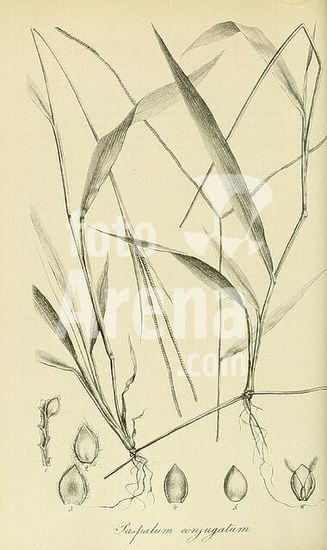
alb15275399 Species Graminum, Petropoli, Impensis Academiae Imperialis Scientiarum, 1828-1836, Gramineae, pictorial works, grasses, An illustration depicting the various stages of *Paspalum conjugatum*, a type of grass. The artwork features slender, elongated leaves characteristic of the plant, showcasing intricate details of various leaf shapes and structures. Below the plants, distinct phases of growth are presented: a sprouting seedling, developed shoots, and the roots. Each part is labeled numerically, emphasizing the transition from seed to mature grass. The overall composition highlights the botanical intricacies and life cycle of this species, emphasizing its natural beauty and ecological significance.
DC
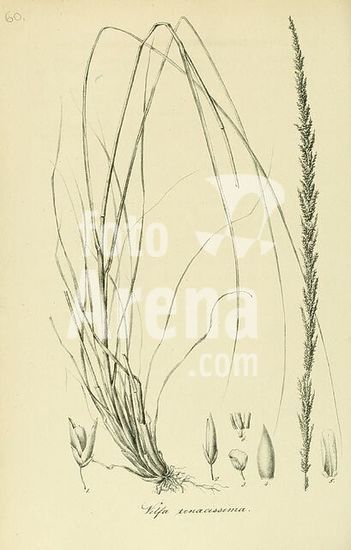
alb15270836 Species, Graminum, Petropoli, Impensis, Academiae, Imperialis, Scientiarum, 1828-1836, Gramineae, pictorial, works, grasses, The illustration showcases a detailed study of a plant species, featuring elongated, slender grasses with fine, linear leaves and distinctive flower structures. On the left, the plant is depicted with numerous long leaves radiating outward, showcasing its vertical growth habit. Adjacent to these, various stages of the flower spike development are illustrated, highlighting the unique floral morphology with detailed annotations. A narrow, upright inflorescence gracefully extends at the right, emphasizing the plant's architectural form. The entire composition is meticulously labeled, likely offering scientific insight into the taxonomy and characteristics of this specific flora.
DC
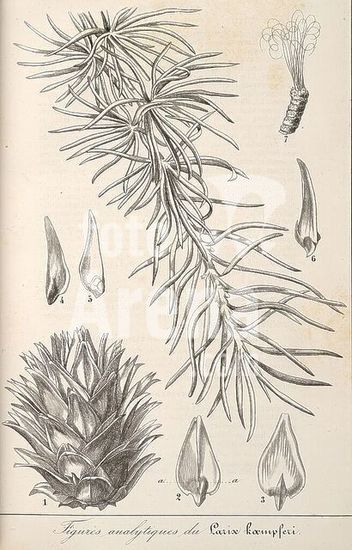
alb15272092 On the germination, development, and fructification of the higher Cryptogamia, London, Pub. for the Ray Society by R. Hardwicke, 1862. Conifers, Pteridophyta, plant morphology, The illustration features a series of detailed scientific sketches depicting various anatomical structures and forms, likely representing different species of corals or similar marine organisms. Each figure is meticulously labeled with numerical identifiers, showcasing the intricate details of their morphology. The designs include a variety of shapes, such as branching structures, elongated forms, and layered textures, emphasizing the diversity found within the group. Additionally, the layout suggests a comparative study, highlighting similarities and differences between the depicted specimens. The overall arrangement reflects a systematic approach to understanding the complex biology of these organisms.
DC
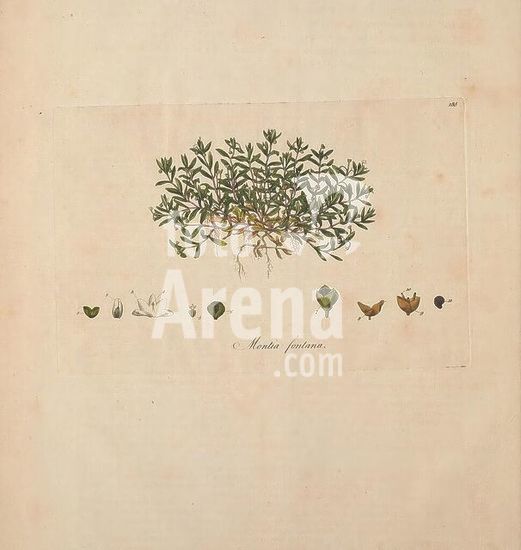
alb15275851 Flora Londinensis, or Plates and descriptions of such plants as grow wild in the environs of London London, Printed for and sold by the author and B. White, 1777. 18th century, botanical illustration, botany, England, engravings, herbals, London, plants, stems, leaves, flowers, The illustration features a detailed botanical rendering of a plant labeled ''Mundu fostorum.'' Above the label, a lush depiction of the plant showcases its sprawling foliage, characterized by numerous green leaves. Below, a series of smaller drawings highlights different stages or parts of the plant, including seeds, buds, and possibly flowers or leaf structures. This composition emphasizes the plant's growth and reproductive features, presenting a thorough study of its biology and development. The overall arrangement exudes a sense of methodical exploration and appreciation for botanical diversity.
DC
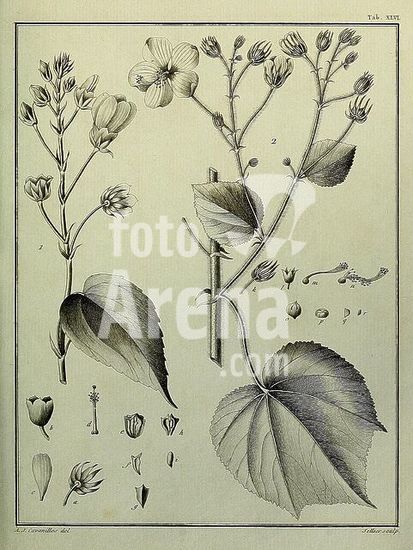
alb15275079 Monadelphiae, classis, dissertationes, decem, Parisiis, Apud F.A. Didot, 1785-1790, plants, spermatophyta, pictorial works, The illustration showcases a botanical study featuring two flowering plants. On the left, a detailed depiction of a plant with multiple blooms, including buds and fully opened flowers, alongside intricately drawn leaves. The plant on the right is similarly detailed, presenting its flowers, stem, and leaves. Below the main figures, smaller drawings highlight various stages of flower development and leaf characteristics, emphasizing the intricate details of plant morphology. Each element is labeled numerically, indicating specific features for reference in botanical studies. The overall composition reflects a classic scientific illustration style, celebrating the beauty and complexity of plant life.
DC
alb15309813 The Quarterly Journal of the Geological Society of London, v. 39 (1883), London, geology, periodicals, This illustration features a detailed geological cross-section of the Horsehead Cliff, documenting the stratigraphy from the top of the Lower Helderberg Belt to the base of the Upper Regimental Sandstone. It presents a systematic representation of various geological layers, each identified by numeric labels, along with descriptions of their composition and characteristics. The chart showcases a variety of rock types, including limestone, shale, and sandstone, organized in a manner that highlights the geological history and structure of the area. The legend provides explanations of the symbols used throughout the section, aiding in the interpretation of the geological features presented. This comprehensive study serves as an important reference for understanding the geological formations and their historical development.
DC
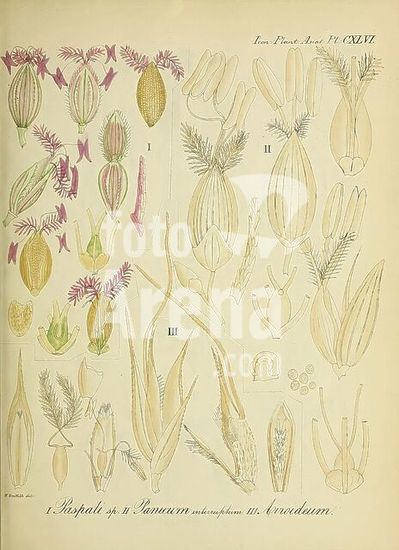
alb15308283 Icones plantarum asiaticarum, Calcutta, Bishop's College Press, 1847-54, Asia, Botany, Paspalum, Sacciolepis interrupta, The illustration showcases a diverse collection of botanical studies depicting various species of plants. Arranged in a structured layout, the drawings highlight intricate details of flowers, seed pods, and leaf structures. Each plant is labeled with Roman numerals, indicating different varieties or stages of development. The delicate lines and soft colors bring attention to the unique characteristics of each specimen, emphasizing their natural beauty and complexity. Overall, the composition serves as a scientific exploration of plant morphology, intertwining art with botanical illustration.
DC
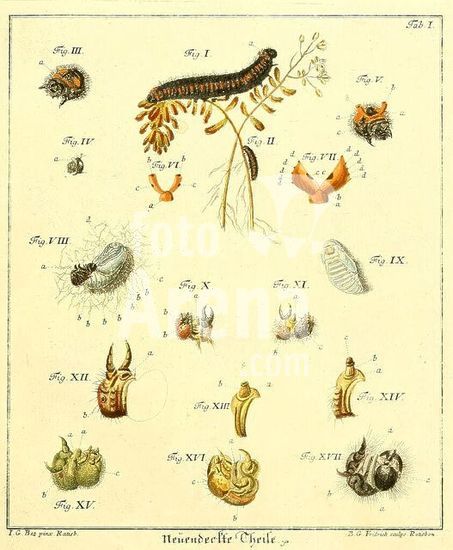
alb15307635 D. Jacob Christian Schäffer's Abhandlungen von Insecten Regensburg, Verlegts Johann Leopold Montag, 1764-1779. insects, parasites, arthropods, life cycle, holometabolism, insect anatomy, caterpillar, Apollo, Apollo butterfly, Parnassius apollo, The illustration features a collection of various insect larvae and caterpillars, each labeled with numerical annotations. The upper part displays a prominent caterpillar clinging to a plant, showcasing intricate details of its form and coloration. Surrounding this central figure are smaller illustrations, each depicting different stages of larval development and diverse species. The arrangement includes a variety of shapes and sizes, highlighting the unique morphological traits of each specimen. Some larvae are nestled in cocoons, while others display distinct textures and colors, providing a comprehensive overview of these fascinating life forms. The illustrations serve as a scientific exploration of the diversity within insect larvae, emphasizing their roles in ecosystems.
DC
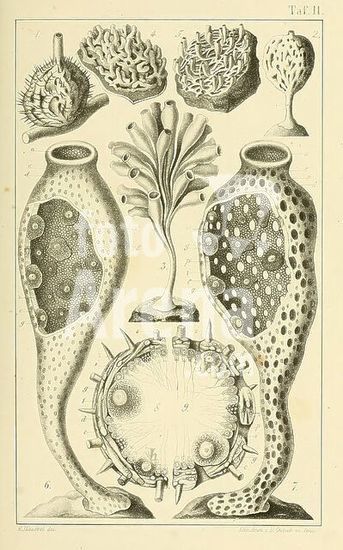
alb15308343 Die Kalkschwämme, Berlin, G. Reimer, 1872, sponges, color our collections, Haeckel, The illustration features a collection of intricate botanical and biological forms, including various organic structures that might represent plant life or microbiological entities. At the top, several distinct formations exhibit a range of textures and shapes, from spiky clusters to branching structures reminiscent of coral or moss. The central part showcases a pair of bulbous vessels, each adorned with unique patterns, possibly depicting cellular or anatomical features. Surrounding these main elements are additional smaller forms, potentially demonstrating different stages of development or variations within a species. The numbering suggests a systematic classification, hinting at a scientific study or exploration of these fascinating organisms.
DC
akg5421935 Elagabalus (203-222), also known as Heliogabalus, was a Syrian and a member of the Severan dynasty. Elagabalus was the grandson of Julia Maesa and cousin to Emperor Caracalla. When Caracalla was assassinated in 217, Julia Maesa instigated a revolt against his killer and successor, Macrinus, championing for Elagabalus to be declared emperor. Macrinus was defeated and executed in 218, and Elagabalus was proclaimed emperor at barely 14 years old.His reign was notorious for its numerous religious controversies and sex scandals, with Elagabalus showing a marked disregard for traditional Roman religious and sexual values. He was said to have been married as many as five times, had many male lovers, and was even reported to have prostituted himself in the imperial palace. He developed a reputation for extreme decadence, eccentricity and zealotry to the god he was named after, Elagabalus, and whom he declared the new head of the Roman pantheon.His actions and behaviour estranged both commoner and Praetorian Guard, and after four years of rule, Elagabalus was assassinated in 222 at the age of 18. The plot was orchestrated by Julia Maesa, the same grandmother that had placed him on the throne, and carried out by the Praetorian Guard, with his cousin Severus Alexander replacing him as emperor. Elagabalus developed one of the worst reputations among Roman emperors in history.
DC
akg4789431 Elagabalus (203-222 CE), also known as Heliogabalus, was a Syrian and a member of the Severan dynasty. Elagabalus was the grandson of Julia Maesa and cousin to Emperor Caracalla. When Caracalla was assassinated in 217 CE, Julia Maesa instigated a revolt against his killer and successor, Macrinus, championing Elagabalus as emperor. Macrinus was defeated and executed in 218 CE, and Elagabalus was proclaimed emperor at barely 14 years old.. His reign was notorious for its numerous religious controversies and sex scandals, with Elagabalus showing a marked disregard for traditional Roman religious and sexual values. He was said to have had been married as many as five times, had many male lovers, and was even reported to have prostituted himself in the imperial palace. He developed a reputation for extreme decadence, eccentricity and zealotry to the god he was named after, Elagabalus, and whom he declared the new head of the Roman pantheon.. His actions and behaviour estranged both commoner and Praetorian Guard, and after four years of rule, Elagabalus was assassinated in 222 CE at the age of 18. The plot was orchestrated by Julia Maesa, the same grandmother that had placed him on the throne, and carried out by the Praetorian Guard, with his cousin Severus Alexander replacing him as emperor. Elagabalus developed one of the worst reputations among Roman emperors in history.
DC
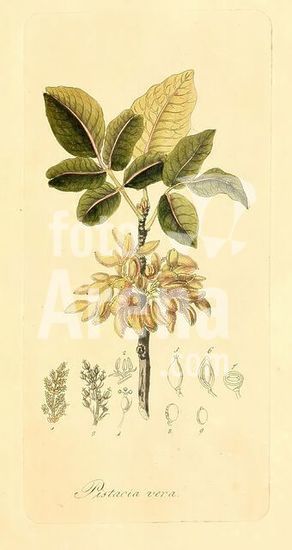
alb15281605 Flora medica, oder, Abbildung der wichtigsten officinellen Pflanzen, Jena, August Schmid, 1831 [i.e. 1829-1831], medicinal plants, The New York Botanical Garden, pictorial works, This illustration features a detailed study of the Pistacia vera plant, showcasing a branch adorned with vibrant green leaves. Beneath the leaves is a cluster of distinctive, ripe pistachio nuts, each encased in a hard outer shell. The composition includes various botanical drawings that depict different stages of the plant's development, including flowers and seeds. Each element is accompanied by numerical labels, providing a reference for the viewer. The overall presentation emphasizes the intricate details of the pistachio tree's anatomy and its edible produce, highlighting its significance in botany and agriculture.
DC
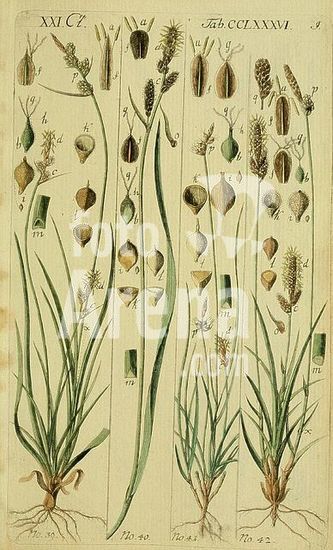
alb15286923 Beschreibung und Abbildung der theils bekannten, theils noch nicht beschriebenen Arten von Riedgräsern, Wittenberg, 1801-1806, Carex, Cyperaceae, A detailed botanical illustration featuring various grass species, labeled with letters indicating specific parts and characteristics. On the left side, the illustration displays several types of grass flowers and seeds in different stages of development, showcasing their intricate structures. The center features elongated green blades, highlighting the growth form of the grasses, while the right side continues with additional variations, focusing on the roots and base of the plants. Each specimen is meticulously detailed, providing a clear visual reference for identification purposes, accompanied by corresponding numerical annotations for further study.
DC
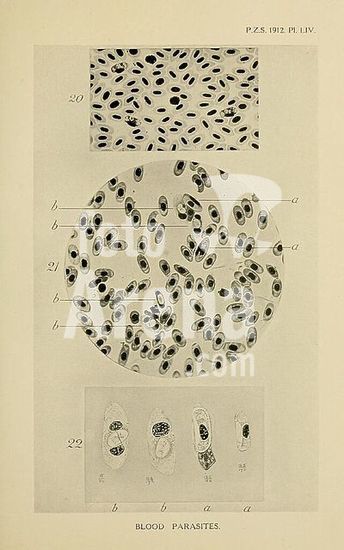
alb15286961 Proceedings of the Zoological Society of London, London, Academic Press, 1833-1965. Dierkunde, Periodicals, Zoology, The illustration presents a detailed scientific depiction of blood parasites, specifically highlighting various stages and types. The top section features a series of darkly stained cellular structures, likely demonstrating different forms of the parasites under magnification. The central circular section displays numerous organisms, each labeled to indicate unique characteristics or stages of development, providing insight into their morphology. The lower section includes close-up views of specific parasites, showcasing distinct features, such as shapes and internal structures. This educational depiction serves as a crucial resource for understanding the complexity and diversity of blood parasites within the field of parasitology.
DC
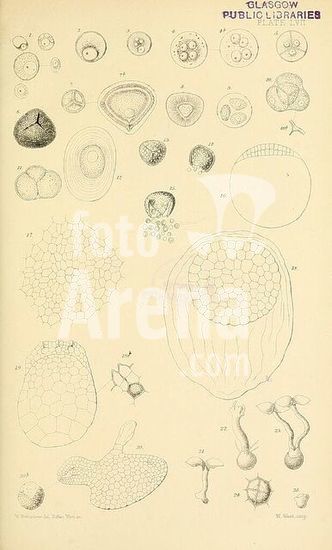
alb15286235 On the germination, development, and fructification of the higher Cryptogamia, London, Pub. for the Ray Society by R. Hardwicke, 1862, conifers, pteridophyta, plant morphology, The illustration showcases a diverse array of microscopic organisms, primarily focusing on various types of protists and other unicellular life forms. Each specimen is meticulously numbered and displayed in distinct shapes and sizes, revealing intricate structural details. The organisms are depicted in a scientific context, highlighting their unique morphological features such as cell walls, nuclei, and feeding structures. This comprehensive depiction serves as an educational resource, offering insights into the complexity and diversity of microscopic life. The presence of numerous small cells and colonies emphasizes the microscopic scale at which these organisms exist, illustrating their biological significance in various ecosystems.
DC
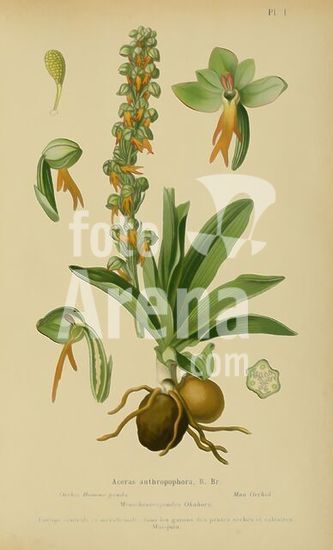
alb15281901 Album des orchidées de l'Europe centrale et septentrionale Genève Librairie Georg 1899 Europe Orchidaceae The New York Botanical Garden Pictorial works Orchis anthropophora, The illustration features the orchid species Aceras anthrophora, commonly known as the Man Orchid. Prominently displayed is a tall flowering spike adorned with numerous delicate blossoms that resemble the shape of a human figure, showcasing the unique morphology of the flowers. The image also includes detailed renderings of the plant's leaves, which are elongated and lanceolate, contributing to the overall aesthetic. In addition to the flowers, the illustration highlights the plant's bulbous root system, emphasizing its growth habit. Various stages of the flower's development are depicted, along with a small diagram of a seed, providing additional context to the reproductive aspects of this fascinating species.
DC
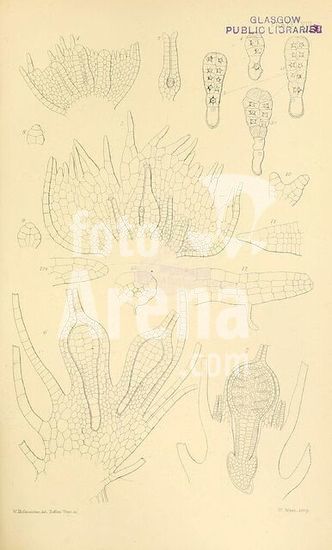
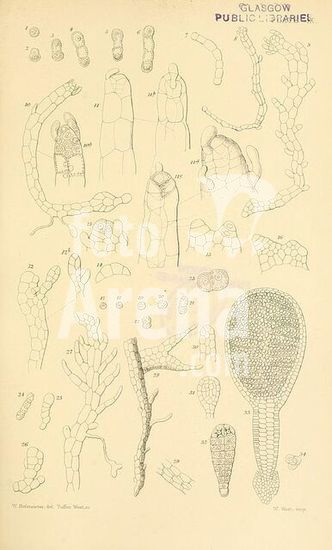
alb15281928 On the germination, development, and fructification of the higher Cryptogamia, London, Pub. for the Ray Society by R. Hardwicke, 1862. Conifers, Pteridophyta, Plant morphology, This illustration features a detailed study of various microscopic structures, likely related to plant or fungal anatomy. The arrangement showcases numerous elongated and segmented forms, including a bulbous structure at the bottom, possibly representing a spore or reproductive organ. Each section is meticulously labeled with numbers, indicating a systematic approach to classification. The intricate line work highlights the complexity and diversity within the depicted samples, making it a valuable resource for scientific understanding and research in the field of microbiology or botany. The illustration is attributed to W. H. Hudson, with a publication date of 1899, and is marked as part of the Glasgow Public Libraries collection.
DC
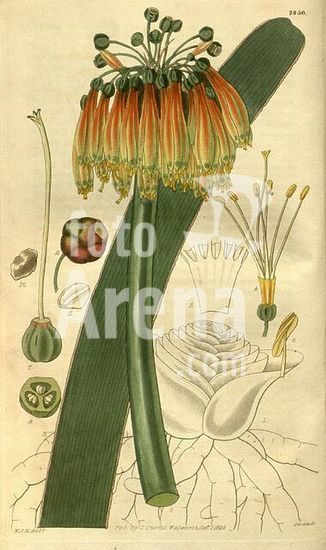
alb15281829 Curtis's botanical magazine, London, New York, botanical illustration, botany, periodicals, pictorial works, plants ornamental, Curtis, The illustration features a botanical study of a flowering plant, showcasing an intricately detailed blooming flower with elongated green stems and vibrant orange-red petals. Surrounding the central flower are additional botanical elements, including buds in various stages of development and several annotated parts, such as the ovary and stamen, emphasizing the reproductive structures. The composition is enhanced by clear labels and numerical references to specific parts, reflecting the scientific study of plant anatomy. The background showcases a large, broad leaf and other floral elements, creating a comprehensive depiction of the plant's morphology.
DC
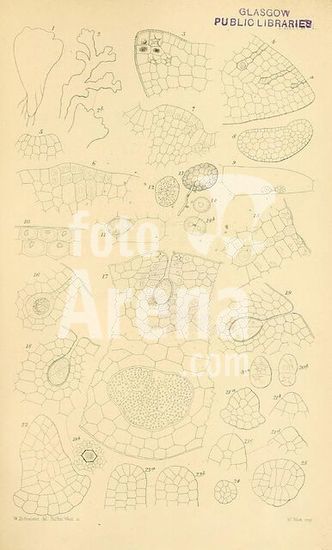
alb15282972 On the germination, development, and fructification of the higher Cryptogamia, London, Pub. for the Ray Society by R. Hardwicke, 1862, conifers, pteridophyta, plant morphology, A collection of intricately detailed scientific illustrations depicting various forms of cellular structures and plant anatomy. The visuals include elongated cells, reproductive structures, and cross-sectional views of different types of plant tissues. Each illustration is labeled with numerical annotations, indicating specific features or components. The variety showcases the complexity and diversity of cellular life, emphasizing the intricate designs found within nature. Additionally, certain figures reveal the arrangement and organization of cells, highlighting their functions and relationships in biological systems. A watermark indicating the source is present in the corner.
DC
alb15283783 Proceedings of the Zoological Society of London, London, Academic Press Periodicals, Zoology, This illustration features a collection of detailed drawings depicting various forms and structures related to the paired ovaries of Circus species, specifically focusing on egg development stages. The arrangement includes labeled sections identifying distinct shapes and sizes of the ovarian follicles, from elongated forms to rounded clusters. Each entry is meticulously outlined, showcasing the diversity in morphology associated with these reproductive structures, emphasizing biological intricacies. The use of labels such as ''l.c, ' ''r.l, ' and numerical identifiers provides clarity to the viewer, facilitating identification and study of these anatomical features.
DC
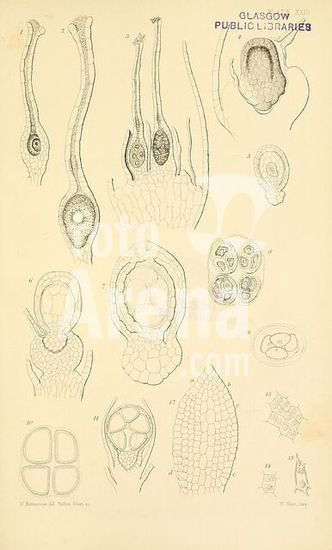
alb15284515 On the germination, development, and fructification of the higher Cryptogamia, London, Pub. for the Ray Society by R. Hardwicke, 1862. Conifers, Pteridophyta, Plant morphology, This illustration features a series of detailed anatomical and morphological studies of various cellular structures. The visual is organized into numerous labeled sections, showcasing different shapes and arrangements of cells, including polygonal formations and nests. Some sections depict larger, more complex structures, while others focus on more microscopic forms, providing insights into the diverse characteristics of cellular composition. Each part is meticulously numbered for reference, suggesting a scientific examination of biological forms. The inclusion of a library stamp indicates a historical context, hinting at its preservation and relevance to academic study.
DC
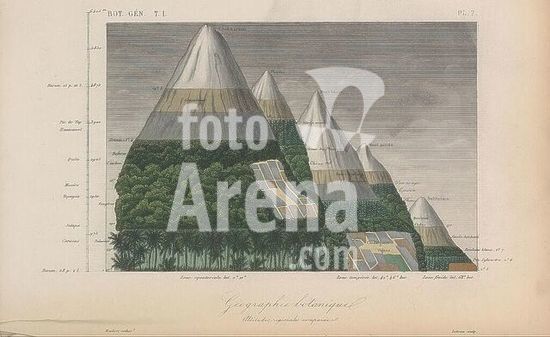
alb15369468 Traité de botanique générale, Paris, Abel Pilon et Cie, éditeurs,33 rue de fleurs, botany, pictorial works, plants, The illustration depicts a series of distinctly shaped mountain ranges with detailed topographical features. The peaks are portrayed with steep slopes, while the valleys between them are lush with greenery, indicating forested areas. Each mountain section is labeled with numerical indicators that likely represent altitude or elevation. The artistic representation contrasts the natural terrain with geometric patterns, suggesting human intervention or development in the landscape, possibly indicated by the grids on the mountainsides. Key markings and annotations provide additional context to the geographical layout, emphasizing the relationship between natural and constructed elements in this topography.
DC
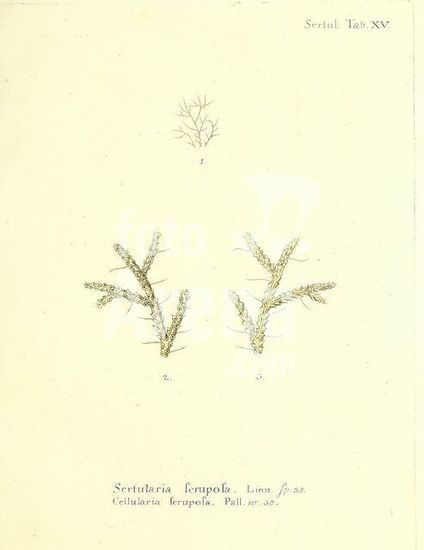
alb15369190 Die Pflanzenthiere in Abbildungen nach der Natur, Nürnberg, in der Raspischen Buchhandlung, 1791-1830, Cnidaria, Ctenophora, The illustration features three detailed botanical drawings of the plant species Sertularia cerroplis. The top sketch presents a delicate, branching structure characterized by fine, slender stems. The two lower sketches depict more developed branches, showcasing the intricate, feathery formations of the plant. Each drawing is labeled: the first with a numeral indicating its position in the series, and the subsequent sketches are accompanied by their scientific classifications. This artwork emphasizes the finer characteristics of terrestrial marine flora, capturing the elegance of this specific species.
DC
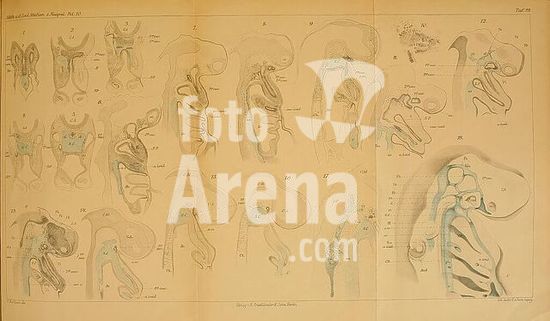
alb15360072 Mittheilungen aus der Zoologischen Station zu Neapel, Berlin, Friedlander, 1879-1921, periodicals, zoology, museum of comparative zoology, anatomy, torpedo ocellata, This illustration features a series of anatomical diagrams focused on various dissection studies. The detailed depictions showcase different anatomical structures, possibly highlighting embryonic or organ development in vertebrates. Each figure is labeled with numerical identifiers, guiding viewers through the intricate variations and features of the specimens. The layout presents a systematic exploration of the anatomical curiosities, emphasizing the complexity and diversity found within biological forms, and serves as a historical reference in the field of anatomy or developmental biology.
DC

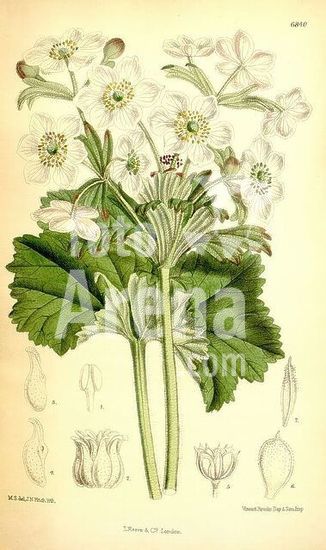
alb15367473 Curtis's Botanical Magazine London, New York Botanical Illustration Botany Periodicals Pictorial Works Plants Ornamental Curtis, A botanical illustration featuring a cluster of delicate white flowers with prominent green leaves at the base. The flowers have numerous petals and a distinct central structure, surrounded by smaller floral elements. Alongside the main illustration, several labeled drawings showcase various stages of the plant's development, including buds and seed pods. Each part of the plant is depicted with intricate detailing, highlighting the textures and shapes of the leaves and petals, emphasizing the beauty of this particular species. The illustration bears a publication mark, indicating its origin from a botanical catalog.
DC
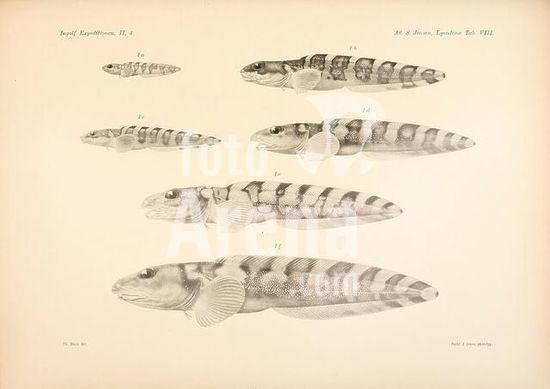
alb15368008 The Danish Ingolf-Expedition. Copenhagen, H. Hagerup, 1899-1928, Arctic Ocean, Scientific Expeditions, This composition showcases a series of meticulously illustrated fish specimens, each distinctively labeled. They exhibit a range of sizes, demonstrating the varying stages of development or different species. The fish are characterized by elongated bodies and detailed markings, which include stripes and patterns that provide insight into their biological diversity. Accompanying each specimen are numerical annotations, likely indicating their identification or classification, while a small shell-like structure appears affixed to one fish, suggesting a relationship to its habitat or anatomy. The overall arrangement highlights the beauty and complexity of marine life.
DC
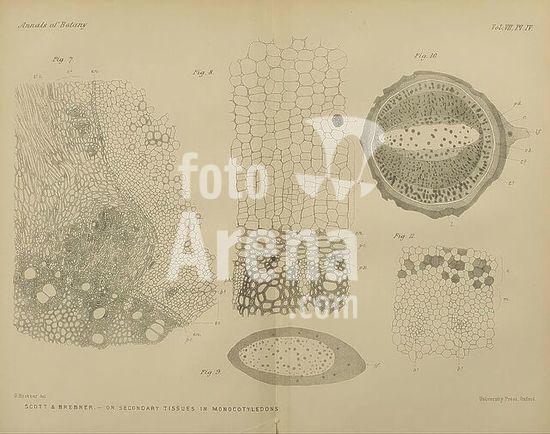
alb15369771 Annals of botany London, Botany, Periodicals, Plants., The illustration displays a series of detailed cellular diagrams, showcasing various types of secondary tissues found in monocotyledons. Numerous figures illustrate cross-sections and cellular structures, labeled with a combination of letters and numbers to indicate specific features. The diagrams highlight the complexity of plant anatomy, with different cell types and arrangements, including vascular tissue and other key components related to the growth and development of monocots. The meticulous presentation serves as a valuable reference for understanding plant biology and the structural diversity present within plant tissues.
DC
alb15391304 Historia fisica y politica de Chile según documentos adquiridos en esta republica durante doce años de residencia en ella y publicada bajo los auspicios del supremo gobierno Paris, Chile, en el Museo de historia natural de Santiago, En casa del autor 1844-71 Chile, plants, history, naturalhistory, agriculture, zoology, sources, politics and government., A historical depiction of Valparaíso, showcasing the bustling port city with its distinctive architecture and maritime activities. In the foreground, numerous boats are seen navigating the bay, while the waterfront is lined with buildings and docks. The background features rolling hills, some of which appear to be engulfed in smoke, suggesting a backdrop of either a fire or an industrial activity. Notable landmarks, including a prominent church or public building, stand out against the landscape, contributing to the city's characteristic skyline. This scene captures the dynamic nature of Valparaíso during a period of significant development and change.
DC
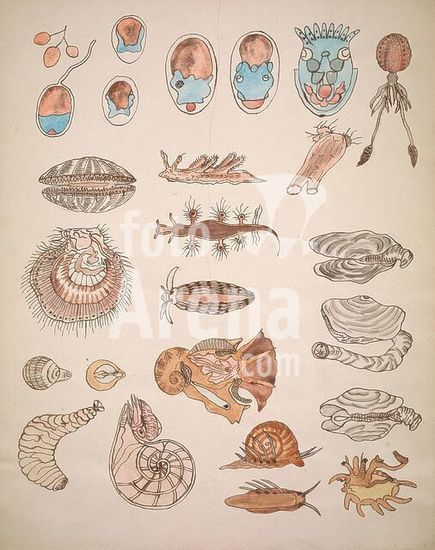
alb15391728 Drawings, illustrating, the, Lowell, Lectures, on, comparative, embryology, ca. 1849, embryology, An intricate arrangement of various marine organisms is displayed, showcasing a range of life forms from different species. At the top, several oval shapes represent fish eggs or embryos in varying shades of blue and red, highlighting their development stages. Below, a series of distinct aquatic creatures are illustrated, including a bright blue frog-like figure, a whimsical sea creature with elaborate appendages, and numerous shell varieties exhibiting complex spiral designs. The composition features detailed renditions of crustaceans, mollusks, and marine arthropods, each rendered with careful attention to anatomical details. This collection reflects the diversity of marine life, emphasizing the beauty and intricacies of underwater ecosystems.
DC
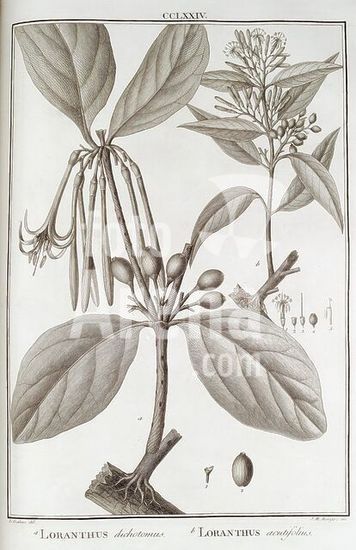
alb15395283 Flora Peruviana, et Chilensis, sive, Descriptiones et icones plantarum Peruvianarum, et Chilensium, secundum systema Linnaeanum digestae, cum characteribus plurium generum evulgatorum reformatis Madrid, Typis Gabrielis de Sancha, 1798-1802. Chile, Peru, plants, 83, This illustration features two species of the Loranthus plant, labeled as 'Loranthus dichotomus' and 'Loranthus axillaris.' Each plant is depicted with detailed botanical accuracy, showcasing their distinct leaves, flowers, and fruiting structures. The composition includes a flowering stem on the left, complete with elongated drooping flower buds, and a more upright branch on the right, which displays leaves and a cluster of developing fruit. The intricate shading and fine lines emphasize the textures of the foliage and floral components, providing a clear representation for botanical study. The caption at the bottom identifies the illustration with the Roman numeral 'CCLXXIV,' indicating its place in a larger collection.
DC
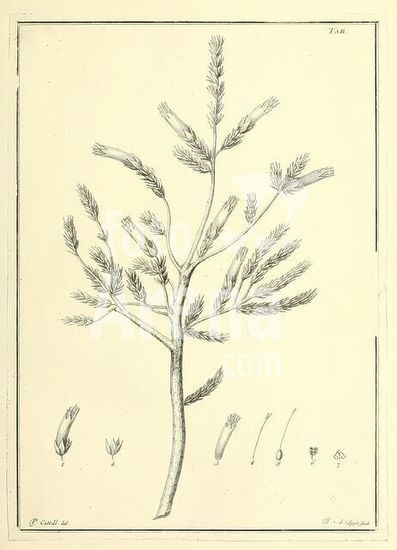
alb15392628 Ericetum africanum, Leiden, circa 1760, Ericaceae, botany, An intricate illustration of a plant species, featuring a central branch with slender, needle-like leaves arranged symmetrically. The branch is adorned with numerous floral buds, showcasing various stages of development. Below the main depiction, several smaller botanical sketches highlight individual flowers, buds, and anatomical details, providing a comprehensive study of the plant's structure. Each element is carefully labeled, demonstrating a meticulous approach to botanical illustration. This artwork reflects the intricate beauty and complexity of plant life.
DC
alb15395694 De uitlandsche kapellen, voorkomende in de drie waereld-deelen Asia, Africa en America, A Amsteldam, Chez Barthelmy Wild, 1779-1782 [i.e. 1775-1782], lepidoptera, suriname, pictorial works,, The illustration features various stages of a caterpillar's life cycle, showcasing multiple caterpillars, their eggs, and pupae. Each specimen is intricately detailed, depicting different species or stages, including both hairy and smooth-bodied caterpillars. There are clusters of eggs in differing shapes, nestled on leaves, and several pupae positioned among the foliage. The leaves are realistically rendered, serving as the habitat for the caterpillars and their developing forms. Each stage is labeled with numerical figures, suggesting a scientific classification or study related to entomology.
DC
alb15391949 A Practical Handbook of British Birds London, Witherby, 1920-24. Birds, Great Britain, Ringed Plover, Kentish Plover, Lapwing, Oystercatcher, Stone Curlew, The illustration features a series of five young birds, showcasing various species in a naturalistic style. Each chick is depicted in a different pose, illustrating their distinctive features and characteristics. The top left showcases a plump chick with a speckled pattern, while the adjacent chick has a more streamlined shape, highlighting its slender build. The third chick, positioned centrally, appears curious with its head tilted slightly. The fourth is resting, presenting its soft, downy feathers, while the bottom right chick sprawls on the ground, demonstrating its well-developed legs. Each specimen is labeled numerically, providing a detailed reference to their respective species, contributing to the understanding of avian development and diversity.
DC
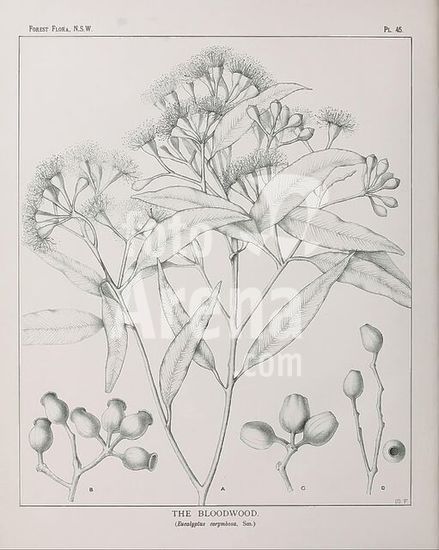
alb15390019 The forest flora of New South Wales, Sydney, W. A. Gullick, 1902-1925, Australia, New South Wales, trees, Margaret Flockton, Margaret Flockton, women in science, A botanical illustration depicting the Bloodwood tree (Eucalyptus erythronema), showcasing its distinctive features. The illustration includes a detailed representation of its leaves, flowers, and fruit. Several labeled parts highlight the structure of the plant: the long, thin leaves are prominently featured, alongside clusters of small flowers characterized by their numerous stamens. Additionally, the fruit, with its distinctive shape and texture, is illustrated in various stages of development, providing a comprehensive study of this native Australian species. The overall arrangement emphasizes the plant's natural beauty and botanical significance.
DC
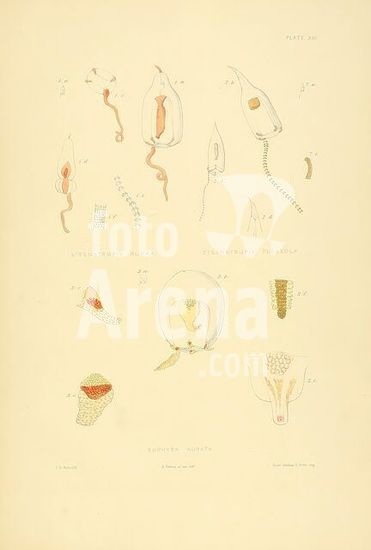
alb15395482 A monograph of the British naked-eyed Medusæ, London, 1848, Great Britain, Hydromedusae., This illustration showcases various species of marine life, with a focus on their anatomical structures. Each figure is meticulously labeled with numerical references for detailed study. The top section features elongated forms, possibly representing different stages of development or various organisms, characterized by unique curves and segmented bodies. The central area highlights distinct shapes, including a bulbous structure and elongated appendages, which could belong to different species of invertebrates. The lower part presents additional diverse forms, each with individual textures and patterns, emphasizing the biological diversity within aquatic ecosystems. The overall composition serves as a scientific reference for understanding anatomy and classification in marine biology.
DC
alb15395060 De metamorphosi eleutheratorum observationes, Kjøbenhavn, Thieles Bogtrykkeri, 1861-72, detail, illustration, details, beetles, biology, scientific illustration, De metamorphosi eleutheratorum observationes, Metamorphoses eleutheratorum, JC Schiødte, Johann Christian Schiødte, Thieles Bogtrykkeri edition, Thieles Bogtrykkeri, This illustration showcases a series of intricate, detailed anatomical structures, primarily focused on various types of molluscan shells and their cross-sections. The arrangement includes a range of shapes and sizes, highlighting the diversity of patterns found in nature. The top portion features spiraled and ribbed forms, while the central area presents a complex arrangement of chambered structures, indicative of embryonic development or internal anatomy. The lower section displays a network of cellular structures, emphasizing the microscopic features of these organisms. Each component is carefully labeled with numerical annotations, providing insight into their classification and morphology.
DC

Total de Resultados: 523

Página 1 de 6