





















































Busque também em nossas outras coleções:

Tipo de arquivo:

Tipo do arquivo:

Tipo da licença:

Orientação:

Total de Resultados: 8

Página 1 de 1

PIX4616978 Mars: Valles Marineris - Illustration - Artist's view of the grand martian canyon Valles Marineris. Valles Marineris on Mars, the largest canyon in the solar system could swallow the Grand Canyon many times over
DC
PIX4616808 Mars view of Deimos - Illustration - Mars seen from Deimos - Illustration - Mars seen from Deimos satellite. A view of Mars from its moon Deimos
DC
PIX4616806 Mars and Phobos - Illustration - Mars and Phobos - Illustration - Mars seen from its nearest satellite, Phobos. A view of Mars from its nearest moon, Phobo
DC
PIX4616971 Mars: Valles Marineris - Illustration - Artist's view of the Martian canyon filled with haze. Artwork showing the great martian canyon filled with fog
DC
PIX4616993 Mars: Noctis Labyrinthus - Illustration - Artist's view of Noctis Labyrinthus, a Martian canyon located in the western part of Valles Marineris. Panorama of Noctis Labyrinthus, a giant fault system on Mar
DC
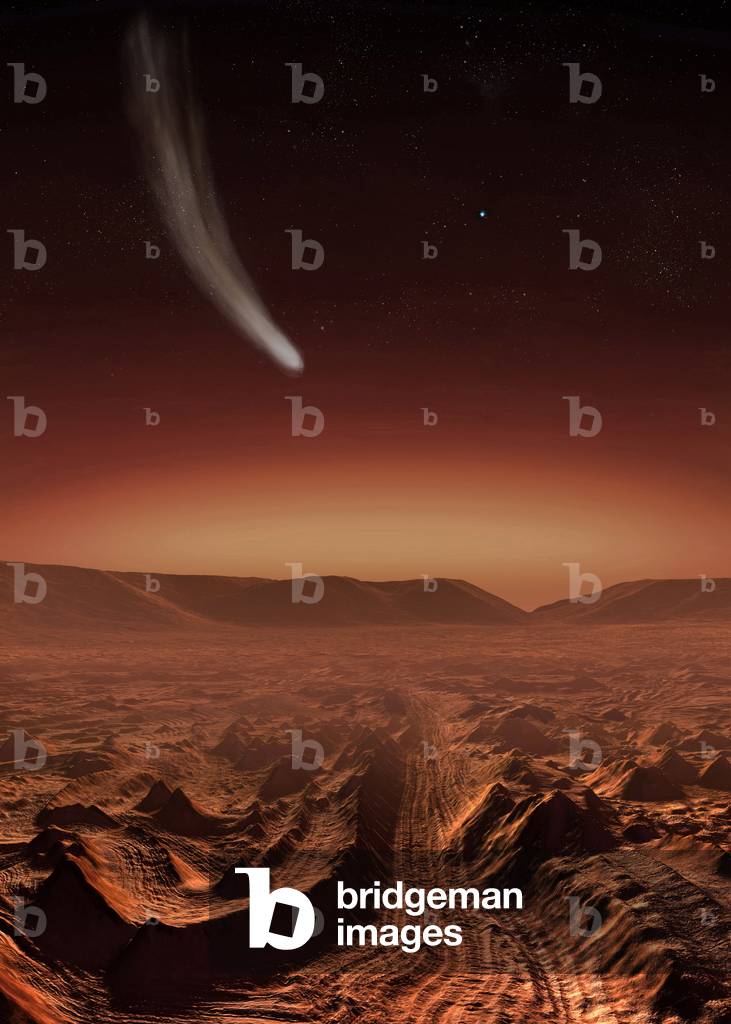
PIX4617044 A comet seen in the sky of the planet Mars - illustration - Comet Over Candor on Mars - Illustration - A comet passes over Candor Chasma, one of the canyons of Valles Marineris. In the sky, the bright spot is the planet Earth. A comet lights up the Martian predawn over the twisted landscape of Candor Chasma. The distant mountains are several kilometers high. The planet Earth shines as a bright blue star in the sky
DC
PIX4616786 Mars - Illustration - Mars - Illustration - Artist's view of the planet Mars. The three volcanoes of Tharsis and Olympus Mons are visible on the left. In the centre is the great canyon Valles Marineris. A “” full””” Mars. In this image the massive volcano Olympus Mons is clearly visible upper left of center, while near center are the three Tharsis Montes volcanoes. All these volcanoes are believed to be extinct. To the right of the Tharsis Montes are the deep canyons of Valles Marineris, a meandering network of channels as long as the United States is wide. Mars has been known historically as a bright, reddish “” star”” in Earth's sky. The ruddy hue is due to the presence of iron oxide (i.e., rust) on the martian surface. Mars is often host to white clouds of water - ice crystals (like the high - altitude cirrus clouds on Earth) and experiences seasonal dust storms that can cover the entire planet
DC
PIX4616824 Mars and Deimos - Illustration - Mars and Deimos - Illustration - Artist's view of Deimos, the smallest of Mars's two satellites. This is how Mars and its even smaller satellite Deimos might appear from a distance of about 100 miles from the surface of Deimos. Deimos is over Acidalia Planitia, an albedo feature that has been observed by Earth - bound astronomers since the 19th century. To the southwest are the fog - filled canyons of Valles Marineris, the westernmost of which are still in darkness. Beyond Mars, immediately to the left of its night side, is Phobos at a distance of 20,000 miles. The two bright objects in the lower left are the stars Beta Gruis and Al Nair in the southern constellation Grus. Like it's larger companion Phobos, Deimos does not possess enough mass to pull itself into a sphere; its shape instead is oblong with a length of about 10 miles and only 6 miles wide at its smallest dimension. Like Phobos, Deimos may be an asteroid long ago captured by Mars' gravity. Orbiting 14,600 miles above Mars' surface, Deimos completes one revolution every 30 hours
DC

Total de Resultados: 8

Página 1 de 1