














































Busque também em nossas outras coleções:

Tipo de arquivo:

Tipo do arquivo:

Orientação:

Total de Resultados: 84

Página 1 de 1

LRI9037067 NEWTON Sir Isaac, English physicist and mathematician (1642-1727).
DC
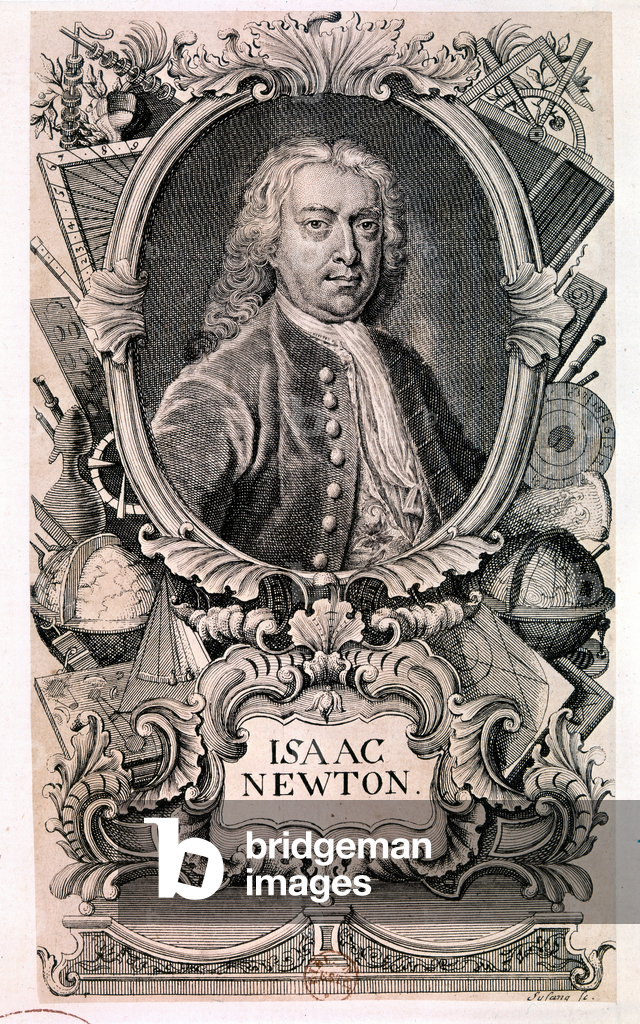
UIG5305258 Portrait of Sir Isaac Newton (1643-1727) an English mathematician, astronomer, and physicist. Dated 18th Century.
DC
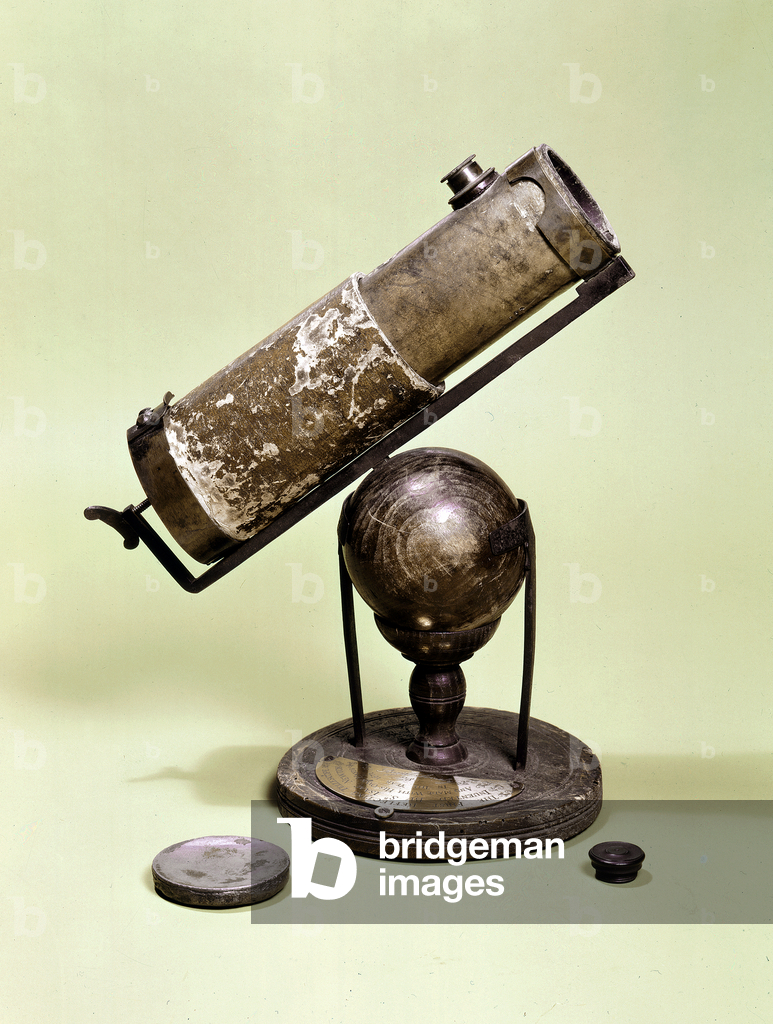
LRI9037069 NEWTON Sir Isaac, English physicist and mathematician (1642-1727): Newton's Telescope.
DC
UIS5064407 Sir Isaac Newton, English mathematician and physicist, 1689. Oil painting by Thomas Barlow, 1863, after the original by Sir Godfrey Kneller of 1689. Newton (1642-1727) graduated from Trinity College, Cambridge in 1665, becoming Lucasian Professor of Mathematics there in 1669. His theories, published in his treatise 'The Mathematical Principle of Natural Philosophy' in 1687, exerted a huge influence on science. They included the three laws of motion, the theory of gravitation and the law of cooling. As a mathematican, Newton also discovered the binomial theorem and differential calculus. His work was unique, pointing physics in a new direction and giving mathematical expression to physical phenomena. He was knighted in 1705 by Queen Anne (1665-1714) and is buried at Westminster Abbey. ©SSPL/Science Museum
DC
UIS5072541 Sir Isaac Newton, English mathematician and physicist, 1702. Oil on canvas painting. Newton (1642-1727) graduated from Trinity College, Cambridge in 1665. The following year he began his experiments into the nature of light as well as working on his ideas of planetary motion. In 1667 he returned to Cambridge and in 1669 became Lucasian Professor of Mathematics. His theories, published in 'The Mathematical Principle of Natural Philosophy' (1687), exerted a huge influence on science. They included the three laws of motion, the theory of gravitation and the law of cooling. Newton also discovered the binomial theorem and differential calculus. His work was unique, pointing physics in a new direction and giving mathematical expression to physical phenomena. ©SSPL/Science Museum
DC
XRH1730150 Sir Isaac Newton PRS (25 December 1642 – 20 March 1726/27) was an English mathematician, physicist, astronomer, alchemist, theologian, and author widely recognised as one of the greatest mathematicians and physicists of all time and among the most influential scientists.
DC
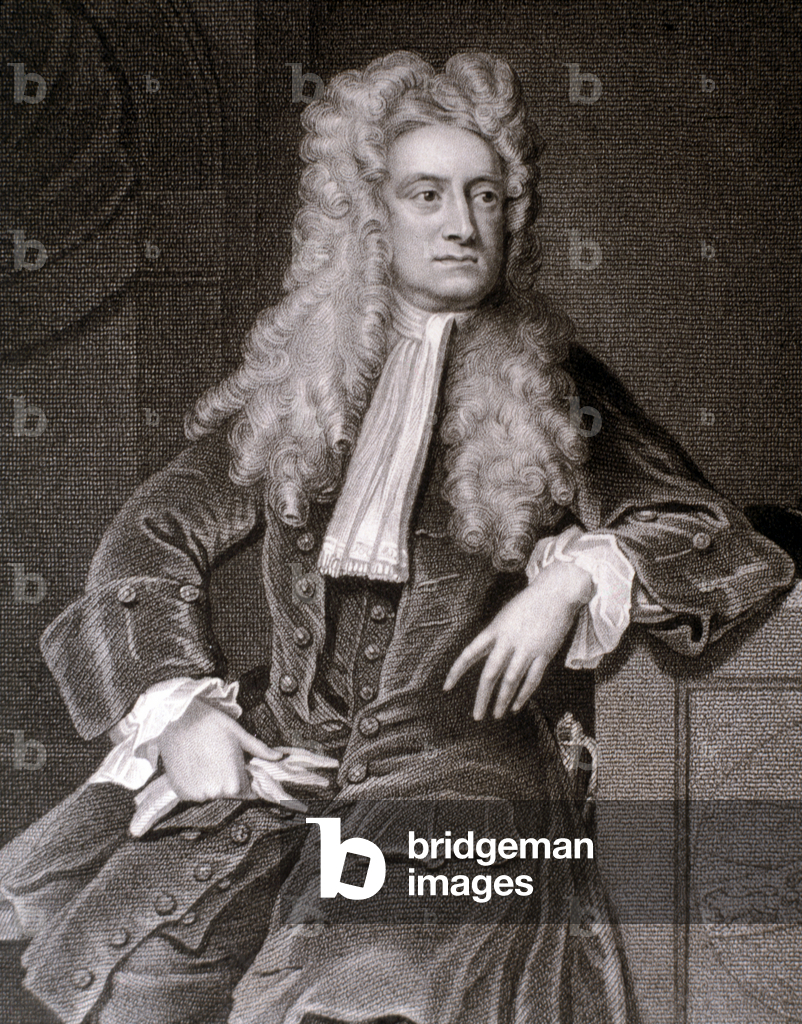
UIS5071221 Sir Isaac Newton, English mathematician and physicist, 1702. Engraving by J Smith, 1712, after an original oil painting by Sir Godfrey Kneller, 1702. Newton (1642-1727) graduated from Trinity College, Cambridge in 1665, becoming Lucasian Professor of Mathematics there in 1669. His theories, published in his treatise 'The Mathematical Principle of Natural Philosophy' in 1687, exerted a huge influence on science. They included the three laws of motion, the theory of gravitation and the law of cooling. As a mathematican, Newton also discovered the binomial theorem and differential calculus. His work was unique, pointing physics in a new direction and giving mathematical expression to physical phenomena. He was knighted in 1705 by Queen Anne (1665-1714) and is buried at Westminster Abbey. ©SSPL/Science Museum
DC
UIS5064774 "Opticks" by Sir Isaac Newton, English mathematician and physicist, 1704. Title page of this great work which explored the properties of light. Newton (1642-1727) found that by refracting light through a prism, white light was dispersed into its constituent colours. If one colour was selected and refracted through a second prism, no further colours were introduced, showing that colours were a property of light and not the prism. Newton's discovery that it was impossible to focus an image distinctly using a single lens led him to build the world's first reflecting telescope. He also discovered the three laws of motion, the theory of gravitation, the law of cooling, the binomial theorem and differential calculus. His work was unique, pointing physics in a new direction and giving mathematical expression to physical phenomena. ©SSPL/Science Museum
DC
LLE5233629 Sir Isaac Newton (1642-1727), English physicist, mathematician and astronomer. After a painting by Sir Godfrey Kneller.
DC
GRC2630121 Portrait of Sir Isaac Newton after Godrey Kneller (English, 1646-1723); engraving, 1689.
DC
PFH2635592 Sir Isaac Newton PRS MP (25 December 1642 - 20 March 1726) was an English physicist and mathematician (described in his own day as a 'natural philosopher') who is widely recognised as one of the most influential scientists of all time and as a key figure in the scientific revolution. His book Philosophiæ Naturalis Principia Mathematica ('Mathematical Principles of Natural Philosophy'), first published in 1687, laid the foundations for classical mechanics. Newton made seminal contributions to optics, and he shares credit with Gottfried Leibniz for the development of calculus.
DC
XLF3792637 Sir Isaac Newton, portrait, b. 4 January 1643 – d. 31 March 1727.Cassell's History of England, vol. III, From the Great Rebellion to the Fall of Marlborough, p.169
DC
LLM976603 The boyhood of Sir Isaac Newton. Illustration for The Picture Book (Educational Book Company, c 1920).
DC
GIA4792234 Isaac Newton (1642-1727) English physicist using his telescope.
DC
UIS5070999 Sir Isaac Newton, English mathematician and physicist, c 1725. Drawn by G M Brighty after an engraving by George Romney, based on an original oil painting by John Vanderbank. Newton (1642-1727) graduated from Trinity College, Cambridge in 1665, becoming Lucasian Professor of Mathematics there in 1669. His theories, published in his treatise 'The Mathematical Principle of Natural Philosophy' in 1687, exerted a huge influence on science. They included the three laws of motion, the theory of gravitation and the law of cooling. As a mathematican, Newton also discovered the binomial theorem and differential calculus. His work was unique, pointing physics in a new direction and giving mathematical expression to physical phenomena. Published by C G Dyer of Compton Street, London on 1 August 1817. ©SSPL/Science Museum
DC
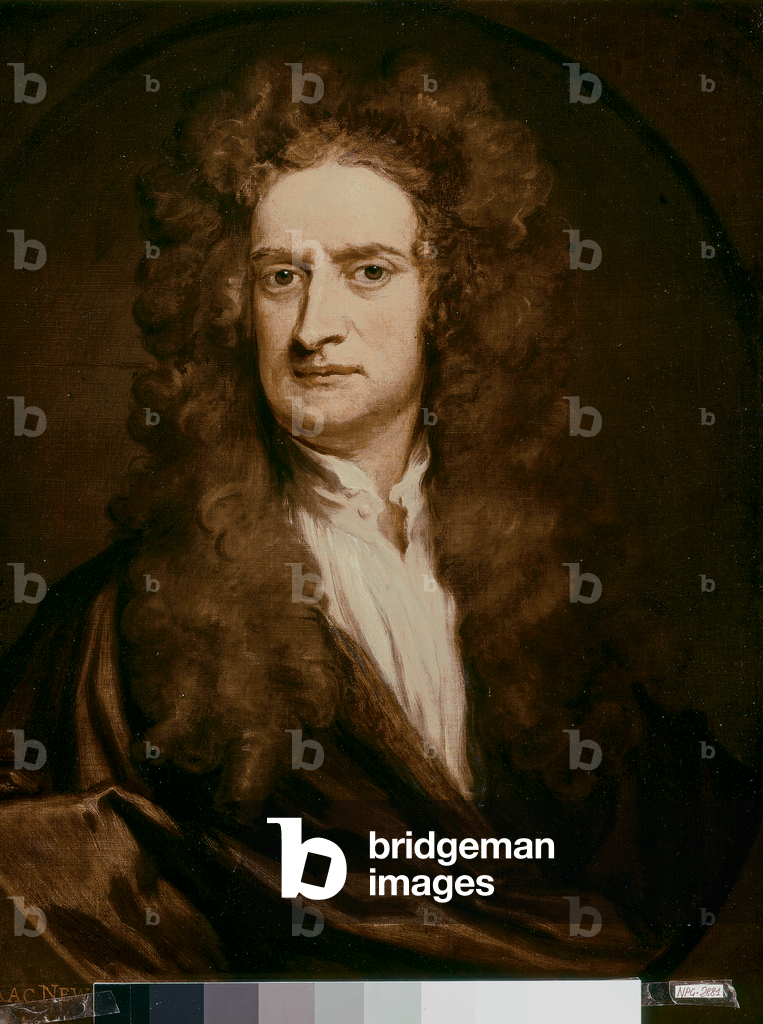
LRI9037066 NEWTON Sir Isaac, English physicist and mathematician (1642-1727): Portrait by Kneller. KNELLER Godfrey (1646-1723)
DC
XOS2635591
RF
LLM976606 Sir Isaac Newton sits dreaming. Illustration for The Picture Book (Educational Book Company, c 1920).
DC
XYC277140 Isaac Newton (1642-1727) President of the Royal Society; English mathematical scientist;
RF
LRI11908072 NEWTON Sir Isaac, English physicist and mathematician (1642-1727): Portrait
DC
LLM7190987 Sir Isaac Newton. One of a set of portraits of historical figures that appeared in the supplement to Teachers World (Evans Brothers, late 1930s).
DC
XYC277113 Sir Isaac Newton (1643-1727); President of the Royal Society; English mathematical scientist;
RF
XEE4407476 Portrait of Isaac Newton (1642-1727) English physicist.
RF
LLM979585 Sir Isaac Newton sees an apple fall. Illustration for Popular Science edited by Arthur Mee (Amalgamated Press, 1913).
DC
XEE4406354 The English physicist Isaac Newton (1642-1727) decomposing light with a prism of glass. Engraving from 1880.
RF
XLA3766460 Isaac Newton, portrait. English mathematician, physicist, astronomer and philosopher, 25 December 1642-20 March 1727-Newton 's telescope also shown.
DC
XJF4070973 Sir Isaac Newton FRS PRS (1642 – 1726) was an English mathematician, physicist, astronomer, theologian, and author;Published in "Portraits of Illustrious Personages of Great Britain" Volume 7, 1835. By Edmund Lodge;
RF
XLA3761862 Isaac Newton, portrait. English mathematician, physicist, astronomer and philosopher, 25 December 1642-20 March 1727-Newton 's telescope also shown.
DC
LLM666704 Sir Isaac Newton. Illustration from The Gallery of Portraits (Charles Knight, 1836). Digitally cleaned image.
DC
IBE5351079
DC
BAL4910 Sir Isaac Newton by Godfrey Kneller is a portrait painting of the famous physicist and mathematician.
RF
XEE4117187 Portrait of Isaac Newton (1642-1727), English mathematician, physicist and astronomer.
RF
XLA3770327 Isaac Newton-portrait-English mathematician, physicist, astronomer and philosopher, 25 December 1642-20 March 17271952 Topps Look N See Set-Break # 68 Isaac Newton VG
DC
XEE4162620 Portrait of Sir Isaac Newton 1642-1727, English physicist and mathematician - From series “” Leaders of Men” - Chromolithography - English School, 20th century -
RF
RER4397991 Portrait of Isaac Newton (1642-1727)
DC
LIP8676528 Statue of Sir Isaac Newton, by William Theed, erected on St Peter's Hill, Grantham, Lincolnshire. Illustration from The Illustrated News of the World, 2 October 1858.
DC
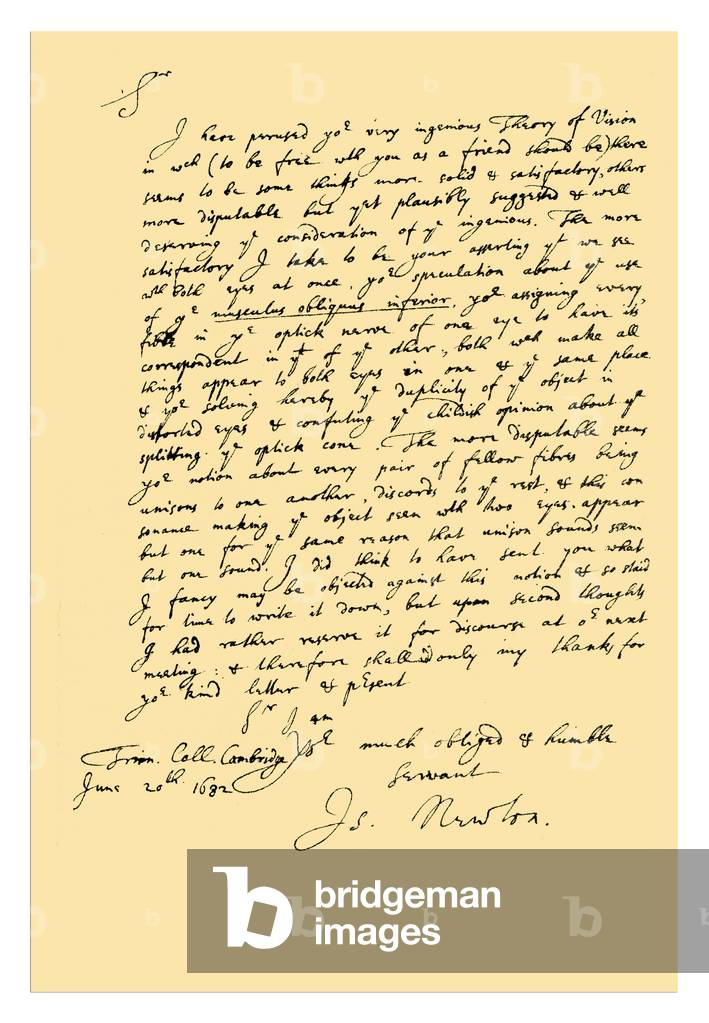
XLF3784330 Autograph: Letter from Sir Isaac Newton to William Briggs, commending his 'New Theory of Vision', but dissenting from some of Briggs' conclusions. 20 June 1682, Trinity College, Cambridge. English physicist, natural philosopher, mathematician and astronomer, 25 December 1642 – 20 March 1727. Signature: Sir Isaac Newton. Source: British Museum.Facsimiles of royal, historical, literary and other autographs in the department of manuscripts, British Museum. Edited by George F Warner 1899, Longmans & Co
DC
GIA4813801 Isaac Newton (1642-1727), English mathematician, physicist and astronomer, finds the theory of gravitation by observing the fall of an apple tree, an illustration of the 19th century.
DC
XLF3782764 Woolsthorpe House, Lincolnshire, the birthplace of Sir Isaac Newton, English physicist and mathematician, 4 January, 1643 – 31 March, 1727.Taken from 'A Short History of the English People' by J.R. Green, vol. III, published by Macmillan & Co in London and New York, 1893, p. 1302.
DC
CCI1811799 Isaac Newton (1642-1727) english mathematician, physicist and astronomer, author of the theory of terrestrial universal attraction, painting by Goldschmit (1847) after G. Kneller
DC
IBE5351148
DC
UIG5307341 Wedgewood medallion of Isaac Newton on blue Jaspar Ware. Isaac Newton (1643-1727) an English mathematician, astronomer, theologian and physicist. Dated 18th century.
DC
IBE5351159
DC
XLA3751974 Sir Isaac Newton and the theory of gravity-sitting next to an apple tree with falling apples. English physicist, mathematician, astronomer, natural philosopher, theologian. Wrote Philosophiæ Naturalis Principia Mathematica, Published in 1687. 4 January 1643-31 March 1727. (advert for Liebig)
DC
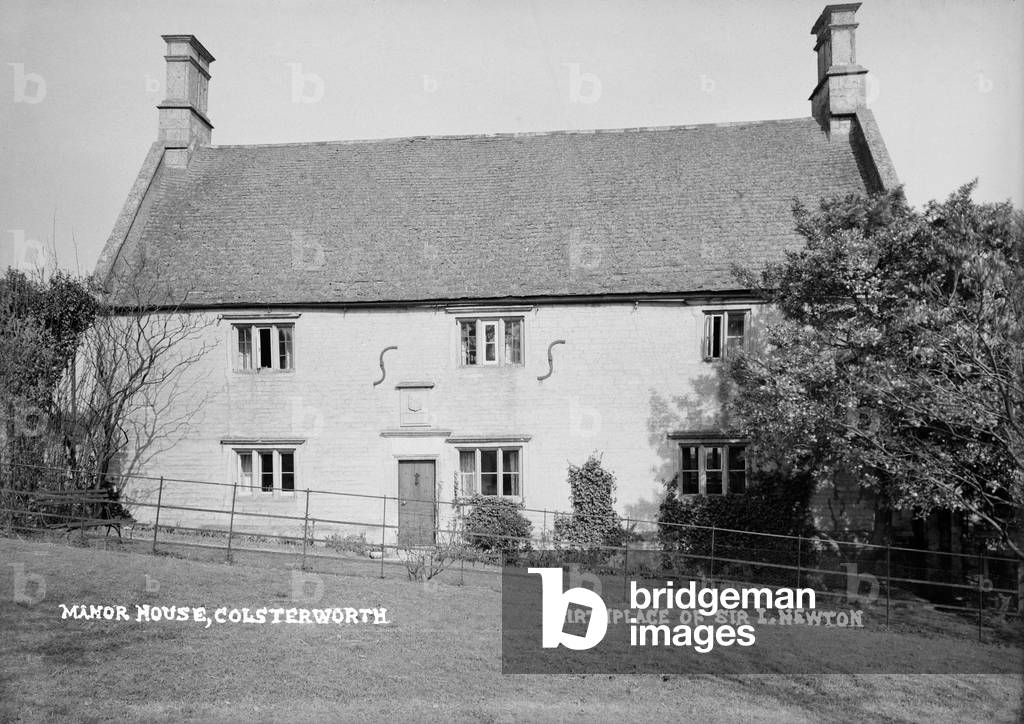
LIP8676572 The Manor House, Woolsthorpe, Lincolnshire, birthplace of Sir Isaac Newton. Illustration from The Illustrated News of the World, 2 October 1858.
DC
FIA5402788 Portrait of Sir Isaac Newton (1642-1727) by Anonymous, 1710 - Oil on canvas, 69,3x56,2 - Private Collection
DC
PFH4072274 Sir Isaac Newton PRS MP (25 December 1642 - 20 March 1726) was an English physicist and mathematician (described in his own day as a 'natural philosopher') who is widely recognised as one of the most influential scientists of all time and as a key figure in the scientific revolution. His book Philosophiæ Naturalis Principia Mathematica ('Mathematical Principles of Natural Philosophy'), first published in 1687, laid the foundations for classical mechanics. Newton made seminal contributions to optics, and he shares credit with Gottfried Leibniz for the development of calculus.
DC
XEE4107279 Portrait of Isaac Newton Seated in an Armchair - Engraving, 19th century
RF
PML114368 Society for the Diffusion of Useful Knowledge, engraved by Edward Scriven (1775-1841)
DC
GRC1202030 Vintage illustration of Isaac Newton; chromolithograph, 1923.
DC
XEE4403602 Sir Isaac Newton PRS (25 December 1642 – 20 March 1726/27) was an English mathematician, physicist, astronomer, alchemist, theologian, and author (described in his time as a "natural philosopher").
RF
JAB9223649 1643-1727, Isaac Newton, english mathematician, physicist, astronomerEngraving 1864
DC
PVD1679712 Isaac Newton (1642-1727) english mathematician, physicist and astronomer, author of the theory of terrestrial universal attraction, engraving
DC
XEE4173654 Portrait and discovery of the solar system by Isaac Newton (1642-1727), English physicist
DC
XLF3782761 Isaac Newton's solution to the problem of the Brachistrochone curve, or curve of quickest descent. English physicist and mathematician, 4 January, 1643 – 31 March, 1727.
DC
XLF3782350 Isaac Newton's solution to the problem of the Brachistrochone curve, or curve of quickest descent. English physicist and mathematician, 4 January, 1643 – 31 March, 1727.Taken from 'A Short History of the English People' by J.R. Green, vol. III, published by Macmillan & Co in London and New York, 1893, p. 1300.
DC
ELD4838881 Isaac Newton (1642-1727), English mathematician, physicist and astronomer, finds the theory of gravitation by observing the fall of an apple tree, 1667 (The apple incident: Isaac Newton, English scientist and mathematician inspired to formulate his theory of gravitation by watching the fall of an apple from a tree) Engraving 1880 Collection privee
DC
TRI98489 by Robert HannahSir Isaac Newton (1642-1726/27): English mathematician, physicist, astronomer, alchemist, theologian and author
DC
PFH3519210 Francois-Marie Arouet (21 November 1694 - 30 May 1778), more commonly known by his nom de plume Voltaire, was a French Enlightenment historian, philosopher and writer. He was famous for his advocacy of freedom of religion, freedom of speech and separation of church and state, often attacking the Catholic Church through his wit and writings.Voltaire was a prolific and versatile writer, with more than 20,000 letters and over 2,000 books and pamphlets to his name, as well as plays, poems, essays and historical and scientific works. Despite the strict censorship laws of the time, Voltaire often spoke up in favour of civil liberties, and regularly used satire to criticise intolerance, religious dogma and other pillars of French institutions of his day.
DC
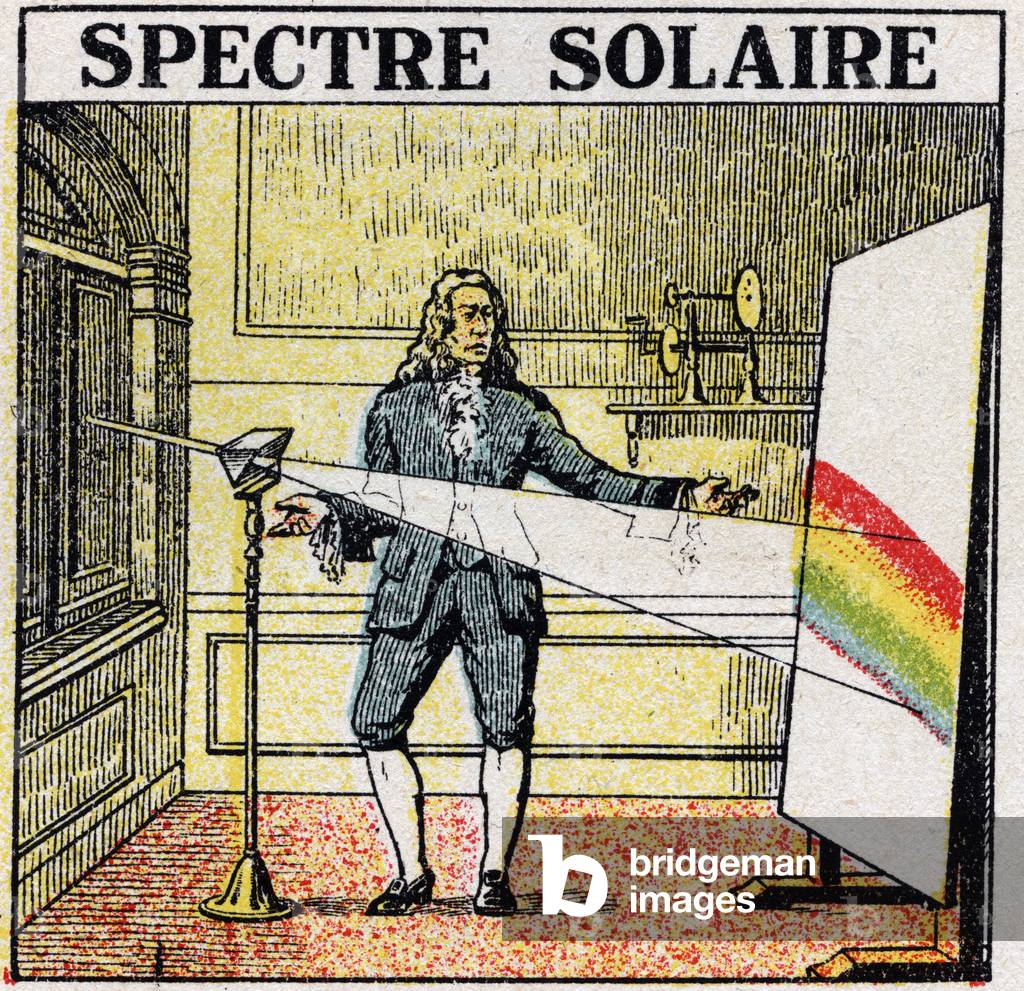
XEE4140529 The colours: solar spectrum studied by Isaac Newton (1642-1727). Anonymous illustration from 1925. Private collection.
RF
PVD1684265 Isaac Newton (1642-1727) english mathematician, physicist and astronomer, author of the theory of terrestrial universal attraction, here dispersing light with a glass prism, engraving
DC
PVD1688368 Isaac Newton (1642-1727) English scientist and mathematician, using a prism to break white light into spectrum. With Cambridge room mate John Wickins. Engraving of 1874. engraving colourized document
DC
KWE189091 President of the Royal Society
DC
XAL885758 Sir Isaac Newton was an English mathematician, physicist, astronomer, alchemist, theologian, and author who was described in his time as a natural philosopher.
DC
UIS5067959 Dedication page of Newton's 'Principia Mathematica', 1687. Dedication in Latin to King Charles II (1630-1685). The 'Principia' (1687) established English physicist and mathematician Newton's (1642-1727) reputation as a great scientist. His discoveries were prolific and exerted a huge influence on science and thought: they include the three laws of motion, the theory of gravitation and the law of cooling. As a mathematician Newton discovered the binomial theorem and the calculus. ©SSPL/Science Museum
DC
KWE3742774
DC
IBE5351162 Sir Isaac Newton (1642-1727) British mathematician, physicist and astronomer. This edition of 1740 in Rome, is dedicated to George II (1683-1760), King of Great Britain and Ireland and Charles II (1630-1685) King of England, Scotland and Ireland.
DC
XEE4411089 Portrait of Isaac Newton (1642-1727). Chromolithography of the late 19th century.
RF
UIS5067946 Title page to Newton's 'Principia Mathematica', 1687. Book One of English physicist and mathematician Isaac Newton's (1642-1727) 'Philosophiae Naturalis Principia Mathematica' applies the laws of motion to the behaviour of bodies. Book Two continues with the motion of resisted bodies in fluids and with the behaviour of fluids themselves. Book Three ('The System of the World') applies the Law of Universal Gravitation to the motion of planets, moons and comets within the Solar System. The 'Principia' (1687) established Newton's reputation as a great scientist. His discoveries were prolific and hugely influential on science and thought. He also wrote on the law of cooling, the binomial theorem and the calculus. ©SSPL/Science Museum
DC
HIM5302293 Woolsthorpe Manor House, Newton Way, Colsterworth, Lincolnshire, 1896-1920. Artist: Alfred Newton & Sons - Woolsthorpe Manor House, Newton Way, Colsterworth, Lincolnshire, 1896-1920. The birthplace of physicist and mathematician Sir Isaac Newton.
DC
UIS5067951 Inside title page to Newton's 'Principia Mathematica', 1687. Book One of English physicist and mathematician Isaac Newton's (1642-1727) 'Philosophiae Naturalis Principia Mathematica' applies the laws of motion to the behaviour of bodies. Book Two continues with the motion of resisted bodies in fluids and with the behaviour of fluids themselves. Book Three ('The System of the World') applies the Law of Universal Gravitation to the motion of planets, moons and comets within the Solar System. The 'Principia' (1687) established Newton's reputation as a great scientist. His discoveries were prolific and hugely influential on science and thought. He also wrote on the law of cooling, the binomial theorem and the calculus. ©SSPL/Science Museum
DC
XEE4139748 Gravitation: portrait of Isaac Newton (1642-1727) who discovered the laws of gravity (gravite). Anonymous illustration from 1925. Private collection.
RF
JB1219513 Sir Isaac Newton (1642-1726/27) was an English physicist and mathematician (described in his own day as a "natural philosopher") who is widely recognised as one of the most influential scientists of all time and a key figure in the scientific revolution.
DC
XEE4139764 Gravitation: Newton's apple. Isaac Newton (1642-1727) observes an apple falling from an apple tree and discovers the laws of earth gravity (gravite). Anonymous illustration from 1925. Private collection.
RF
XLF3782354 Woolsthorpe House, Lincolnshire, the birthplace of Sir Isaac Newton, English physicist and mathematician, 4 January, 1643 – 31 March, 1727.Taken from 'A Short History of the English People' by J.R. Green, vol. III, published by Macmillan & Co in London and New York, 1893, p. 1302.
DC
LLM5996184 Log from Sir Isaace Newton's apple tree from his garden at Woolsthorpe, Lincolnshire. Illustration from Hutchinson's Splendour of the Heavens (Hutchinson & Co, London, 1923).
DC
XEE4164319 Isaac Newton (1642-1727), English mathematician and astronomer, discovering the notion of earth gravity through an apple falling from an apple tree of Woolsthorpe.
RF
LLM976605 The man who won imperishable fame. Sir Isaac Newton blowing soap bubbles to study light. Illustration for The Picture Book (Educational Book Company, c 1920).
DC
HIM5296425 La decouverte de la loi de la gravitation. Description d'un des freres Wright dont l'avion s'est ecrase sur le pommier qui a inspire a Isaac Newton la loi de l'attraction universelle. Lithographie de Louis Glackens, 1910 - The Discovery of the Law of Gravitation, pub. 1910 (colour lithograph). Depicting The Wright brothers and Sir Isaac Newton (1643 - 1727)
DC
KDC441037 Isaac Newton (1642-1727); English physicist, mathematician and President of the Royal Society; letter praises the physician and oculist William Briggs (c.1650-1704) for his 'New Theory of Vision' with certain reservations; facsimile from 'Facsimiles of Royal, Historical & Literary Autographs in the Department of Manuscripts', British Museum, 4th series, printed for the Trustees, 1898; Add.MS.32681,f.209.;
DC
KDC384151 Isaac Newton (1642-1727); English physicist, mathematician and President of the Royal Society; letter praises the physician and oculist William Briggs (c.1650-1704) for his 'New Theory of Vision' with certain reservations; facsimile of manuscript in British Library, Add.MS. 4237, f.32;
DC
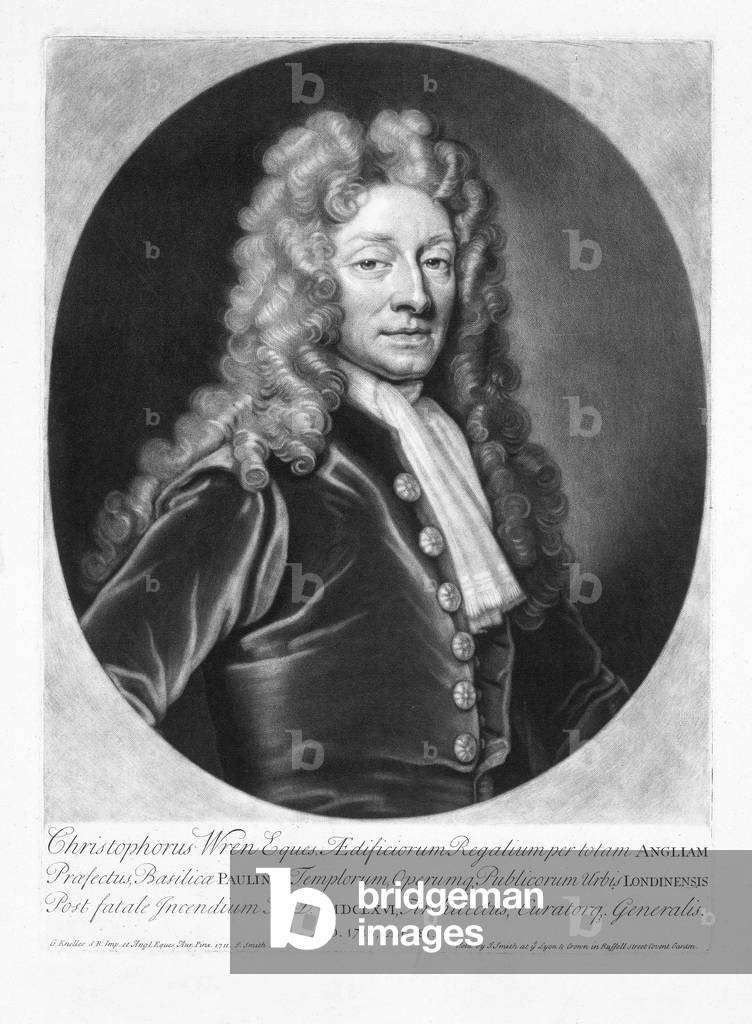
PFH3431867 Sir Christopher Wren PRS (30 October 1632 – 8 March 1723) is one of the most highly acclaimed English architects in history. He was accorded responsibility for rebuilding 52 churches in the City of London after the Great Fire in 1666, including what is regarded as his masterpiece, St. Paul's Cathedral, on Ludgate Hill, completed in 1710. Educated in Latin and Aristotelian physics at the University of Oxford, Wren was a notable anatomist, astronomer, geometer, and mathematician-physicist, as well as an architect. He was a founder of the Royal Society (president 1680–82), and his scientific work was highly regarded by Isaac Newton and Blaise Pascal.
DC
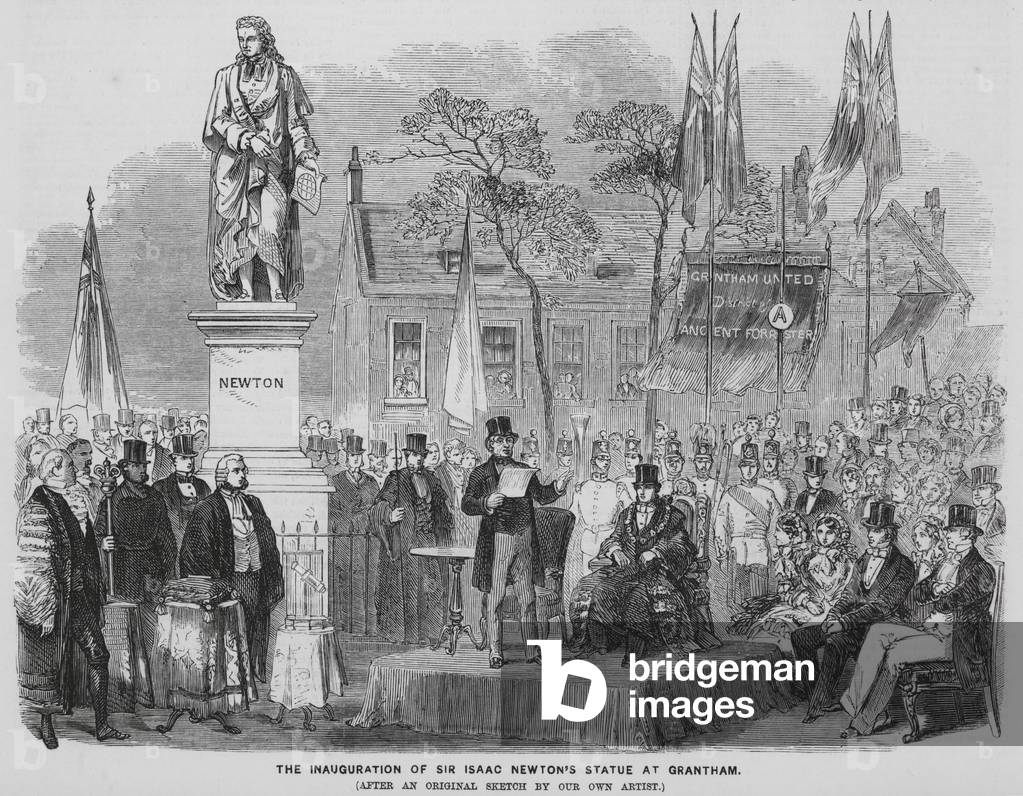
LIP8676522 Inauguration of Sir Isaac Newton's statue, Grantham, Lincolnshire. Illustration from The Illustrated News of the World, 2 October 1858.
DC
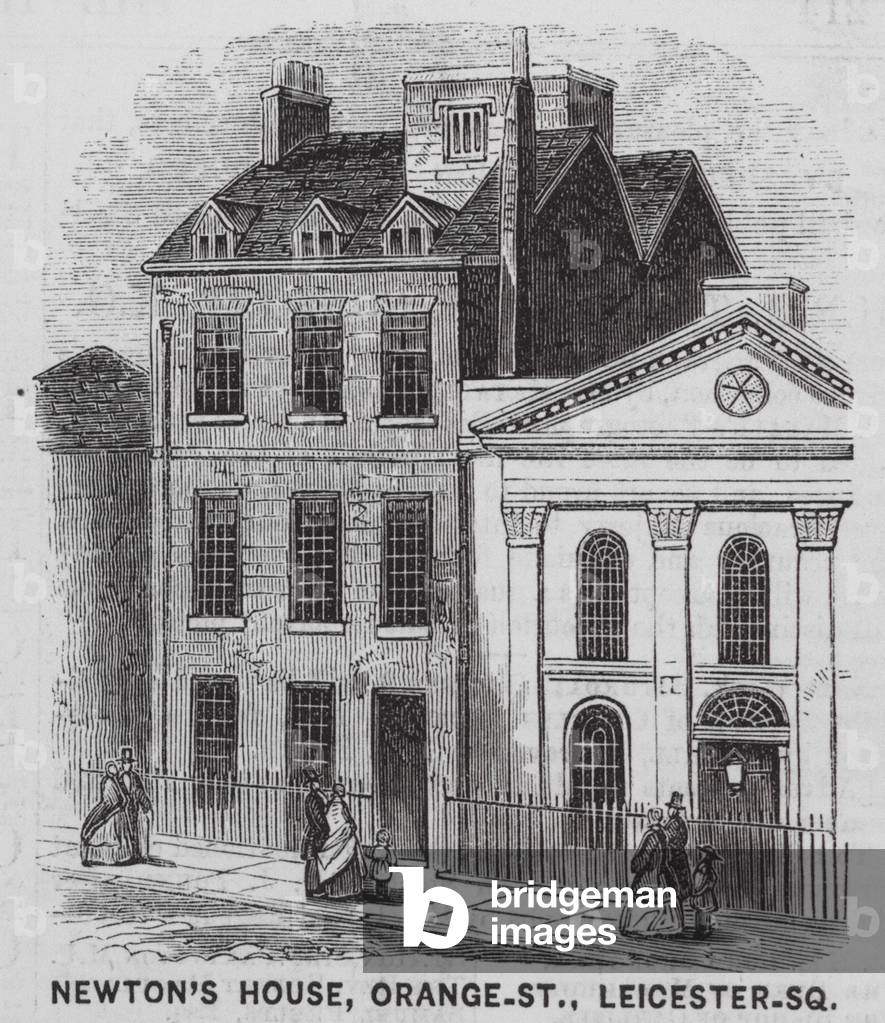
LIP8676573 Sir Isaac Newton's House, Orange Street, Leicester Square, London. Illustration from The Illustrated News of the World, 2 October 1858.
DC

Total de Resultados: 84

Página 1 de 1