




















































Busque também em nossas outras coleções:

Tipo de arquivo:

Tipo do arquivo:

Orientação:

Total de Resultados: 5

Página 1 de 1

PIX4634623 L'Universe en forme de dodecaedre - Dodecahedral universe - Representation of the theoretical model of the dodecaedric space of Poinsare (PDS). This model envisaged by Jean-Pierre Luminet describes a closed but infinite universe. Artwork showing the theorical model of Universe called Poincare Dodecahedral Space (PDS). This model was suggested by english researcher Jean-Pierre Luminet to explain the shape of the universe; it describes a multiply-connected universe
DC
PIX4634241 From Big Bang to Today - From Big Bang to the Earth. Artwork - Artist's view showing the stages of formation of the universe. From left to right, the Big Bang, the first stars, the formation of galaxies, and a zoom in on the place of the solar system in the universe. Universe from the beginning (left), the first stars, first galaxies, to the solar system
DC
PIX4646038 Satellite Planck. Illustration - Artist's view of the European satellite Planck separating from the upper floor of the Ariane V rocket, 30 minutes after its launch. This satellite measures temperature fluctuations in the fossil radiation of the primordial universe. Planck separates from upper stage. Planck separated from the launcher about 30 minutes after launch, a couple of minutes after Herschel. The two spacecraft independently headed towards their respective orbits around the second Lagrange point of the Sun - Earth system (L2), some 1.5 million km from Earth in the direction opposite to the Sun. Planck is the first european mission to study the relic radiation from the Big Bang. Ever since the detection of small fluctuations in the temperature of this radiation, called Cosmic Microwave Background, astronomers have used the fluctuations to understand both the origin of the Universe and the formation of galaxies
DC
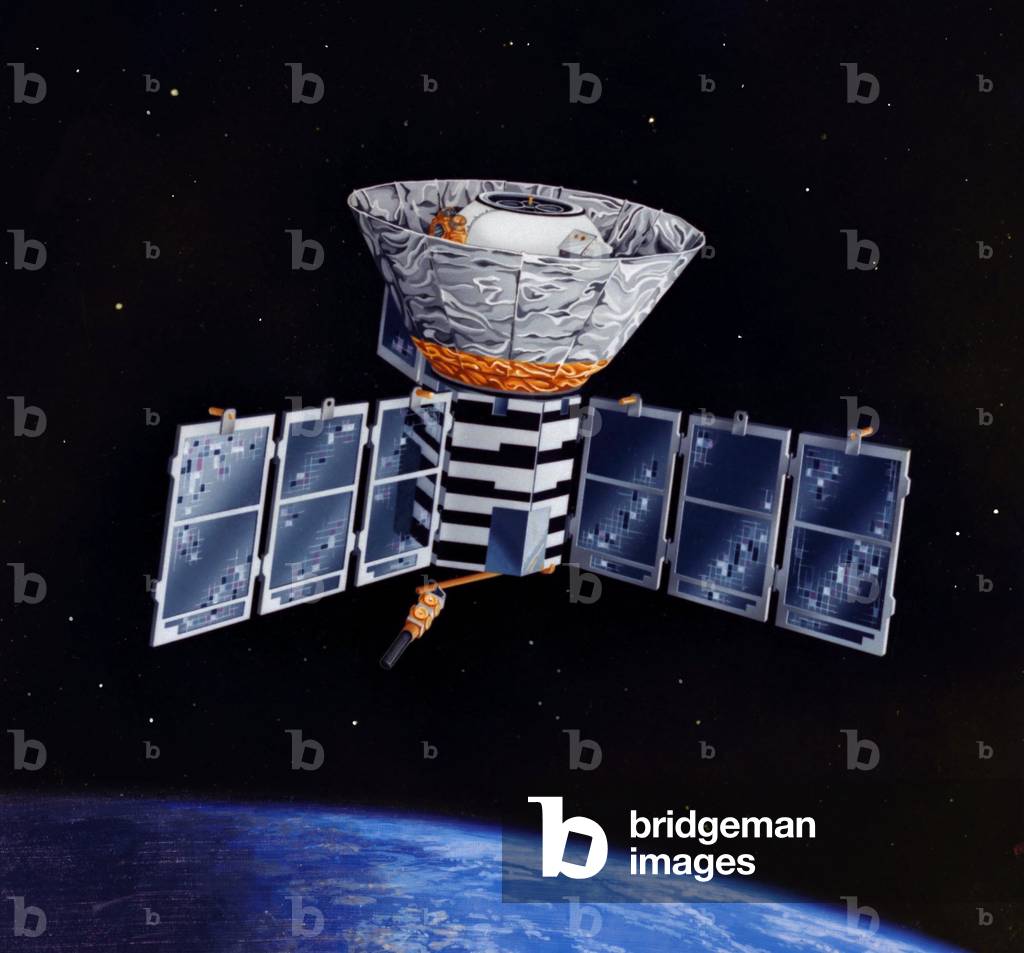
PIX4645980 Satellite Cobe - Illustration - The COBE satellite was developed by NASA's Goddard Space Flight Center to measure the diffuse infrared and microwave radiation from the early universe to the limits set by our astrophysical environment. It was launched November 18, 1989 and carried three instruments, a Far Infrared Absolute Spectrophotometer (FIRAS) to compare the spectrum of the cosmic microwave background radiation with a precise blackbody, a Differential Microwave Radiometer (DMR) to map the cosmic radiation sensitively, and a Diffuse Infrared Background Experiment (DIRBE) to search for the cosmic infrared background radiation
DC
PIX4646030 Satellite Planck - Illustration - Artist's view of the European satellite Planck. This satellite measures temperature fluctuations in the fossil radiation of the primordial universe. Artist view of Esa's Planck observatory. Planck is the first european mission to study the relic radiation from the Big Bang. Ever since the detection of small fluctuations in the temperature of this radiation, called Cosmic Microwave Background, astronomers have used the fluctuations to understand both the origin of the Universe and the formation of galaxies
DC

Total de Resultados: 5

Página 1 de 1