





















































Busque também em nossas outras coleções:

Data da imagem:
Pauta
ver mais opções...
Agência
ver mais opções...
Fotógrafo
ver mais opções...
Pais
Estado
Cidade
ver mais opções...
Local
ver mais opções...
Tipo de licença
Orientação
Coleção
ver mais opções...

Total de Resultados: 323

Página 1 de 4
71096_rf_28_total ecipse of the sun_195a1h A Total Eclipse Of The Sun , As Seen From Space, Showing The Earth & The Total Eclipse In Action.
DC
71096_rf_28_roaring t_rex_196a1h A Carnivorous T.Rex Dinosaur From Earths Cretaceous Era Roaring.
DC
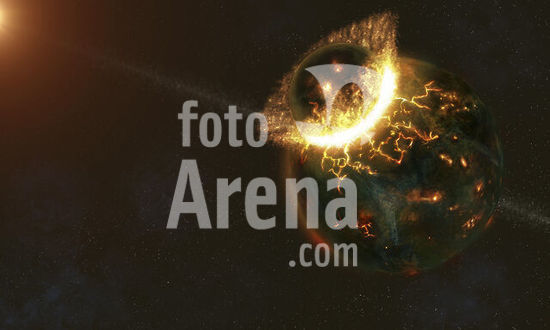
71096_rf_28_creation of the moon,195a1h A 3D Conceptual Image, Showing The Creation Of The Moon, Many Millions Of Years Ago.
DC
71096_rf_28_creation of the moon_195a2h A 3D Conceptual Image, Showing The Creation Of The Moon, Many Millions Of Years Ago.
DC
990_05_1-Sci-Astro-HB_5HR Moon: May, 1969 View of the earth rising above the lunar horizon photographed from the Apollo 10 Lunar Module, (Snoopy) as it orbited around the moon. © Underwood Archives / The Image Works
DC
00624439 astronomy, moon, first photo of the earth (left), taken from the vicinity of the moon, by Lunar Orbiter I, 23.8.1966,
DC
948_05_01252797 From the Middle Kingdom from there were three main places of worship in Thebes, Elephantine on the upper Nile and in Memphis. Was worshiped there Gods triads, was handed out by the chief god a wife and a son. So it was in Thebes: Amun, the sun god and the goddess Mut and Khonsu All-Father, the moon-god; in Elephantine Khnum was the Allbildner, the others were Hekat and Amakt, in Memphis was worshiped Hapi, the sun, the Nile and earth god with the sacred bull Apis him, the war goddess Sekhmet and their son Nefertum, the god of death. These and other deities were worshiped now in a myriad of temples that attract as stone witnesses of a bygone time both our religion, as cultural and art historical interest. The mightiest abundance of temples offered the old 100 - engined Thebes, in which we recognize here the hewn in the rock temple of Deir el Bahri, the mighty Queen Hatshepsut create.
DC
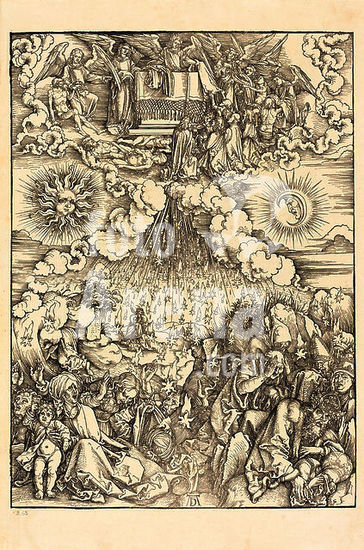
alb3733100 The Opening of the Fifth and Sixth Seal. Dated: 1498. Dimensions: image: 39.2 x 28.6 cm (15 7/16 x 11 1/4 in.) sheet: 45.6 x 31.2 cm (17 15/16 x 12 5/16 in.). Medium: woodcut on laid paper. Museum: National Gallery of Art, Washington DC. Author: ALBRECHT DURER.

DC
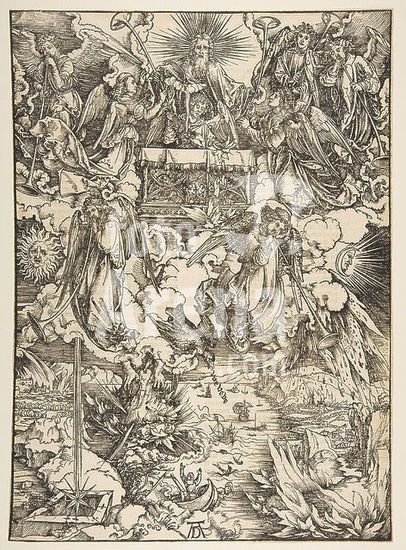
alb3655026 The Seven Angels with the Trumpets, from The Apocalypse, Latin Edition, 1511. Artist: Albrecht Dürer (German, Nuremberg 1471-1528 Nuremberg). Dimensions: sheet: 15 5/16 x 11 1/16 in. (38.9 x 28.1 cm). Date: 1511. Museum: Metropolitan Museum of Art, New York, USA.
DC
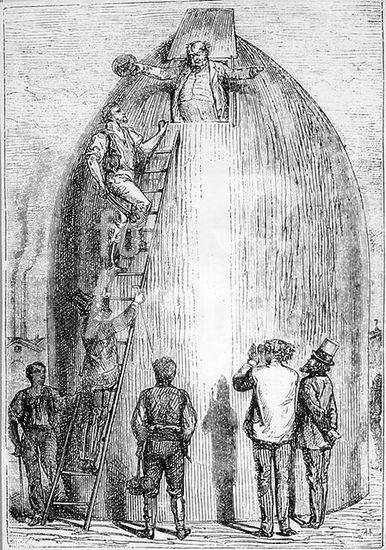
akg138815 Verne, Jules French writer; 1828-1905. Works: From the Earth to the Moon (De la terre a la lune, 1865). Moon rocket. Woodcut, 1865. Author: ANONYMOUS.
DC
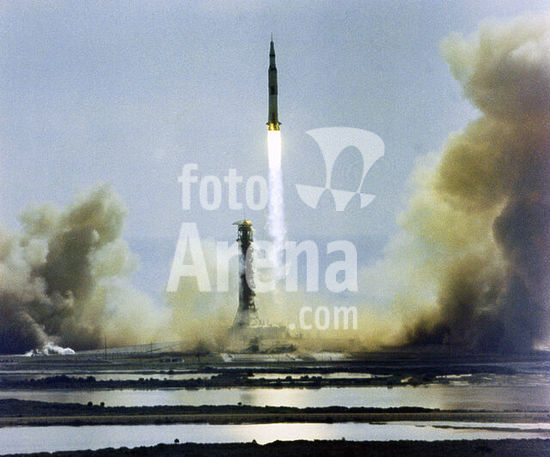
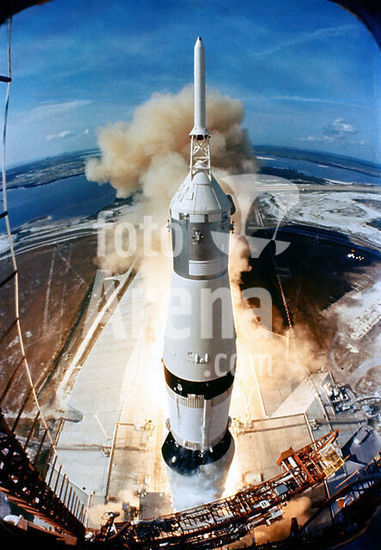
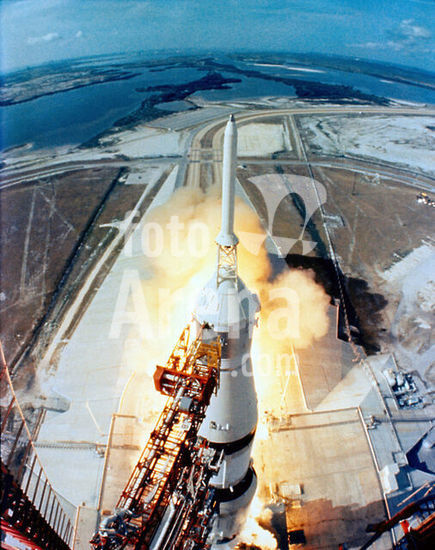
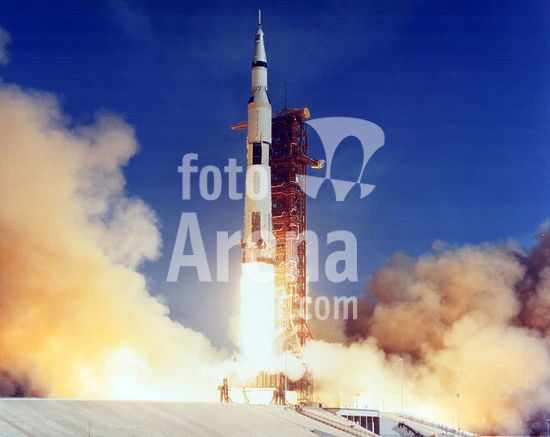
akg6359164 Apollo 11 Mission / 20th Century. Launch of the Saturn V vehicule. The Apollo 11 mission, the first manned lunar mission, launched from the Kennedy Space Center, Florida via the Marshall Space Flight Center (MSFC) developed Saturn V launch vehicle on July 16, 1969 and safely returned to Earth on July 24, 1969. The Saturn V vehicle produced a holocaust of flames as it rose from its pad at Launch complex 39. The 363 foot tall, 6,400,000 pound rocket hurled the spacecraft into Earth parking orbit and then placed it on the trajectory to the moon for man's first lunar landing. Aboard the space craft were astronauts Neil A. Armstrong, commander; Michael Collins, Command Module pilot; and Edwin E. Aldrin Jr., Lunar Module pilot. Photo, July 16, 1969.
DC
akg6359172 Apollo 11 Mission / 20th Century. Launch of the Saturn V vehicule. The Apollo 11 mission, the first manned lunar mission, launched from the Kennedy Space Center, Florida via the Marshall Space Flight Center (MSFC) developed Saturn V launch vehicle on July 16, 1969 and safely returned to Earth on July 24, 1969. The Saturn V vehicle produced a holocaust of flames as it rose from its pad at Launch complex 39. The 363 foot tall, 6,400,000 pound rocket hurled the spacecraft into Earth parking orbit and then placed it on the trajectory to the moon for man's first lunar landing. Aboard the space craft were astronauts Neil A. Armstrong, commander; Michael Collins, Command Module pilot; and Edwin E. Aldrin Jr., Lunar Module pilot. Photo, July 16, 1969.
DC
akg6359173 Apollo 11 Mission / 20th Century. Launch of the Saturn V vehicule. The Apollo 11 mission, the first manned lunar mission, launched from the Kennedy Space Center, Florida via the Marshall Space Flight Center (MSFC) developed Saturn V launch vehicle on July 16, 1969 and safely returned to Earth on July 24, 1969. The Saturn V vehicle produced a holocaust of flames as it rose from its pad at Launch complex 39. The 363 foot tall, 6,400,000 pound rocket hurled the spacecraft into Earth parking orbit and then placed it on the trajectory to the moon for man's first lunar landing. Aboard the space craft were astronauts Neil A. Armstrong, commander; Michael Collins, Command Module pilot; and Edwin E. Aldrin Jr., Lunar Module pilot. Photo, July 16, 1969.
DC
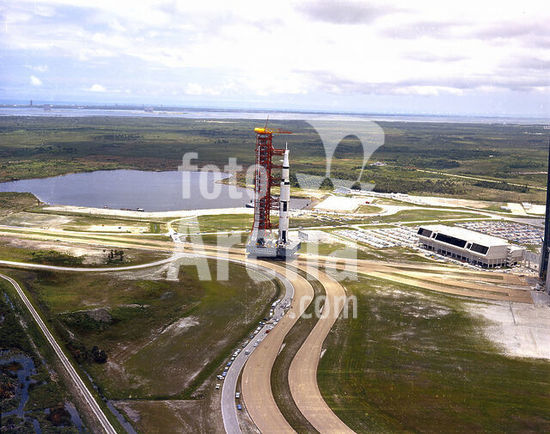
akg6359187 Apollo 11 Mission / 20th Century. View of the Saturn V launch platform. Aboard a Saturn V launch vehicle, the Apollo 11 mission launched from The Kennedy Space Center, Florida on July 16, 1969 and safely returned to Earth on July 24, 1969. The space vehicle is shown here during the rollout for launch preparation. The 3-man crew aboard the flight consisted of Neil A. Armstrong, commander; Michael Collins, Command Module pilot; and Edwin E. Aldrin Jr., Lunar Module pilot. Armstrong was the first human to ever stand on the lunar surface, followed by Edwin (Buzz) Aldrin. The crew collected 47 pounds of lunar surface material which was returned to Earth for analysis. The surface exploration was concluded in 2½ hours. With the success of Apollo 11, the national objective to land men on the Moon and return them safely to Earth had been accomplished. The Saturn V launch vehicle was developed by the Marshall Space Flight Center under the direction of Dr. Wernher von Braun. Photo, July 16, 1969.
DC
akg6359237 Apollo 11 Mission / 20th Century. Launch of the Saturn V vehicule. The Apollo 11 mission, the first manned lunar mission, launched from the Kennedy Space Center, Florida via the Marshall Space Flight Center (MSFC) developed Saturn V launch vehicle on July 16, 1969 and safely returned to Earth on July 24, 1969. The Saturn V vehicle produced a holocaust of flames as it rose from its pad at Launch complex 39. The 363 foot tall, 6,400,000 pound rocket hurled the spacecraft into Earth parking orbit and then placed it on the trajectory to the moon for man's first lunar landing. Aboard the space craft were astronauts Neil A. Armstrong, commander; Michael Collins, Command Module pilot; and Edwin E. Aldrin Jr., Lunar Module pilot. Photo, July 16, 1969.
DC
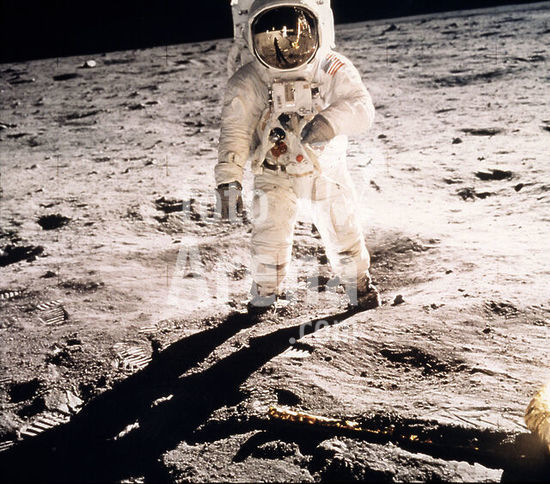
alb457168 Buzz Aldron on the moon from Apollo 11. NEIL ARMSTRONG. BUZZ ALDRIN.
DC
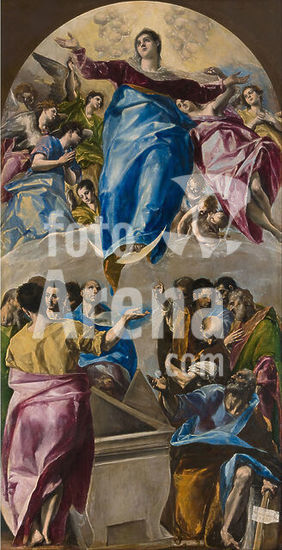
alb3896519 Assumption of the Virgin. Date/Period: From 1577 until 1579. Painting. Oil on canvas. Height: 4,032 mm (13.22 ft); Width: 2,118 mm (83.38 in). Author: EL GRECO.
DC
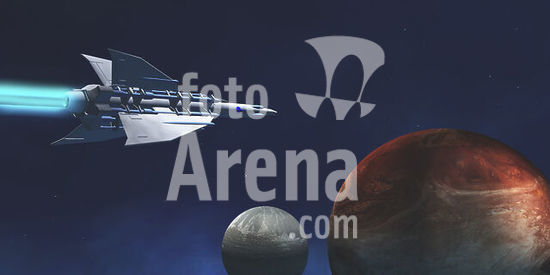
alb5575520 A starship from Earth travels to a red planet to begin an exploratory expedition.
DC
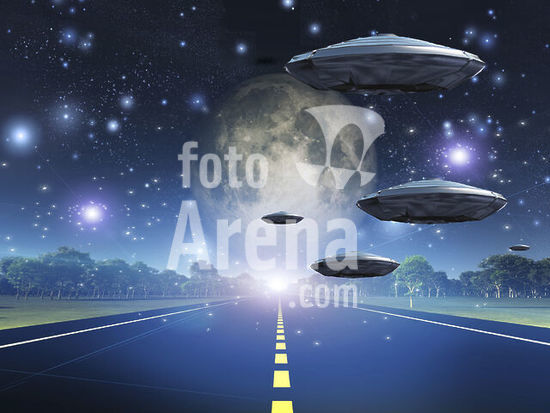
alb5576846 Full moon seen from Earth. Flying saucers over the highway.
DC
alb5576874 Terraformed moon seen from Earth.
DC
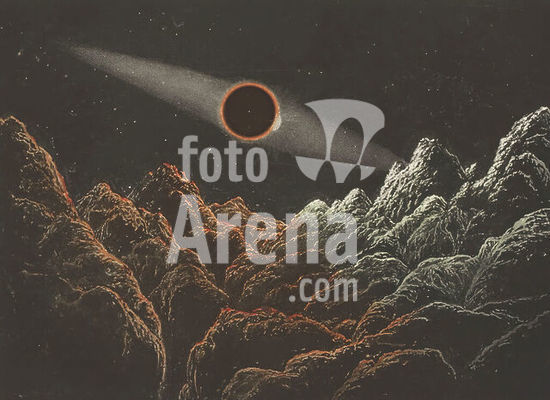
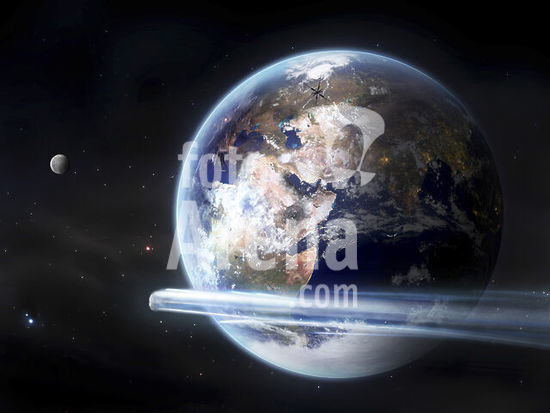
alb5578626 Total eclipse of the Sun as seen from space.
DC
alb5576733 Terraformed Moon. View from Earth or Exo Solar Planet. Calm water and green forest at the horizon.
DC
alb5570846 Artist's conception of Jupiter and one of its moons, Io, seen from 10 kilometres above the frozen surface of Europa, another of the giant planet's moons. The sun is seen here as a very bright star, since it is over five times the distance it is from Earth.
DC
alb5575660 A total eclipse of the Sun as seen from being in Earth's orbit.
DC
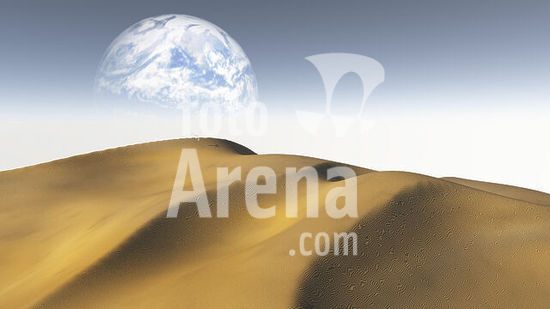
alb5575691 Amber sand desert with terraformed moon or Earth from terraformed moon or exoplanet.
DC
alb5578192 Mountain Vista. Terraformed moon seen from the Earth. 3D rendering.
DC
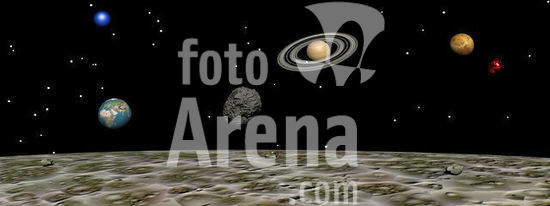
alb5579430 View of the universe and planets as seen from a distant moon.
DC
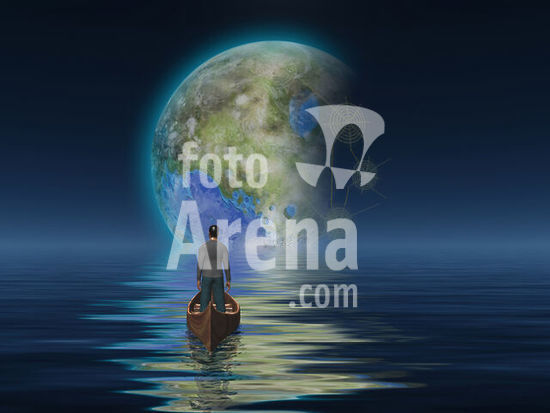
alb5576901 Terraformed moon seen from Earth ocean.
DC
alb5570015 A thin veil of gaseous material surrounding the blue-white star Vega is seen here as a hazy sunrise on a small moonlet in orbit around the cloudy planet. Vega itself is still below the horizon. The Vega system is over 25 light years from Earth.
DC
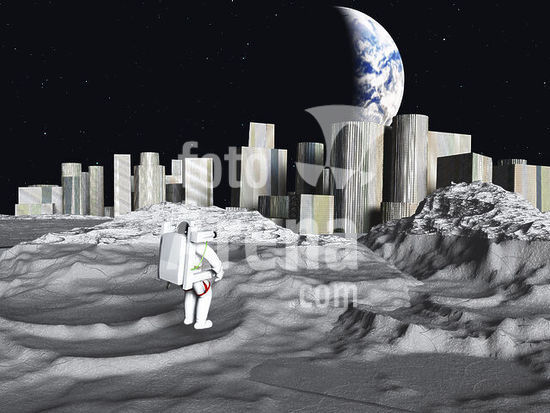
alb5579303 Lunar city. Earth rise seen from the moon.
DC
alb5579351 Terraformed Luna seen from field on Earth.
DC
alb5579291 Terraformed moon from Earth or exosolar planet.
DC
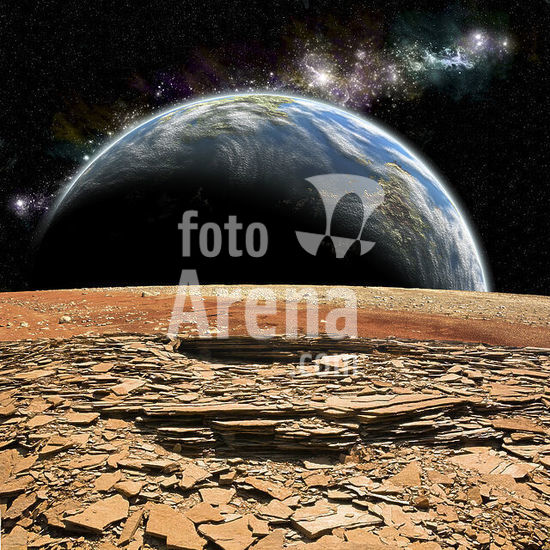
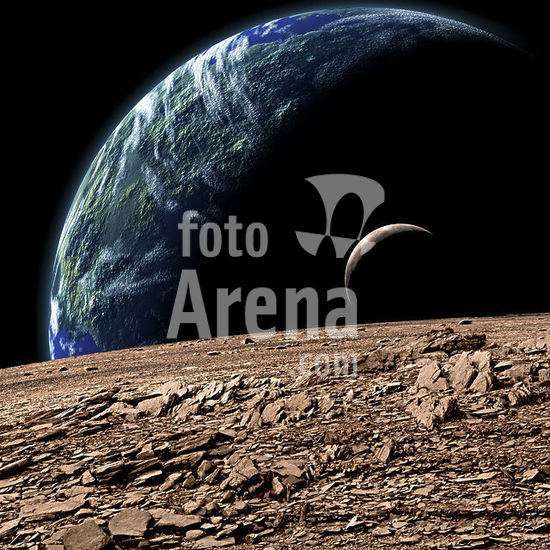
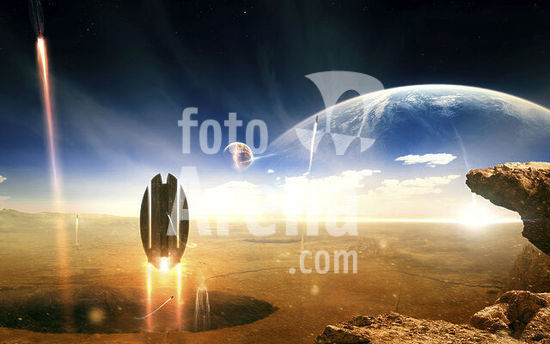
alb5570303 An artist's depiction of the view from a rocky and barren alien moon. An Earth-like planet rises over the airless environment.
DC
alb5578023 A starship from Earth with ion drive propulsion explores the cosmos.
DC
alb5578027 Terraformed Moon seen from Earth.
DC
alb5575493 Mountain Vista. Terraformed moon seen from the Earth. 3D rendering.
DC
alb5577672 Terraformed moon as seen from highway on future Earth.
DC
alb5570406 August 18, 2013 - The waxing gibbous moon above the blue shadow of the Earth and pink Belt of Venus band, with dark blue crepuscular rays converging on the anti-solar point in the east, at sunset, from the badlands of Dinosaur Provincial Park, Alberta, Canada.
DC
alb5576455 Earth From moonscape.
DC
alb5577773 Terraformed moon seen from Earth.
DC
alb5577731 Terraformed moon seen from Earth. Flying saucers over the highway.
DC
alb5577241 Terraformed moon seen from Earth.
DC
alb5577275 A shuttle from an Earth base makes its way with supplies to a space station in orbit over the planet.
DC
alb5577257 Solar flares radiate from a huge sun near a planet and its orbiting moons.
DC
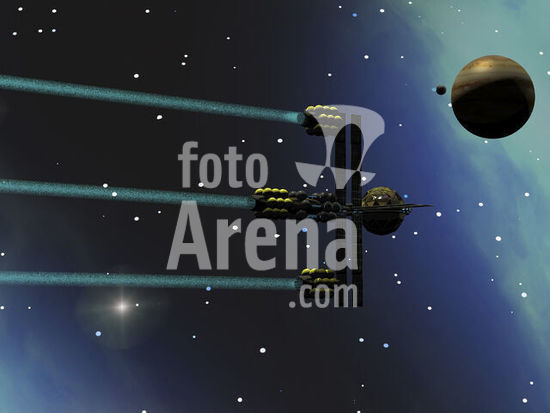
alb5576686 Three spaceships from Earth travel to a planet near the Crab Nebula.
DC
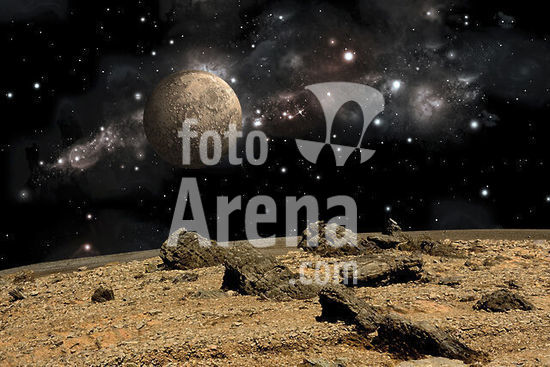
alb5570717 An artist's depiction of the view from a rocky and barren alien world. A moon rises over the airless environment. Elements of this image furnished by NASA.
DC
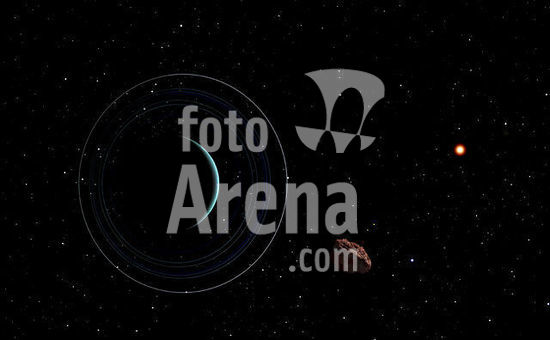
alb5566741 Most of the nine major rings of Uranus can be seen in this back-lit painting of Uranus. At far right the distant sun can be seen, dimmed by its distance of over 19 times as far away as when seen from Earth. The object at lower center is very likely U15-Puck, one of the many minor inner satellites lying between the rings and the major moons of Uranus. With a diameter of 150 km and radius of 70 km this minor moon is probably composed of dirt and ice and has a very low albedo, or reflectivity. The rings of Uranus, aligned with the equator, shows how the planet is tipped over 90 degrees, which makes it unique within our solar system and causes the north and south poles to alternately point toward the sun during the planets' 84-year period of completing a single orbit around the sun.
DC
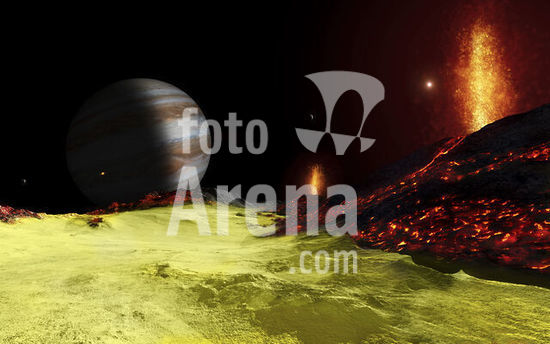
alb5566715 Io is the innermost of the Galilean moons orbiting Jupiter. Io is on average around 400 000 km away from Jupiter, which is approximately the same distance as our moon is from Earth. Jupiter looks 37 times larger than our full moon does in the night sky.. Io faces great tidal forces from Jupiter, and the other three Galilean moons Europa, Ganymede and Callisto, which are tidally locked with respect to each other. At some places the tidal forces move the surface by as much as 100 meters up and down. This twists the moon inside out, but it is not because of this that the moon is the second hottest place (1 700 degrees C) in the solar system, next to the sun.. Io's surface is being constantly bombarded by electromagnetic radiation from Jupiter. This radiation rips off about 1 000 kg of sulphur and other materials from the surface each second. This material (plasma) creates a physical bond between Jupiter and Io. As Io moves through Jupiter's magnetic field, it acts as a giant generator, inducing 400 000 volts and more than 3 000 000 amperes across Io's surface. Because of this bond, massive electrical discharges have been observed in Jupiter's atmosphere.. More than 400 active volcanoes have been observed on Io, and the moon is known to change its' physical appearance over short periods (few years). An impact by an asteroid is seen on Jupiter's night side.
DC
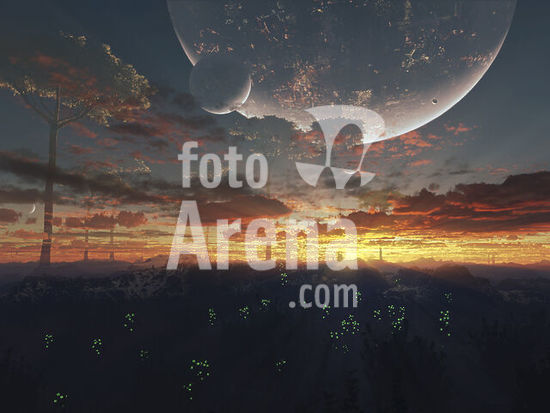
alb5566799 The view from an alien moon towards the massive planet it orbits. Four of the five moons are large enough to sustain life, and the planet at their center is a monster 3 times the mass of the Earth. On the near moon it is dusk, when the Lamplight plants turn on, they use bioluminescence to attract the flying insect-like creatures that pollinate their glowing globes.
DC
alb5566769 Futuristic illustration concept depicting astronaut in orbit over earth-like planet system with space station.
DC
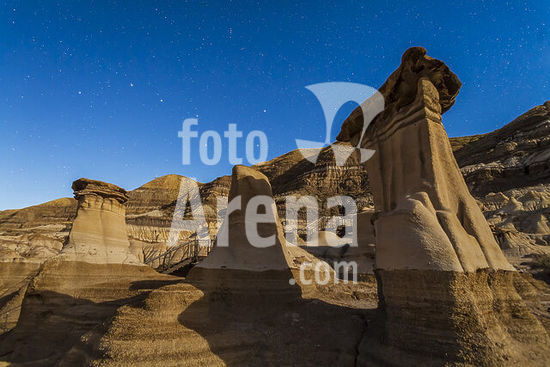
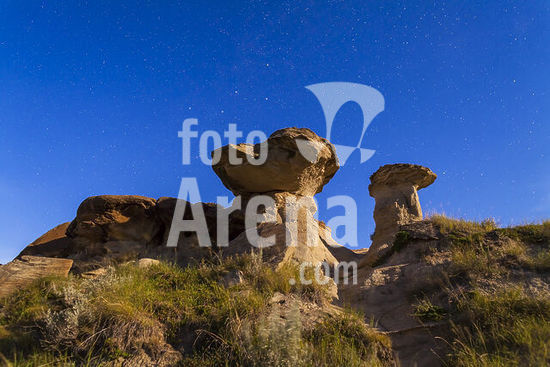
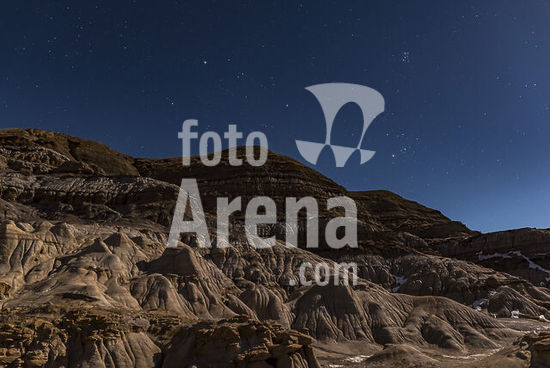
alb5568162 September 21, 2013 - Stars over the hoodoos in the Red Deer River valley on Highway 10 east of Drumheller, Alberta, Canada. Light from a waning gibbous moon provided the illumination.
DC
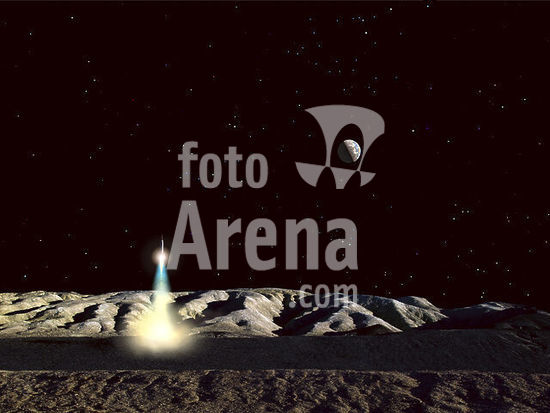
alb5567369 Our home-planet hangs in the low lunar sky as a sleek moonship heads home after a late 1950's exploration trip from Earth. The barren lunar hills are side-lit by the sun as the ship rises from the rocky plain.
DC
alb5568776 The moon in total eclipse, on January 20, 2019, in a multiple exposure composite showing the moon moving from right to left (west to east) through the Earths umbral shadow.
DC
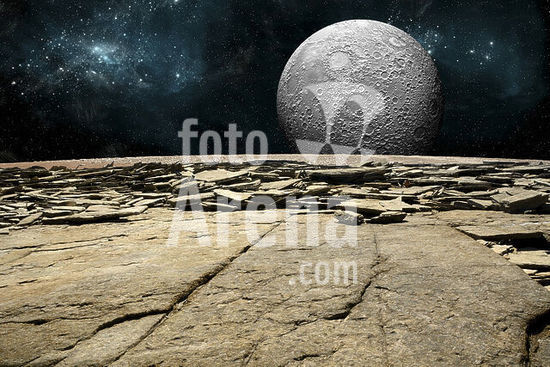
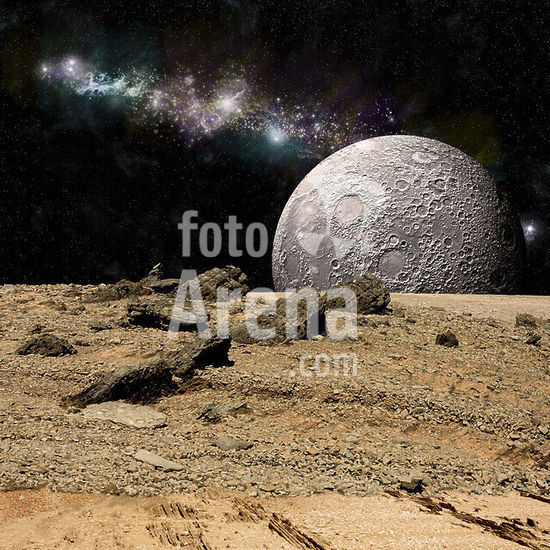
alb5568756 An artist's depiction of the view from a rocky and barren alien world. A large cratered moon rises over the airless environment.
DC
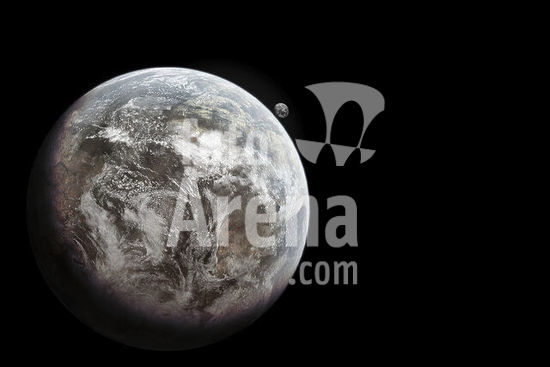
alb5568799 An artist's depiction of the view from a rocky and barren alien world. A large Earth-like planet rises over the airless environment.
DC
alb5569190 Artist's concept of Earth as a lifeless and vast desert with almost no vegetation, and with deadly mutated animals. The Earth can't take it anymore, we've taken everything we could from it, including water.
DC
alb5568223 An artist's depiction of an Earth-like planet in deep space with an orbiting moon observed from the surface of a rocky sister moon.
DC
alb5569235 An artist's depiction of the view from a rocky and barren alien world. A moon rises over the airless environment. Elements of this image furnished by NASA.
DC
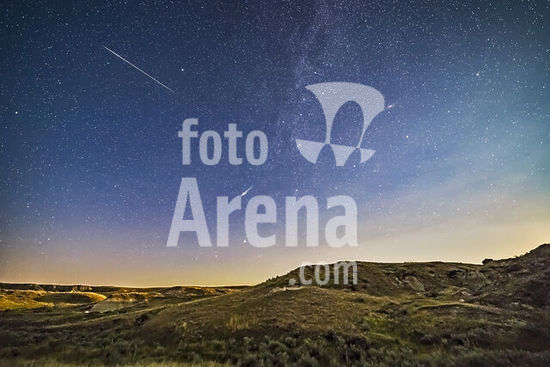
alb5567481 August 12/13, 2017 - Two bright Perseid meteors over the moonlit landscape of Dinosaur Provincial Park, Alberta, Canada. The waning gibbous moon is off frame at right providing the illumination. Smoke in the air from forest fires provides the banding and haze in the sky. A faint aurora colorrs the horizon yellow-green.. The meteors point back to the radiant point in Perseus. The Double Cluster is at centre; M31, the Andromeda Galaxy, is at right. Capella is low above the northeast horizon. Polaris is just above the upper meteor. The base image contains the sky and ground, and the meteor at upper left. The bright meteor at centre is from a later exposure, with its layer blended with Lighten mode and masked to reveal only the meteor, and rotated to align its sky to the base image sky, so the meteor is in the correct location with respect to the stars.
DC
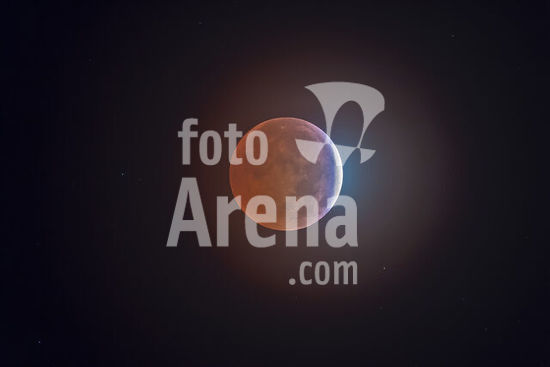
alb5567443 October 8, 2014 - An HDR stack of images to encompass the range of brightness from the bright portion of the lunar disk (at right ) still just in the penumbral shadow, to the dark portion of the disk at left deep in the umbral shadow. Ive processed the total lunar eclipse for enhanced contrast to bring out the color variation along the umbral shadow boundary where it appears blue, from sunlight filtering through the high atmosphere of Earth in the stratospheric ozone layer.
DC
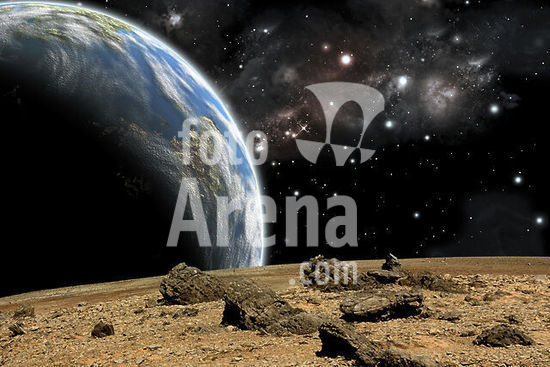
alb5565932 An artist's depiction of the view from a rocky and barren alien world. A large Earth-like planet rises over the airless environment.
DC
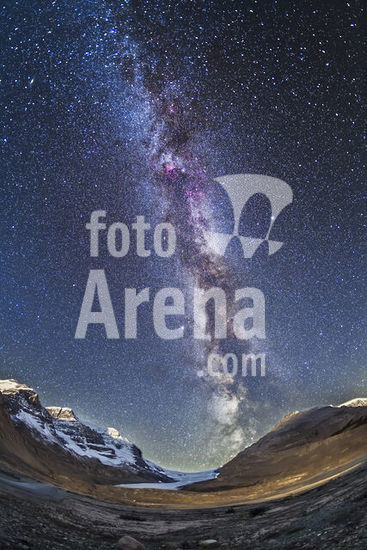
alb5567696 September 14, 2014 - The Milky Way over Athabasca Glacier and the Columbia Icefields in Jasper National Park, Alberta, Canada, on a very clear night before moonrise. The centre of the Galaxy area in Sagittarius is setting in the southwest behind the icefields. The foreground light on the moraines is wash from lights on the Glacier View Inn and Icefields Centre. Other ground illumination on the peaks is from starlight though the tops of the peaks are just being lit by light from the rising waning moon which is also beginning to light the sky a deep blue. Mount Andromeda is at left. The Summer Triangle stars are at centre.
DC
alb5568379 An artist's depiction of the view from a rocky and barren alien world. A moon rises over the airless environment. Elements of this image furnished by NASA.
DC
alb5569052 October 5, 2017 - An overhead pass of the International Space Station in Alberta, Canada, with the full moon rising in the east at left. The ISS is moving from west (at right) to east (at left), passing nearly overhead at the zenith at centre. North is at the top, south at bottom in this fish-eye lens image. The increasing apparent speed of the ISS against the background sky as the ISS approaches from the distance out of the west, then decreases as it flies away to the east, creates the dashed trails of different lengths reflecting its change in apparent speed against the star field. The ISS is much closer to us when it is overhead than when it is near the horizon. At left, the ISS fades to deep red as it enters Earths shadow. The stars are trailed over the few minutes of exposures, moving in concentric arcs around Polaris at top.
DC
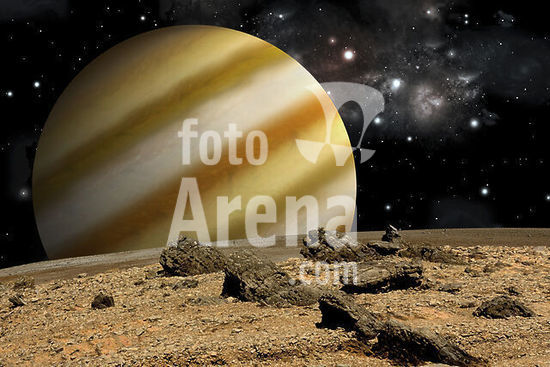
alb5566637 An artist's depiction of the view from a rocky and barren alien world. A large cloud covered planet rises over the airless environment.
DC
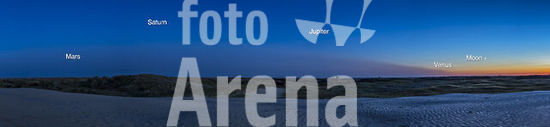
alb5566631 August 13, 2018 - A panorama of four planets in the twilight across the twilight sky, tracing the visible ecliptic in the sky. Photographed from the Great Sandhills, Saskatchewan, Canada.. From left (southeast) to right (southwest) they are: Mars, Saturn, Jupiter, and Venus, below the waxing crescent Moon this evening. The line of planets nicely defines the arc of the ecliptic across the south, mirrored in the dark arc of blue caused by a band of smoke across the south, and the shadow of a crepuscular ray cast by the smoke, and also the blue arc of Earths shadow rising to the southeast near Mars. However, the arc of the ecliptic drawn by the moon and planets isnt perfect as the moon was well above the ecliptic while Mars was well below the ecliptic. Venus, Jupiter and Saturn were all close to the ecliptic. Mars was just over two weeks past opposition, so it was rising in the twilight as Venus was setting, putting both above the horizon at once, with Jupiter and Saturn also well-placed to the south.
DC
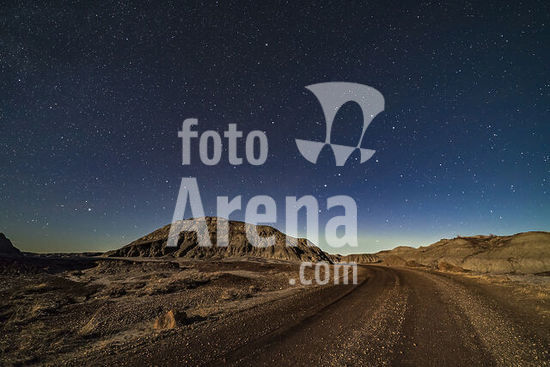
alb5568406 A moonlit nightscape of the badlands loop road in Dinosaur Provincial Park, arcing off toward the Big Dipper in the northern sky. Vega is setting at far left. Polaris is at top centre. Light is from the 8-day waxing Moon.
DC
alb5568537 April 26, 2018 - A scene of Earth and sky, with stars over the late Cretaceous sedimentary layers of the Red Deer River Badlands.. Hercules and Corona Borealis at right rising in the northeast over the moonlit Hoodoos on Highway 10 east of Drumheller, Alberta, Canada. Light from the waxing gibbous Moon provides the illumination.
DC
alb5567038 An artist's depiction of the view from a rocky and barren alien world. A moon rises over the airless environment.
DC
alb5567168 In 500 years from today, the world has changed. Europe is burning in war, climate changed completely and China and India are the new global player.
DC
alb5565526 Idea taken from Star Trek. The project turns dead and lifeless planets into green earth-like habitats, killing already existing forms of life during the process.
DC
alb5566837 August 18, 2013 - The stars of Cassiopeia and Andromeda rising behind hoodoo formations at Dinosaur Provincial Park, Alberta, Canada. Illumination is from the waxing gibbous moon (off camera).
DC
alb5566072 Evidence exists that make astronomers believe that the Earth and the Moon were created when a Mars-sized object slammed into the early proto-earth, about 4.6 billion years ago. Recent findings suggest that heavier metals like gold, platinum, palladium and other iron-loving elements found in Earth's and the Moon's crusts and mantles came from similar, but much smaller impacts at the final stage of formation.
DC
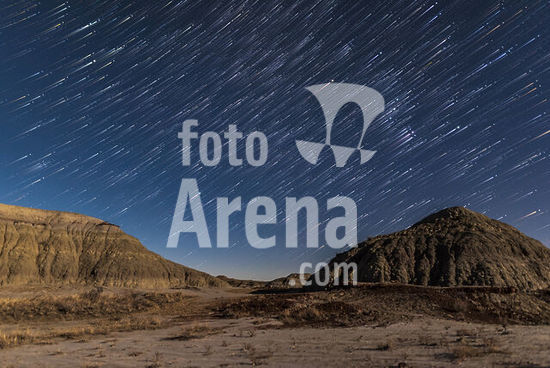
alb5566067 November 27, 2017 - Orion rising in star trails and in the moonlight, at Dinosaur Provincial Park, Alberta, Canada. Light is from the 8-day waxing moon off camera to the right.
DC
alb5566179 Auriga (at left) and Taurus (at right) rising in the moonlight at the Hoodoos near Drumheller, Alberta, Canada. Illumination is from the waxing gibbous moon.
DC
alb5566199 September 14, 2014 - The autumn constellations of Perseus (left), Andromeda (centre) and Pegasus (right) over the peaks of the Columbia Icefields in Jasper National Park. At right is Mt. Andromeda. The waning quarter moon is rising in the southeast at left. The foreground illumination of the moraines from Athabasca Glacier is from moonlight. The Andromeda Galaxy is at top centre.
DC
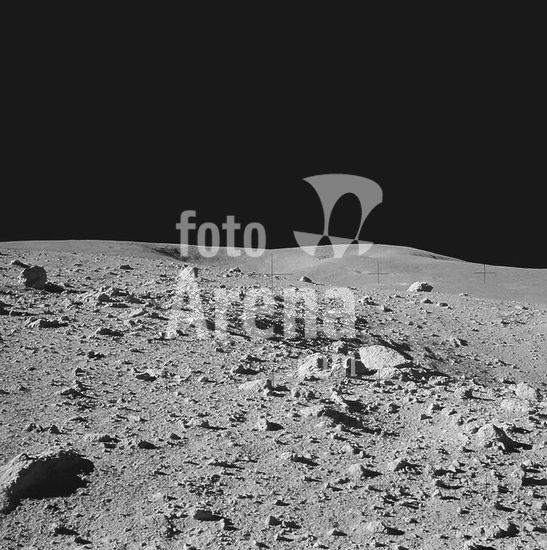
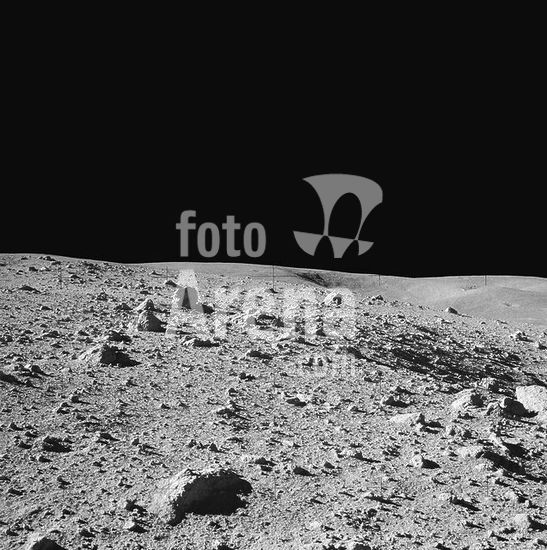
alb3895439 Lunar surface of Earths moon.
DC
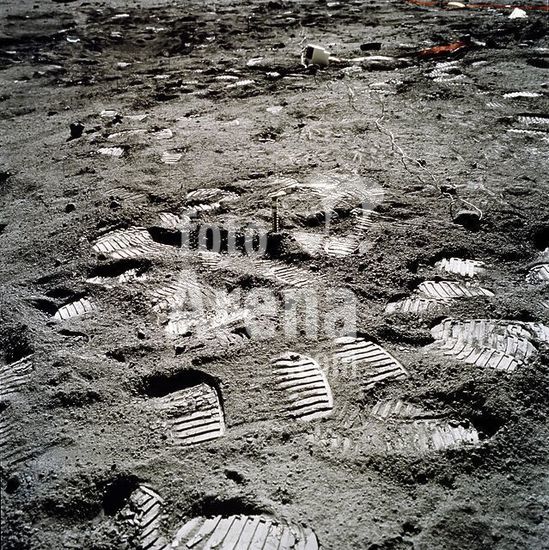
alb3887100 Apollo 17. Lunar foot prints on the moon.
DC
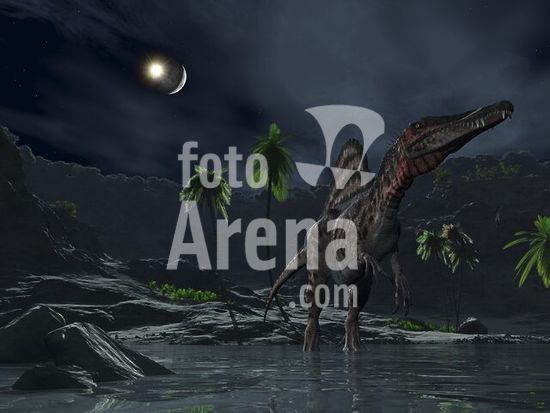
alb3886849 What may appear here as a diamond ring effect from a solar eclipse is in fact a brilliant and momentary flash of light signaling a massive asteroid impact on the Moon.. The Moon and all the inner planets of the Solar System show evidence of a long and violent history of encounters with meteorites and asteroids, leftover debris from the formation of the Solar System. This image depicts an asteroid colliding with the Moon about 95 million years ago. The perspective is from the surface of the Earth in what today is Egypt. The impact would have released millions of times more energy than today's largest nuclear weapon, creating a flash of light that would be far brighter than any star in the sky.. In the foreground of this image stands a wary Spinosaurus, an enormous meat-eating dinosaur that lived during the late Cretaceous period. Its typical length from tail tip to snout was 40-50 feet, and is believed to have weighed at least 8 tons or more.
DC
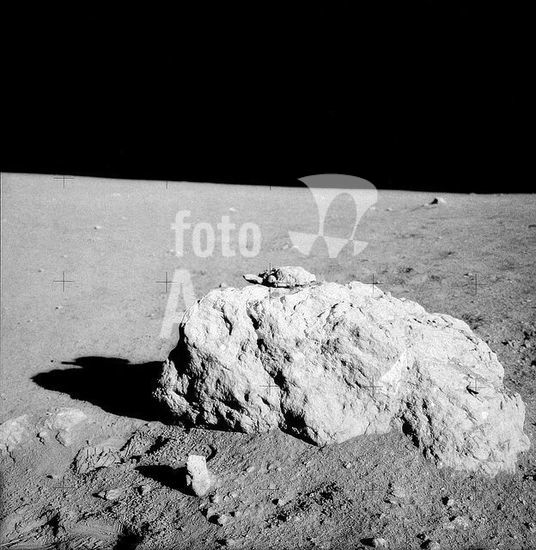
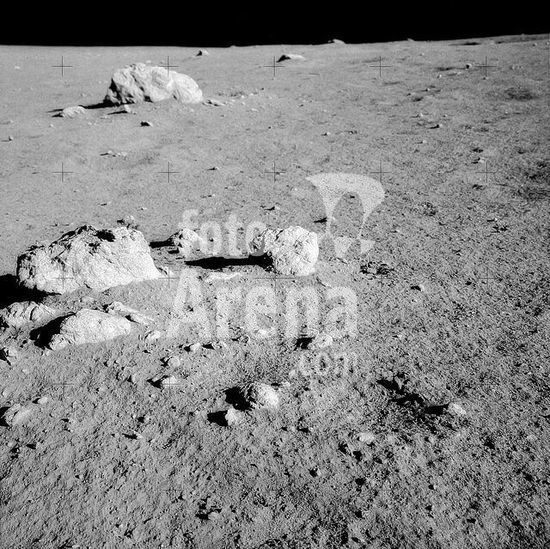
alb3885273 Turtle rock on lunar surface of Earths moon.
DC
alb3888161 Lunar surface of Earths moon.
DC
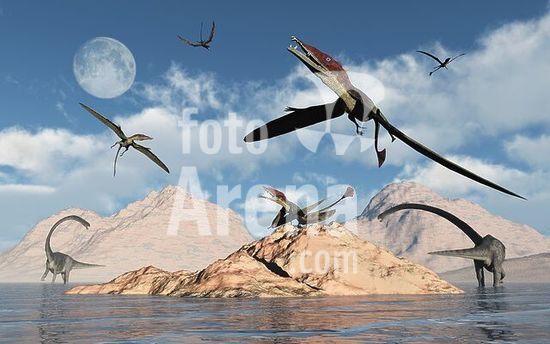
alb3883818 Eudimorphodons from the Triassic Period of Earth.
DC
alb3886188 Lunar surface of Earths moon. Apollo 14.
DC
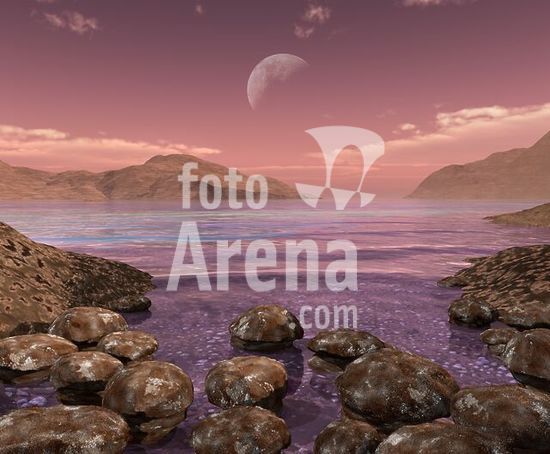
alb3882379 Dome-shaped stromatolites, averaging three feet high and four feet wide, populate the shallow shore of an ancient sea 3 billion years ago. The Moon looms near the horizon, much closer to the Earth than it is now and therefore appearing considerably larger, but otherwise looking much like the moon we know today.. 3 billion years ago the first macro evidence of life on Earth may have appeared in the form of large aggregations of microorganisms and associated sediments known as stromatolites. Cyanobacteria, also known as blue-green algae, were likely one of the primary contributors to these aggregations. During the Archean Eon the Earth's atmosphere contained very little oxygen. Cyanobacteria would have thrived during this time as they employ photosynthesis to combine water, carbon dioxide, and sunlight to create their food, while the byproducts of this process are oxygen and calcium carbonate. Billions of years of photosynthetic processes by cyanobacteria and other living organisms are likely the primary source of the oxygen we breathe. They also provided the oxygen that forms the protective ozone layer, filtering the shorter wavelengths of ultraviolet light from the Sun that are harmful to most forms of life.. Varieties of stromatolites still flourish to this day with well-known formations in parts of Australia, Brazil, and the Bahamas.
DC
alb3884251 Lunar surface of Earths moon.
DC
alb3886636 Lunar surface of Earths moon.
DC
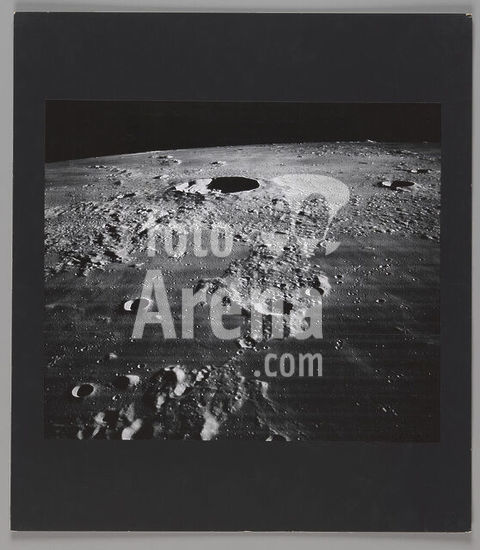
alb3658937 The Moon - Crater Copernicus - Closeup. Artist: National Aeronautics and Space Administration (NASA). Dimensions: Image: 14 in. × 13 7/8 in. (35.5 × 35.2 cm)Mount: 18 × 16 in. (45.7 × 40.6 cm). Printer: Eastman Kodak Co. (American). Date: November 23, 1966.This photograph was made as part of the Lunar Orbiter program, a series of five unmanned spacecraft launched into orbit around the Moon in 1966 and 1967. Each spacecraft was equipped with a sophisticated imaging system provided by Eastman Kodak, which consisted of a dual-lens camera, film processing and handling units, and a readout scanner for transmitting the images back to Earth. The main purpose of the program was to select lunar landing sites for NASA's manned Apollo Missions. Over the course of one year, the Lunar Orbiters photographed 99 percent of the Moon's surface, producing more than 2,000 images of unprecedented clarity and precision. After the film was processed on board the spacecraft, it was scanned in strips and transmitted to Earth via radio. Technicians at Eastman Kodak in Rochester, New York, created the final images by transferring the strips onto sheets of large-format film, from which prints were produced. This print comes from the collection of George Keene, an optical engineer who headed the team responsible for reconstructing the Lunar Orbiter images in Rochester. Museum: Metropolitan Museum of Art, New York, USA.
DC
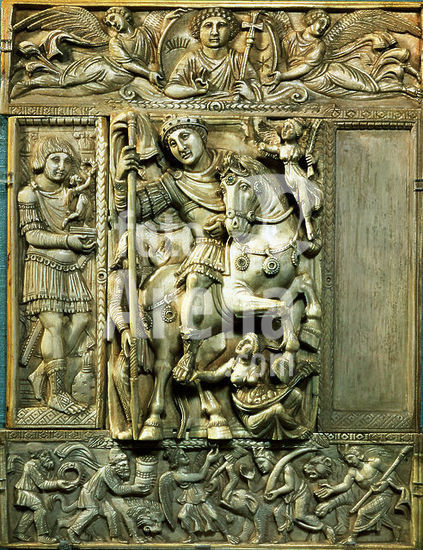
orz003160 Ivory diptych. Detail from the emperor on a horse. Byzantine 6th century. 34 x 26.6 cm. Paris, musée du Louvre. Location: MUSEO DEL LOUVRE-EBORARIA-MARFILE. France. JUSTINIAN I. ZENON DE CITIO. CRISTO IMBERBE. ATANASIO-DISCIPULO DE SANTIAGO APOSTOL.
DC
alb3735462 The Great Red Dragon and the Woman Clothed with the Sun. Dated: c. 1805. Dimensions: Overall: 40.8 x 33.7 cm (16 1/16 x 13 1/4 in.) support: 55.2 x 44.2 cm (21 3/4 x 17 3/8 in.). Medium: pen and gray ink with watercolor over graphite. Museum: National Gallery of Art, Washington DC. Author: William Blake.
DC
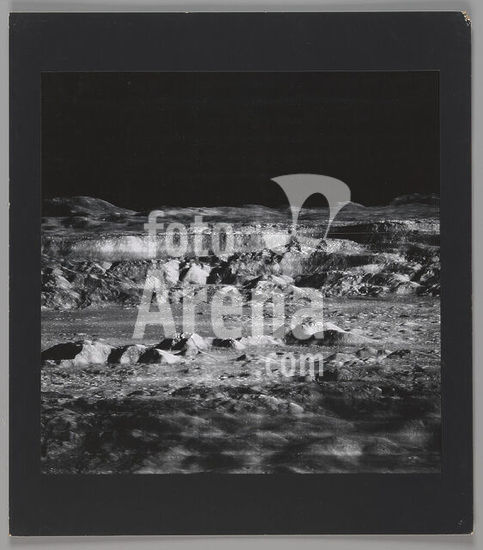
alb3640821 The Moon - Crater Kepler and Vicinity. Artist: National Aeronautics and Space Administration (NASA). Dimensions: Image: 11 7/8 × 13 13/16 in. (30.2 × 35.1 cm)Mount: 16 × 18 in. (40.6 × 45.7 cm). Printer: Eastman Kodak Co. (American). Date: 1967.This photograph was made as part of the Lunar Orbiter program, a series of five unmanned spacecraft launched into orbit around the Moon in 1966 and 1967. Each spacecraft was equipped with a sophisticated imaging system provided by Eastman Kodak, which consisted of a dual-lens camera, film processing and handling units, and a readout scanner for transmitting the images back to Earth. The main purpose of the program was to select lunar landing sites for NASA's manned Apollo Missions. Over the course of one year, the Lunar Orbiters photographed 99 percent of the Moon's surface, producing more than 2,000 images of unprecedented clarity and precision. After the film was processed on board the spacecraft, it was scanned in strips and transmitted to Earth via radio. Technicians at Eastman Kodak in Rochester, New York, created the final images by transferring the strips onto sheets of large-format film, from which prints were produced. This print comes from the collection of George Keene, an optical engineer who headed the team responsible for reconstructing the Lunar Orbiter images in Rochester. Museum: Metropolitan Museum of Art, New York, USA.
DC
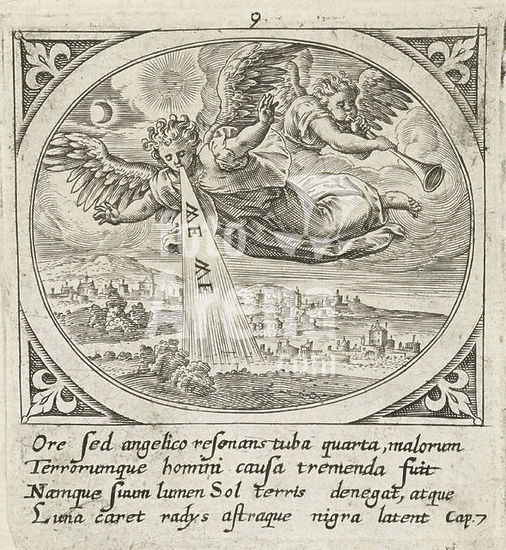
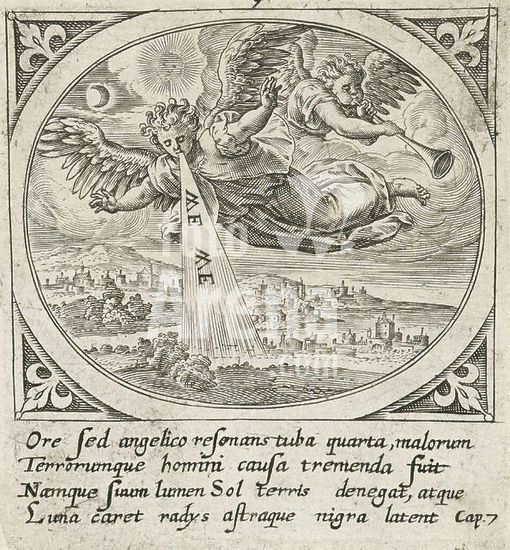
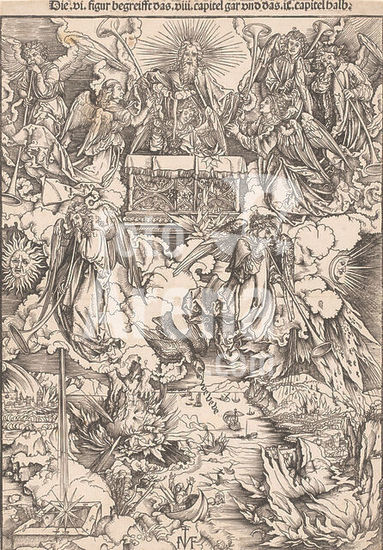
alb15884539 Blowing of the first five trumpets, Copies of Dürer's Apocalypse (series title), After the opening of the seventh seal by the Lamb, seven angels appeared, who received trumpets from God to blow. The first angel caused hail, fire and blood to descend on the earth, the second caused a burning mountain to fall into the sea, the third caused the water to be poisoned by pouring a burning star into it, the fourth caused the sun, moon and stars to be partially darkened. and the fifth angel dropped a star into a bottomless pit. An eagle crows the words 'Ve Ve Ve'., print maker: Ieronimus Greff von Frankfurt, after print by: Albrecht Dürer, 1502, paper, height 390 mm × width 280 mm, print.
DC
alb15855348 Sky map with the northern and southern constellations, Planisphaerium caeleste secundum restitutionem Hevellanam (title on object), Sky map with the northern and southern constellations. Above, from left to right, views of Tycho Brahe's system, Ptolemy's system and the moon's effect on the tides. Below, from left to right, views of the phases of the moon, the system of Nicolaas Copernicus and the position of the earth as it revolves around the sun, according to Philippus Lansbergen., print maker: anonymous, after design by: G.C. Einmarti, publisher: Johann Baptista Homann, Neurenberg, 1707, paper, engraving, etching, height 491 mm × width 567 mm, print.
DC
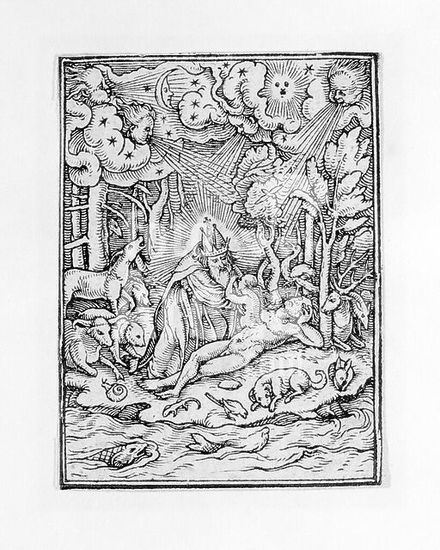
alb15510569 Twelve representations of the Bible book Genesis, verso - stamped, Twelve representations on a sheet. Top representations from left to right: the creation of heaven and earth by God the Father, God separating the waters, God creating the land. Below: the creation of the sun, moon and stars, the creation of fish and birds, the creation of Adam and Eve. Below: God the Father giving Adam and Eve to each other, the Fall, the expulsion from paradise. Lower scenes: Cain kills Abel, a city with towers (Babel?) and Noah in the ark., print, prints, height 279 mm, width 223 mm, print maker, printmaker, 1795 - 1850, paper, engraving, engraving (printing process).
DC
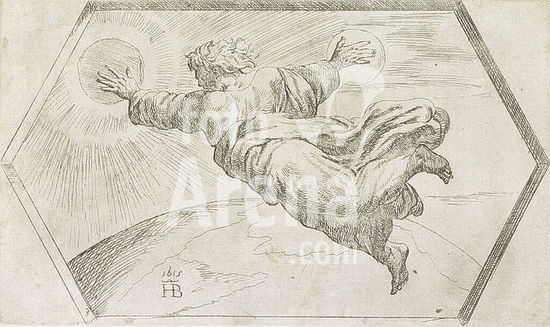
alb15517427 Antwerp, Jode, Gerard de, Thesaurus sacrarum historiarum veteris testamenti, Creation of light, verso - stamped, The first day of creation: God the Father hovers above the earth with outstretched arms and He separates the light from the darkness and day from night. On the left is the sun and on the right the moon. Above God the Father the tetragram. At the bottom a reference to the Bible text in Latin., print, prent, prints, height 190 mm, width 260 mm, print maker, printmaker, 1585 - 1585, paper, papier, engraving, engraving (printing process), Publication (Event), Publication, Northern Netherlands, 1509 - 1591-02-05, publisher.
DC
alb15508416 Antwerp, Jode, Gerard de, Broeck, Crispijn van den, Sadeler, Johann (I), Thesaurus sacrarum historiaru[m] veteris testame[n]ti, elega[n]tissimis imaginibus expressu[m] excelle[n]tissimoru[m] in hac arte viroru[m] opera: nu[n]c primu[m] in luce[m] editus, Historia creationis mundi, Creation and the Fall, Creation of Light, The first day of creation: God the Father hovers above the earth with outstretched arms and He separates the light from the darkness and day from night. On the left is the sun and on the right the moon. At the bottom a reference to the Bible text in Gen. 1 in Latin. The print is part of an album., print, album leaf, prints, height 194 mm, width 265 mm, Southern Netherlands, 1550 - 1600-08, print maker, printmaker, 1579 - 1579, fourth quarter 16th century, paper, engraving, engraving (printing process), Work conception, 1524 - 1591, after a design by, Publication (Event), Publication, Northern Netherlands, 1509 - 1591-02-05, publisher.
DC
alb4154642 Moon and Smoke (Enchu no tsuki), from the series "One Hundred Aspects of the Moon (Tsuki hyaku sugata)". Tsukioka Yoshitoshi; Japanese, 1839-1892. Date: 1886. Dimensions: . Color woodblock print. Origin: Japan. Museum: The Chicago Art Institute, USA.
DC
alb15459710 Munich, Schurich, Carl Robert, Braun and Fr. Schneider, K., Germany, Sickert, Oswald Adalbert, Munich plates, Doctor Spiritus and the moon, verso - stamped, Sheet with 13 illustrations from the story of Doctor Spiritus and the moon. About the doctor's fear that the moon will fall to the earth. A caption under each illustration. Numbered center bottom: No. 52. Numbered top right: 52., print, prent, volksprent, prints, prenten, volksprenten, height 441 mm, width 352 mm, Danish, German, English, 1828 - 1885, print maker, printmaker, 1843 - 1920, paper, papier, houtgravure, letterpress printing, boekdruk, Publication (Event), Publicatie, Duits, publisher, uitgever, 1820, printer, drukker.
DC
alb15488724 Antwerp, Jode, Gerard de, Thesaurus sacrarum historiaru[m] veteris testame[n]ti, elega[n]tissimis imaginibus expressu[m] excelle[n]tissimoru[m] in hac arte viroru[m] opera: nu[n]c primu[m] in luce[m] editus, Creation and the Fall, Creation of Light, The first day of creation: God the Father hovers above the earth with outstretched arms and He separates the light from the darkness and day of night. On the left is the sun and on the right the moon. Above God the Father the tetragram. At the bottom a reference to the Bible text in Latin. This print is part of an album., print, album page, prints, height 191 mm, width 260 mm, print maker, 1585 - 1585, paper, engraving, engraving (printing process), Publication (Event), Publication, Northern Netherlands, 1509 - 1591-02-05, publisher.
DC
alb15507467 Munich, Schurich, Carl Robert, Braun and Fr. Schneider, K., Germany, Sickert, Oswald Adalbert, Munich plates, Doctor Spiritus and the moon, verso - stamped, Sheet with 13 illustrations from the story of Doctor Spiritus and the moon. About the doctor's fear that the moon will fall to the earth. A caption under each illustration. Numbered center bottom: No. 52. Numbered top right: 52., print, prent, volksprent, prints, prenten, volksprenten, height 441 mm, width 349 mm, Danish, German, English, 1828 - 1885, print maker, printmaker, 1843 - 1920, paper, papier, houtgravure, kleuren, letterpress printing, boekdruk, Publication (Event), Publicatie, Duits, publisher, uitgever, 1820, printer, drukker.
DC
akg182591 Mahler, Gustav; composer; 1860-1911. Works: The Song of the Earth (1907-1909; text after Hans Bethge. "Das Trinklied vom Jammer der Erde". Etching, autographed, by Arthur Paunzen (1890-1940). No. 1 from the series: Arthur Paunzen, Sechs Radierungen zum Lied von der Erde von Gustav Mahler. Vienna (Richard Lanyi) 1920. Berlin, Sammlung Archiv für Kunst und Geschichte. Museum: Berlin, Sammlung Archiv für Kunst und Geschichte. Copyright: Additional copyrights must be cleared.
DC

Total de Resultados: 323

Página 1 de 4