
















































Busque também em nossas outras coleções:

Data da imagem:
Pauta
Agência
Fotógrafo
ver mais opções...
Estado
Cidade
Local
Tipo de licença
Orientação
Coleção

Total de Resultados: 12

Página 1 de 1

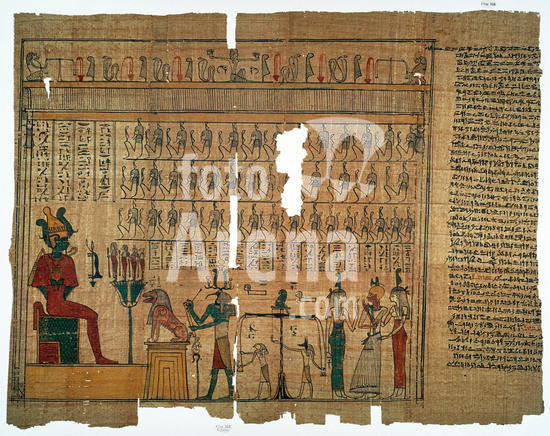
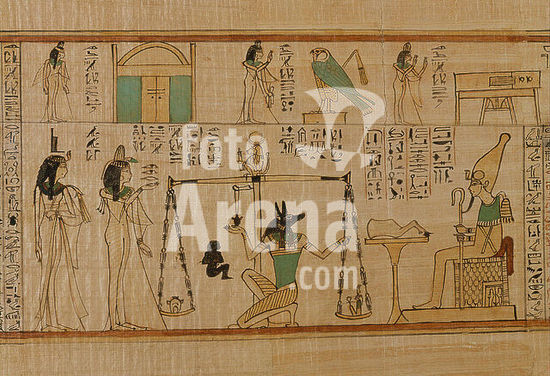
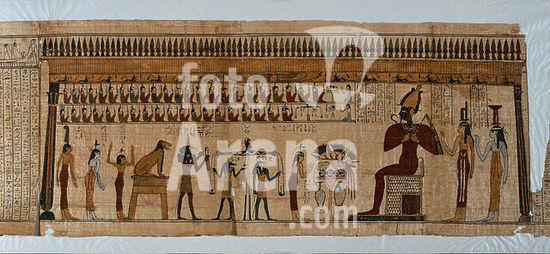
alb3666228 Book of the Dead for the Singer of Amun, Nany. Dimensions: L. 521.5 cm (206 5/16 in); H. 35 cm (13 3/4 in). Dynasty: Dynasty 21. Reign: reign of Psusennes I-II. Date: ca. 1050 B.C..Archaeologists found this papyrus in the burial of Nany, a woman in her seventies. She was a singer of the god Amun-Re. Nany also had the title "king's daughter," which probably means that she was a child of the high priest of Amun and titular king, Painedjem I. As was customary during the Third Intermediate Period, Nany's coffins (30.3.23-.25) and boxes of shabtis (30.3.26-.30) were accompanied by a hollow wooden Osiris figure, which contained a papyrus scroll inscribed with a collection of texts called the "Book of Coming Forth by Day" - better known to us as the Book of the Dead. When unrolled, this scroll is more than seventeen feet long.The scene depicted here shows the climax of the journey to the afterlife. Nany is in the Hall of Judgment. Holding her mouth and eyes in her hand, she stands to the left of a large scale. Her heart is being weighed against Maat, the goddess of justice and truth, who is represented as a tiny figure wearing her symbol, a single large feather, in her headband. On the right, Osiris, god of the underworld and rebirth, presides over the scene. He wears the white crown of Upper Egypt and the curving beard of a god. His body is wrapped like a mummy except for his hands, which clasp a crook. On the table before him is an offering of a joint of beef. Canine-headed Anubis, overseer of mummification, adjusts the scales, while a baboon—symbolizing Thoth, the god of wisdom and writing—sits on the balance beam and prepares to write down the result. Behind Nany stands the goddess Isis, both wife and sister of Osiris. She is identified by the hieroglyph above her head.In this scene, Nany has been found truthful and therefore worthy of entering the afterlife. Anubis says to Osiris, "Her heart is an accurate witness, "and Osiris replies," Give her her eyes and her mouth, since her heart is an accurate witness." In the horizontal register above the judgment scene, Nany appears in three episodes: worshipping the divine palette with which all is written, praising a statue of Horus in his falcon form, and standing by her own tomb. Museum: Metropolitan Museum of Art, New York, USA.
DC
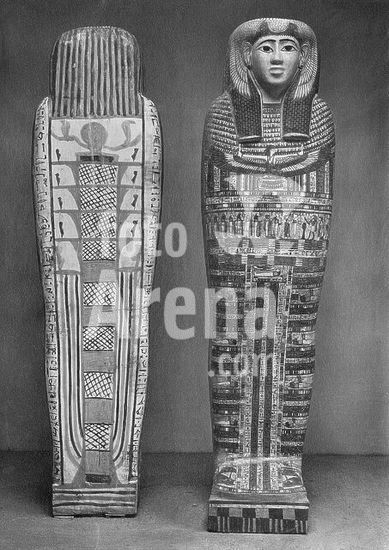
alb3628143 Inner coffin of Ankhshepenwepet. Dimensions: L. 188 cm (74 in). Dynasty: Dynasty 25. Date: ca. 712-664 B.C..The Singer of the Residence of Amun, Ankhshepenwepet, was buried in a tomb within the precinct of Hatshepsut's temple in Deir el-Bahri. The burial was plundered and no traces were left of her mummy, which would have been placed in the inner coffin.The inner coffin of Ankhshepenwepet has a new shape which was developed during Dynasty 25. It is broader, with square shoulders and an over-sized head. On her head she wears a lappet wig (the hair painted blue), and a vulture headdress formerly worn by only queens and goddesses. The decoration on the lid includes the scene of the weighing of the heart from the Book of the Dead, and below it, for the first time on coffins, the mummy is depicted. It lies on an embalmer's bed and a ba-bird, symbolizing Ankhshepenwepet's spirit, hovers above it (see detail photo). Beneath the bed are two groups of objects; four canopic jars and four viscera bundles (containing the internal organs). The fact that the bundles are depicted suggests that the jars are "dummy" canopic jars, like the ones in Ankhshepenwepet's tomb (25.3.205a-d). Museum: Metropolitan Museum of Art, New York, USA.
DC
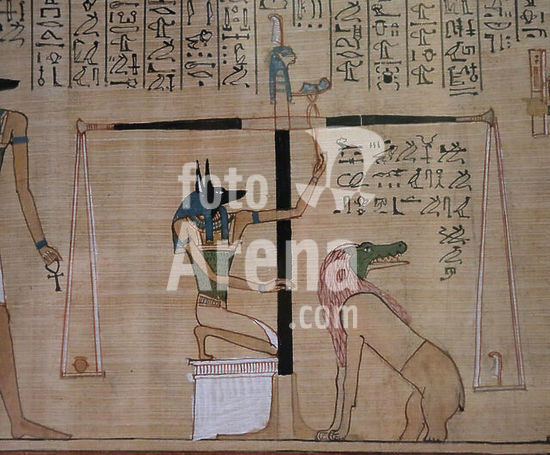
alb11642452 Book of the Dead. Judgement from scribe Hunefer. 19th dynasty. 1300 BCE. Anubis weighed the heart with Ammit. 1300 BCE. Weighing of his heart. British Museum. London.
DC
les08011060 Book of the Dead with 125 chapters, judgement in the Otherworld. The defunct, the Lady Nefer-is, is led into the courtroom: her heart is weighed against the truth; she sacrifices to the Gods Osiris, Isis, and Nephtys. Papyrus (350 BCE), Late Period, Egypt-Inv. 10477. Location: Staatl. Museen, Aegyptisches Museum, Berlin, Germany.
DC
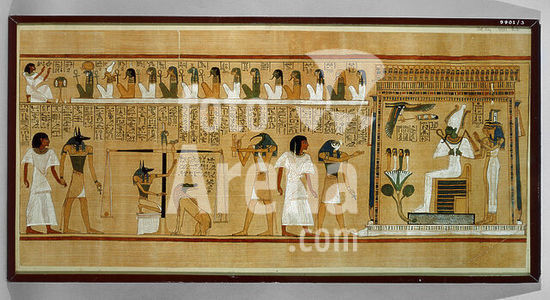
les03010243 Book of the Dead: The papyrus of Hunefer. Above Hunefer kneeling before a table of offerings in adoration, in presence of fourteen gods, seated in order of judges. Below the Judgement, or weighing of the conscience; the jakal-headed Anubis examines the pointer of the balance, wherein the heart (conscience) of the deceased is being weighed against the feather of Maat, symbolical of law or of right and truth; on the left a jakal-headed deity is leading the deceased by the left hand. On the right are the monster Ammut, the Devourer, and the Ibis-headed God Thoth, the scibe of the Gods, who notes down the result of the trial. On the right Hunefer is ushered by Horus into the presence of the God Osiris enthroned within a shrine. Behind him are Isis and Nephtys. In front a lotus flower on which stand the four children of Horus, or gods of the cardinal points. New Kingdom (19th Dynasty). EA9901. Location: British Museum, London, Great Britain.
DC
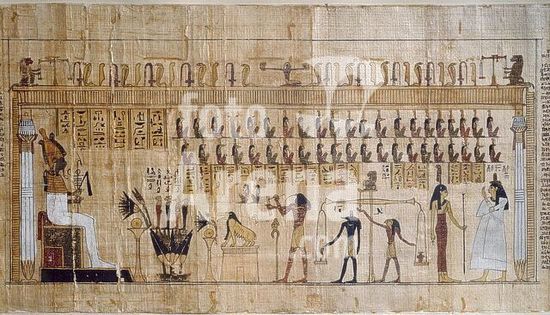
akg332097 Egyptian, Realm of the Dead / Life after Death. Judgement in the Other World with depiction of weighing of the heart against the feather of truth. From a death book. Painting on papyrus. Turin, Museo Egizio. Museum: Turin, Museo Egizio.
DC
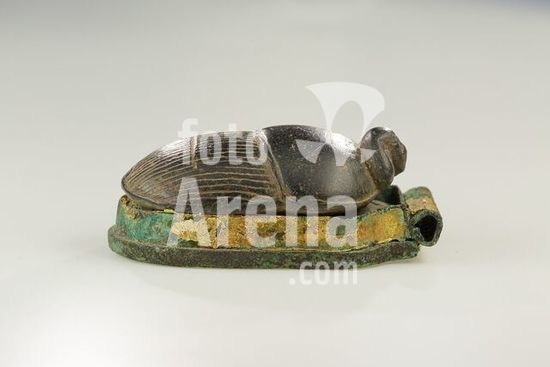
alb3631031 Heart Scarab with a Human Head. Dimensions: L. 6.5 × W. 3.9 × H. 2.5 cm (2 9/16 × 1 9/16 × 1 in.). Date: 1550-1070 B.C..Heart scarabs were very popular amulets. Positioned on the chest of the mummy, they usually take the shape of a large scarab beetle (which was a symbol of regeneration). Occasionally, the beetle's head is replaced with that of a human. For the ancient Egyptians the heart was not only the center of life, but also of thinking, memory, and moral values. In the final judgement the heart was thought to be weighed against maat - the principle of order and justice. Only if the deceased had lived a righteous life was he allowed to live on in the afterlife. Understandably, the Egyptians feared a negative outcome and special amulets were used to ensure a positive judgment. The flat underside of a heart scarab is usually inscribed with chapter 30B of the Book of the Dead, the so-called heart scarab spell that magically "prevents the heart from creating opposition" and in which the deceased's heart is directed not to tell lies about its owner. Here this spell is inscribed in ten horizontal lines; the name of the owner is not included. The underside of this scarab features two holes, a detail found in other human-headed heart scarabs as well. Presumably these were used to fasten the scarab onto a string. The scarab received an additional, gilded metal rim with a large loop for suspension at the top. This setting take the shape of a heart and may have been added slightly later and covers parts of the hieroglyphs on the underside. Museum: Metropolitan Museum of Art, New York, USA.
DC
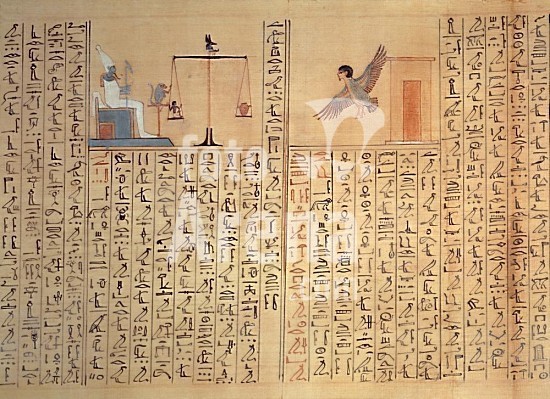
akg362270 Egyptian, New Kingdom, 18th dynasty, c. 1450 BC. Weighing of the hearts before Osiris, judge of the dead / The soul of the deceased leaves the grave as Ba-bird. From the Book of the Dead of Maiherperi. On papyrus, l. 117.5cm, h. 35cm. Found at: Thebes, Valley of the Kings, tomb no. 36. Inv. no. CG 24095. Cairo, Egyptian Museum. Museum: Cairo, Egyptian Museum.
DC
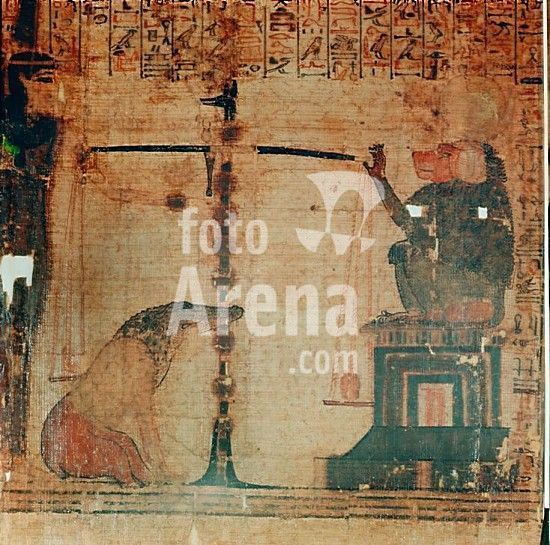
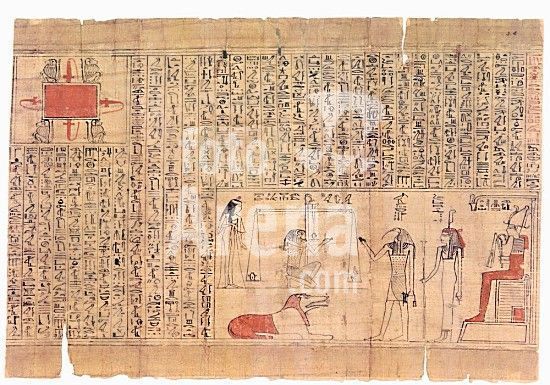
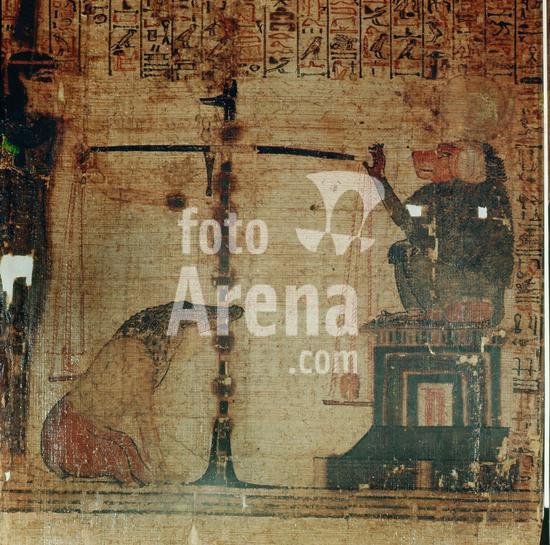
akg615244 A vignette from the Book of the Dead of Kenna. It shows the Day of Judgement in the hall of Osiris. Thoth weighs the dead man's heart. The crocodile-headed monster is ready to devour the dead man's heart should it be found wanting on the scales. Country of (..).
DC
akg308003 Egyptian Papyris, 3rd Interim Period, 21st Dynasty, c. 1000 BC. Book of the Dead of Amun priestess Taherjt. "Taherjt in the hall of truth: Judgement of the Dead (before Osiris, her heart is weighed by Horus, with Truth represented as Goddess Maat). Leaf 14 from 26 leaves, full length 11m, height 33cm. Thebes. Inv. AMS 40. Leiden, Rijksmuseum van Oudheden. . Museum: Leiden, Rijksmuseum van Oudheden.
DC
951_05_55401617 A vignette from the Book of the Dead of Kenna
DC
0026225 EGYPT: BOOK OF THE DEAD.Weighing of the Heart from Egyptian papyrus Book of the Dead. 3rd-2nd century B.C.
DC

Total de Resultados: 12

Página 1 de 1