

















































Busque também em nossas outras coleções:

Data da imagem:
Pauta
Agência
Fotógrafo
ver mais opções...
Estado
Cidade
Local
Tipo de licença
Orientação
Coleção

Total de Resultados: 8

Página 1 de 1

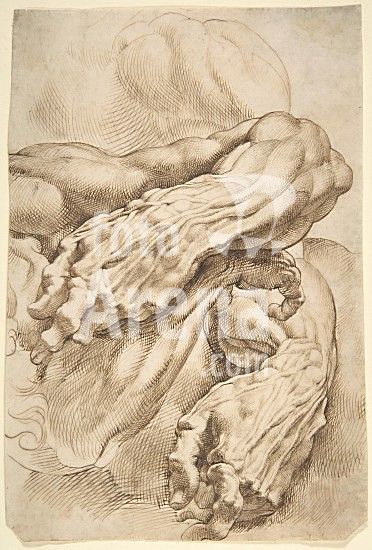
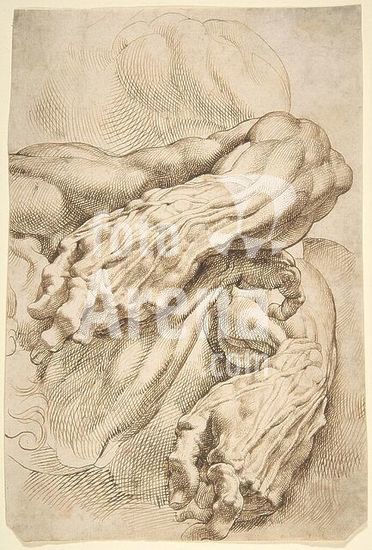
alb3614405 Anatomical Studies: a left forearm in two positions and a right forearm. Artist: Peter Paul Rubens (Flemish, Siegen 1577-1640 Antwerp). Dimensions: sheet: 10 15/16 x 7 5/16 in. (27.8 x 18.6 cm). Date: ca. 1600- ca. 1605.This impressive sheet demonstrates Rubens' understanding of the human body and his commitment to rigorous anatomical study of the sort pioneered in the Italian Renaissance. The same powerful left arm and hand appears in two positions; each view exposes in detail the structure of the underlying muscles, bones, and blood vessels. A right arm and hand is partly concealed beneath one bulky arm, and views of the left shoulder seen from above are drawn in different degrees of finish.Rubens (1577-1640), one of the definitive masters of Baroque painting, had a humanist education and a deep admiration for the accomplishments of Michelangelo and other Italian artists. Like them, he used his command of anatomy to design figures in dramatic poses seen from unusual angles. Evidence suggests that Rubens planned a book of anatomical lessons with illustrations engraved after his designs. Although the project was never completed, this drawing may have been made for it, and several other sheets have been associated with it.In order to impart a sense of energy and immediacy to his paintings, Rubens sought to master the representation of the human figure in all its actions. To achieve this end, he drew anatomy studies in the tradition of Italian Renaissance artists while in Italy between 1600 and 1608. In these drawings, Rubens used cross-hatching in pen to define the muscles and sinews of the flayed body parts that he studied from casts, a technique Leonardo also used for his own anatomy drawings, which Rubens knew. Unlike Leonardo, however, Rubens was interested in more than anatomical accuracy and clear presentation. He also created dynamic compositions, as is so masterfully demonstrated in this drawing, by studying the contorted arms from unusual angles, by inventing details, and by placing the models in a highly complex spatial relationship. Museum: Metropolitan Museum of Art, New York, USA.
DC
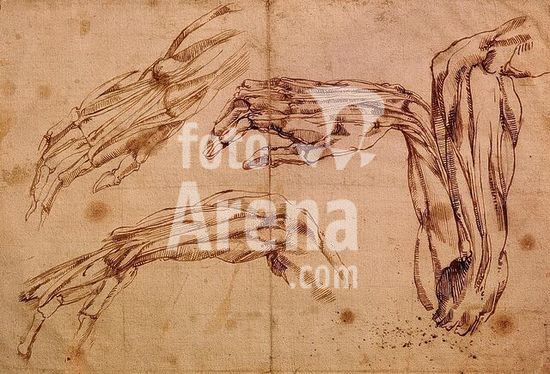
akg360298 Géricault, Théodore. 1791-1824. Anatomical studies of the musculature and bones of the lower right arm. Pen-and-ink drawing, undated. Plate 7. Paris, Musée de l'École des Beaux-Arts. Museum: Paris, Musée de l'École des Beaux-Arts.
DC
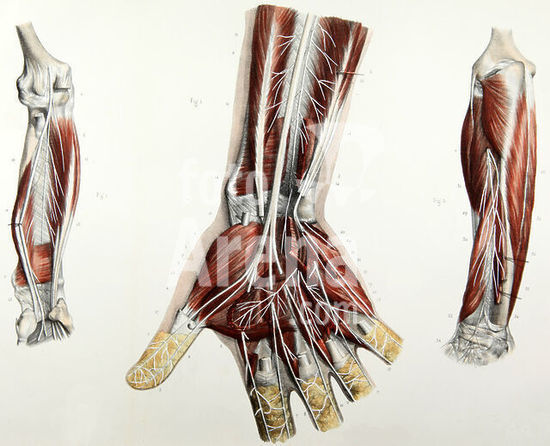
ado00096393 Deep muscular nerves of the hand and forearm. Plate extracted from the "Trait complet de l'anatomie de l'homme comprenant la mdecine opratoire" by Jean-Baptiste Marc Bourgery published between 1831 and 1854. Color lithograph by Nicolas Henri Jacob.
DC
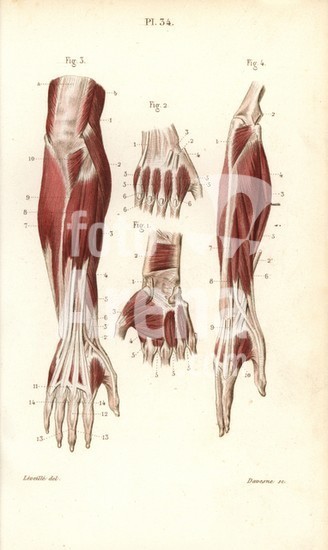
alb1944154 Muscles and tendons of the forearm and hand. Handcolored steel engraving by Davesne of a drawing by Leveille from Dr. Joseph Nicolas Masse's "Petit Atlas complet d'Anatomie descriptive du Corps Humain," Paris, 1864, published by Mequignon-Marvis. Masse's "Pocket Anatomy of the Human Body" was first published in 1848 and went through many editions.
DC
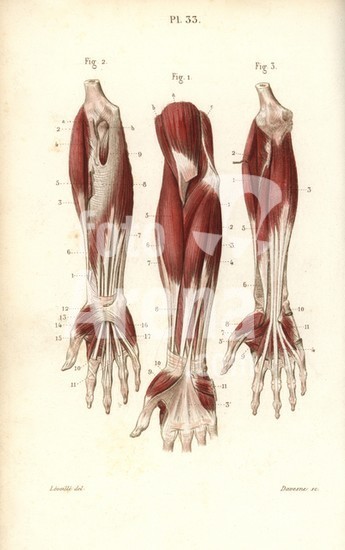
alb1947990 Muscles of the forearm and wrist. Handcolored steel engraving by Davesne of a drawing by Leveille from Dr. Joseph Nicolas Masse's "Petit Atlas complet d'Anatomie descriptive du Corps Humain," Paris, 1864, published by Mequignon-Marvis. Masse's "Pocket Anatomy of the Human Body" was first published in 1848 and went through many editions.
DC
alb3458778 Anatomical Studies: a left forearm in two positions and a right forearm, ca. 1600- ca. 1605, Pen and brown ink, sheet: 10 15/16 x 7 5/16 in. (27.8 x 18.6 cm), Drawings, Peter Paul Rubens (Flemish, Siegen 1577–1640 Antwerp), This impressive sheet demonstrates Rubens' understanding of the human body and his commitment to rigorous anatomical study of the sort pioneered in the Italian Renaissance. The same powerful left arm and hand appears in two positions; each view exposes in detail the structure of the underlying muscles, bones, and blood vessels.
DC
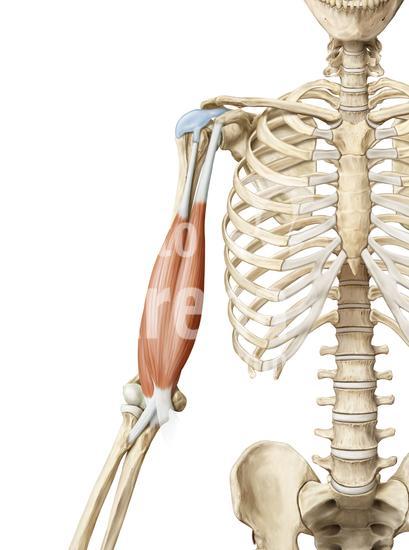
1016_04_50609 Muscle that allows the forearm to bend at the elbow and to rotate outwardly (palm of the hand toward the front); it relaxes when the triceps muscle contracts.
DC
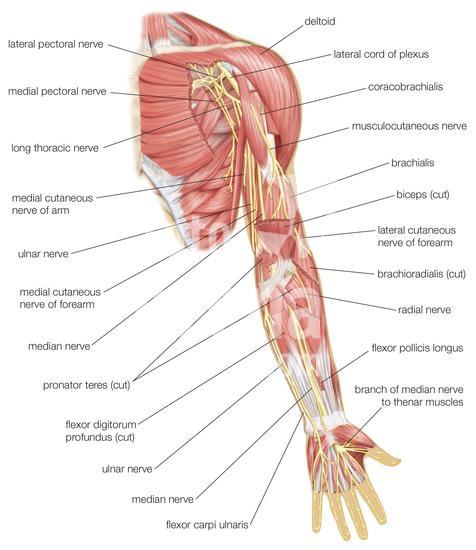
926_09_nerves038a4 Anterior view of the left arm, showing median, ulnar, and radial nerves and other branches of the brachial plexus.
DC

Total de Resultados: 8

Página 1 de 1