




















































Busque também em nossas outras coleções:

Data da imagem:
Pauta
Agência
Fotógrafo
ver mais opções...
Estado
Cidade
Local
Tipo de licença
Orientação
Coleção

Total de Resultados: 38

Página 1 de 1

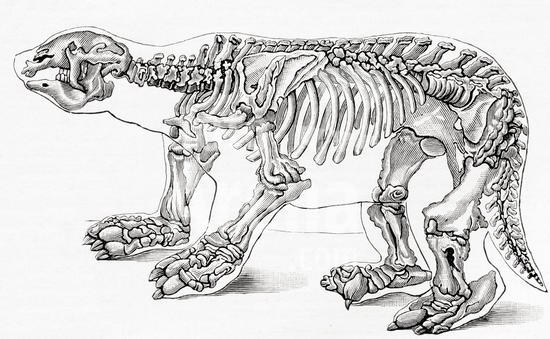
902_05_12323854HighRes Skeleton of a Megatherium, a genus of elephant-sized ground sloths. From Meyers Lexicon, published 1924.
DC
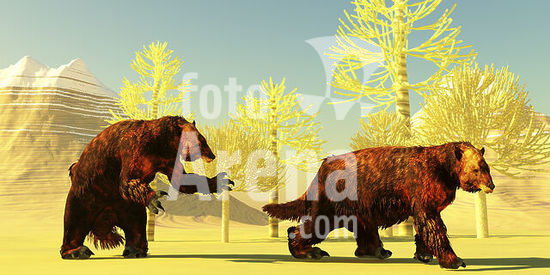
alb5576849 A pair of Megatherium ground sloths on the move. Megatherium was a giant ground sloth that lived in Central and South America during the Pliocene and Pleistocene Periods.
DC
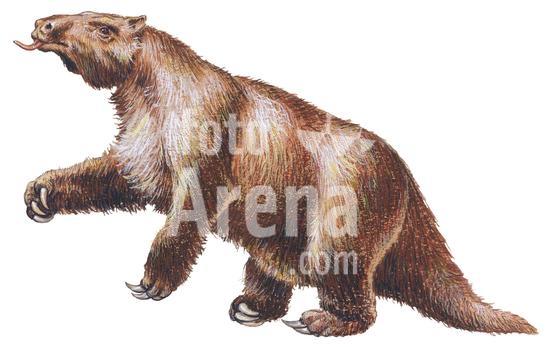
alb5568830 Megatherium ground sloth walking, white background. Megatherium was a herbivorous Giant Ground Sloth that lived in Central and South America during the Pliocene and Pleistocene Periods.
DC
alb5567961 Megatherium ground sloth, white background. Megatherium was a herbivorous Giant Ground Sloth that lived in Central and South America during the Pliocene and Pleistocene Periods.
DC
alb5566350 Megatherium sloth in a sitting position. Megatherium was a herbivorous Giant Ground Sloth that lived in Central and South America during the Pliocene and Pleistocene Periods.
DC
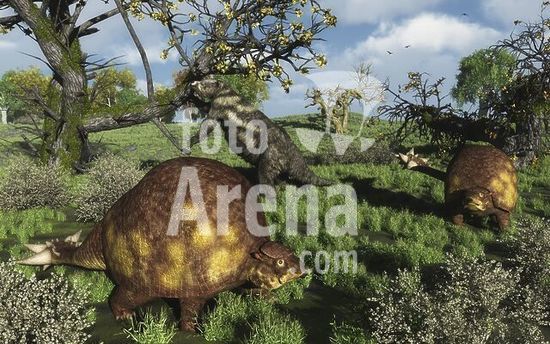
alb3887101 Prehistoric glyptodonts of the genus Doedicurus graze on grassy plains 25,000 years ago in what is today South America. In the background is a giant ground sloth of the genus Eremotherium.. With a turtle-like shell five feet tall and weighing over two tons, Doedicurus was the largest known glyptodontid, an extinct family of heavily-armored herbivores related to modern armadillos. Doedicurus carried a large spiked tail that could have helped protect it from large predators and other Doedicurus.. Eremotherium was a Megatheriid that grew to 20 feet long and weighed up to three tons.
DC
alb3883582 Megatherium americanum from the Pleistocene epoch of South America.
DC
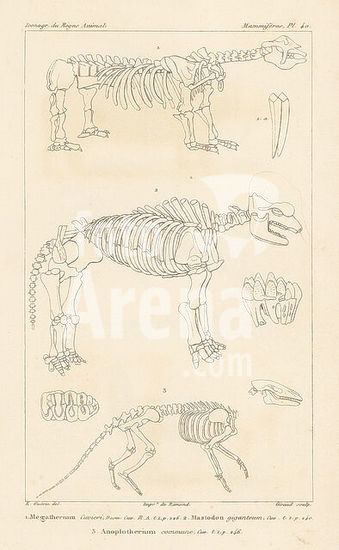
alb18728045 Fossil skeletons of extinct animals. Giant ground sloth, Megatherium americanum 1, American mastodon, Mammut americanum 2, and Anoplotherium commune 3. Handcoloured stipple copperplate engraving by Eugene Giraud after an illustration by Felix-Edouard Guérin-Méneville from Guérin-Méneville's Iconographie du règne animal de George Cuvier, Iconography of the Animal Kingdom by George Cuvier, J. B. Bailliere, Paris, 1829-1844.
DC
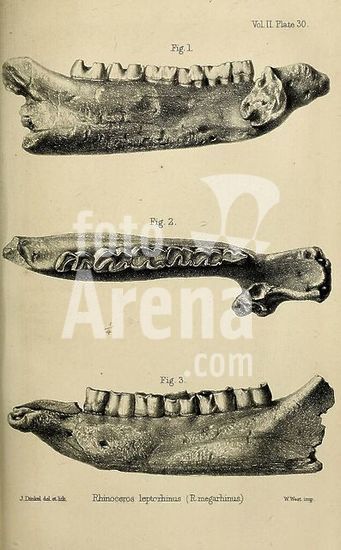
alb15336256 Palaeontological Memoirs And Notes Of H. Falconer With A Biographical Sketch Of The Author London 1868, This illustration features three detailed depictions of a rhinoceros jawbone, specifically highlighting variations and anatomical features. - **Fig. 1** presents a side view of the jawbone, showcasing the overall shape and structure. - **Fig. 2** offers a top-down perspective, emphasizing the arrangement of teeth and their alignment. - **Fig. 3** features a frontal view, highlighting the distinctive characteristics of the jaw. Beneath the illustrations, the caption identifies the specimen as *Rhinoceros leptorhinus* (also known as *R. megatherium*), demonstrating the scientific study of this species' skeletal anatomy. The meticulous details serve to aid in.
DC
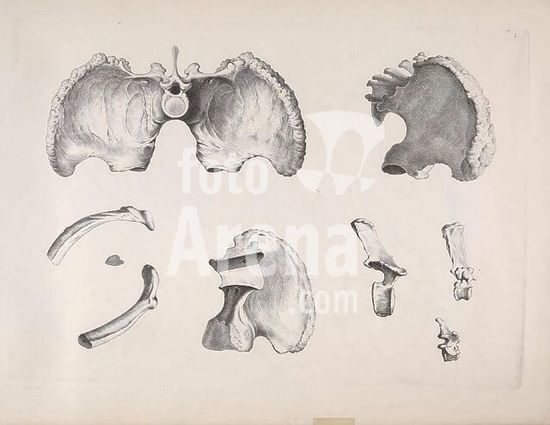
alb15383085 Die vergleichende Osteologie, Bonn, In Commission bei Eduard Weber, 1821-1838 Anatomy, Comparative, Skeleton, Christian Heinrich Pander, Eduard D'Alton, Bradypus giganteus, Megatherium, Giant ground sloth, South America, Ground-dwelling herbivore, Miocene, Pliocene, Quaternary, Fossils, Extinct, Bones, The illustration showcases a detailed anatomical study of the human thoracic cavity. It features depictions of the lungs, highlighting their structure and outlines. The upper section reveals the two lungs with a focus on their lobes and bronchi, while the lower section presents various skeletal components, including rib fragments and vertebral structures, arranged in a manner that enhances their functional relationships within the thoracic region. This scholarly representation serves to educate on respiratory anatomy and the skeletal framework, emphasizing the interconnectivity of these critical body systems.
DC
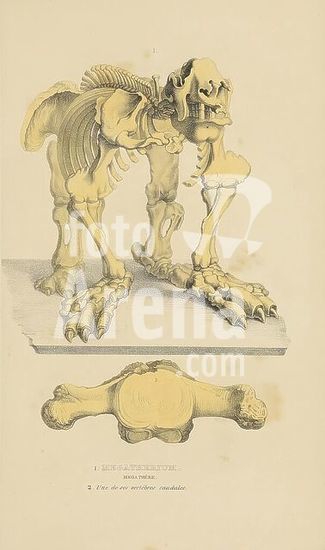
alb15321857 Dictionnaire classique des sciences naturelles Brussels Meline Cans et Ce. 1853 Dictionaries Natural history Giant ground sloth Megatherium Fossils Paleontology Bilingual, The illustration depicts the skeletal structure of a dog, showcasing its anatomical features in a detailed manner. The skeleton is presented in a standing pose, highlighting the distinct shapes of the skull, vertebrae, limbs, and paws. An additional view at the bottom provides a closer look at a specific section of the vertebral column, emphasizing the flexibility and alignment of the bones. This scientific representation serves as an educational tool for studying canine anatomy, with the intricate details revealing the unique characteristics of the dog's skeletal system.
DC
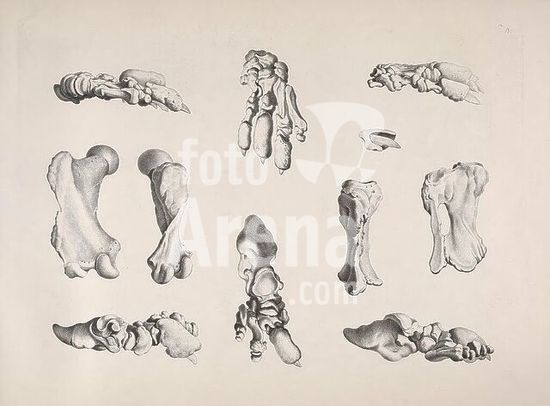
alb15360344 [Die vergleichende Osteologie, Bonn, In Commission bei Eduard Weber, 1821-1838, anatomy, comparative, skeleton, Christian Heinrich Pander, Eduard D'Alton, Bradypus giganteus, Megatherium, giant ground sloth, South America, ground-dwelling herbivore, Miocene, Pliocene, Quaternary, fossils, extinct, bones, A collection of bone structures, displayed in an organized layout, showcasing various skeletal forms that emphasize intricate details and contours. Each bone is rendered with a focus on its unique shape and texture, highlighting the complexity of human anatomy. The arrangement allows for a comparative view, underscoring the diversity in skeletal morphology. The study of these forms could serve educational purposes, illustrating the fundamentals of osteology and the aesthetic beauty found within anatomical study.
DC
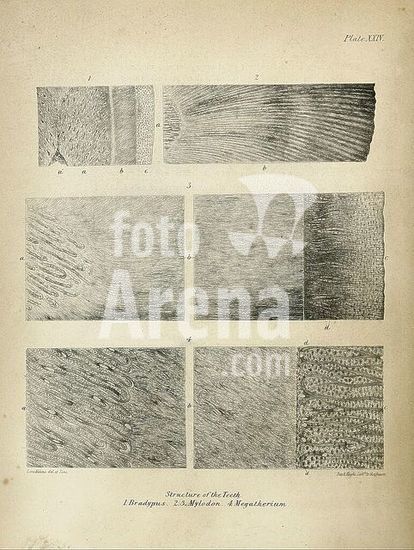
alb15284560 Description, of, the, skeleton, of, an, extinct, gigantic, Sloth, Mylodon, robustus, Owen, with, observations, on, Megatherioid, quadrupeds, in, general, London, 1842., The illustration presents a detailed examination of the structure of various teeth, showcasing six distinct sections labeled numerically and alphabetically. The top row features the first three sections, labeled 1, 2, and 3, which depict the unique characteristics and textures of the teeth from different species, specifically highlighting the anatomical variations among Brachypus, Mylohyus, and Megatherium. The bottom row includes three additional sections, labeled 4, 5, and 6, continuing the exploration of dental structures. Each detail is meticulously rendered, emphasizing the complexity and diversity of dental morphology. The overall layout serves as an educational resource for the study of comparative anatomy and paleontology.
DC
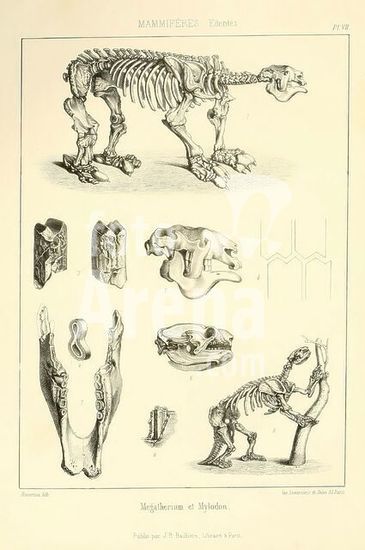
alb15396483 Traité de paléontologie, London, H. Ballière, J.-B. Baillière, 1853-1857, paleontology, fossils, pictorial works, fossil stories, This illustration showcases various scientific studies of prehistoric mammals, specifically focusing on the Megatherium and Mylodon. The main figure displays a skeletal reconstruction of the Megatherium, a gigantic ground sloth from the Pleistocene epoch. Surrounding it are detailed anatomical studies and cross-sections of bones and teeth, highlighting the unique features of these extinct species. The labels provide taxonomic information, reflecting a scholarly approach to the understanding of these ancient creatures and their evolutionary significance. The careful execution emphasizes the intricate structure and form of the skeletal remains, contributing to the broader study of paleontology.
DC
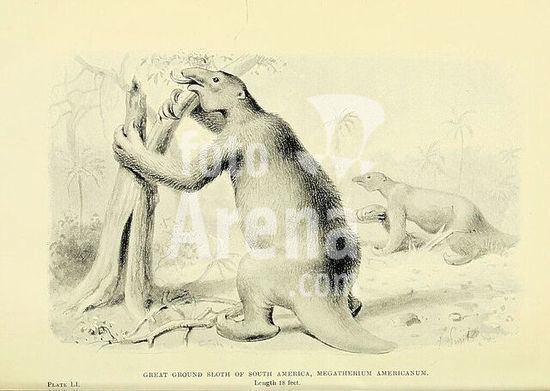
alb15290998 Extinct monsters and creatures of other days, London, Chapman & Hall, 1910, extinct animals, paleontology, Megatherium americanum, sloth, Megatherium americanum, color our collections,, The illustration depicts two prehistoric giant ground sloths from South America, known as Megatherium americanum. The larger sloth is shown in a dynamic pose, standing on its hind legs and using its powerful forelimbs to grasp a tree, likely for feeding on foliage. Its robust body and distinctive claws emphasize its adaptation to a herbivorous lifestyle. In the background, another sloth is seen in a more crouched position, suggesting a social behavior or foraging activity. The scene captures the lush, tropical environment typical of the region during the time these creatures roamed, with vegetation creating a sense of habitat.
DC
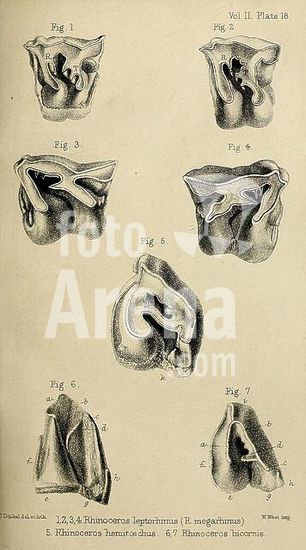
alb15312404 Palaeontological, memoirs, and, notes, of, H. Falconer, with, a, biographical, sketch, of, the, author London, 1868, A series of detailed illustrations displaying the anatomical structures of rhinoceros species. Each labeled figure highlights various aspects of their morphology, such as the nasal passages, skull shape, and internal features. The figures are numbered from 1 to 7, with additional annotations indicating specific anatomical parts for clarity. This compilation serves as an educational reference for understanding the unique adaptations and biological characteristics of rhinoceroses, particularly focusing on the species Rhinoceros leptorhinus, Rhinoceros megatherium, Rhinoceros hemietos, and Rhinoceros bicornis.
DC
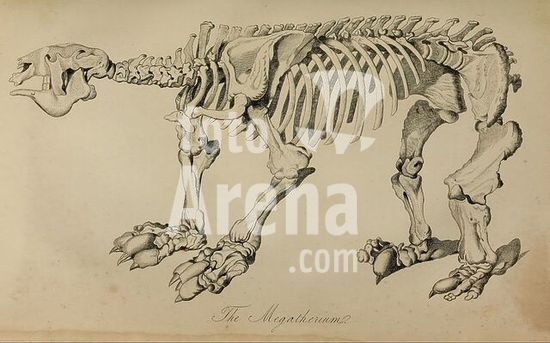
alb15410527 The, fossil, remains, of, the, animal, kingdom, London, Whittaker, Treacher, 1830, paleontology, fossil, stories, color our, collections, The illustration depicts a detailed anatomical representation of an animal skeleton, showcasing the intricate structure of its bones. The skeleton is portrayed in a side view, allowing for a clear examination of the vertebral column, ribcage, and limb components. Notable features include the elongated skull, prominent jaw, and distinct claws on the forelimbs. Below the skeletal depiction, the title 'The Megatherium' is inscribed, indicating a connection to this prehistoric mammal known for its massive size and unique adaptations. The meticulous details highlight the bone structure and its significance in understanding the evolutionary history of extinct species.
DC
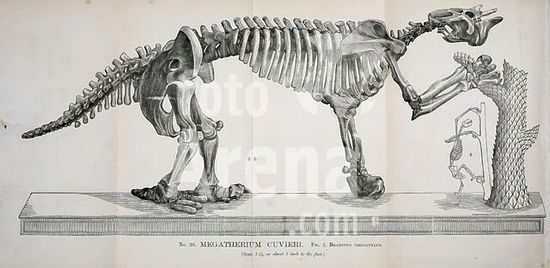
alb15411297 Catalogue of casts of fossils, Rochester, N.Y, Benton & Andrews, printers, 1866,, fossils, Megatherium americanum, fossil stories, histsciart, Bradypus tridactylus, pale throated sloth, sloths, giant ground sloth, The illustration features the skeletal structure of a Megatherium, a prehistoric giant ground sloth, positioned alongside a human figure for scale. The skeleton is meticulously detailed, showcasing the large bones and distinct anatomical features of this ancient creature. Its enormous limbs and elongated torso highlight its terrestrial nature, while in the background, a smaller, human-like figure stands beside the skeletal remains, emphasizing the sheer size of the Megatherium. The artwork illustrates the scientific curiosity of the era, combining natural history with a comparative perspective on size and anatomy, reflective of early paleontological studies.
DC
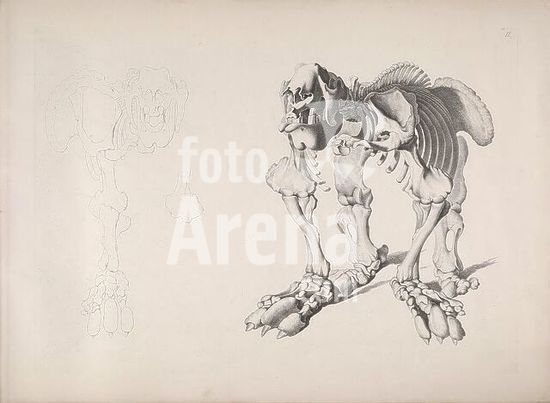
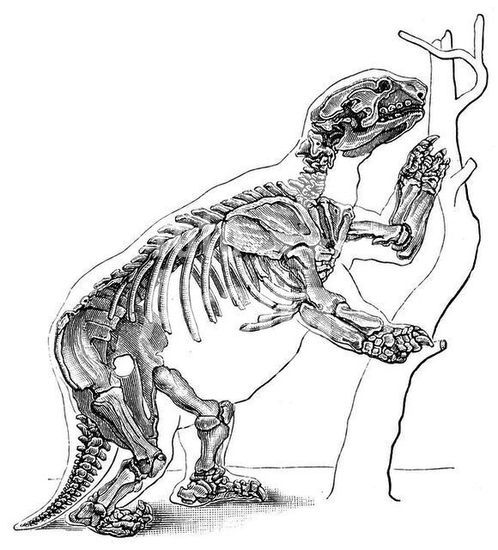
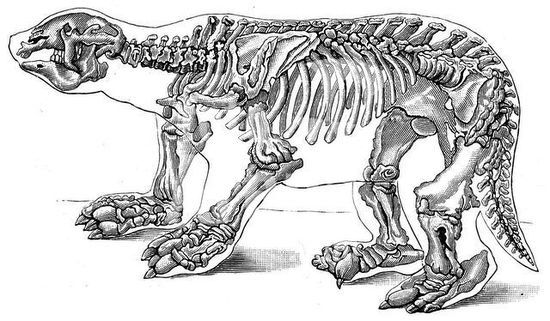
alb15374403 [Die vergleichende Osteologie, Bonn, In Commission bei Eduard Weber, 1821-1838, Anatomy, Comparative, Skeleton, Christian Heinrich Pander, Eduard Dalton, Bradypus Giganteus, Megatherium, Giant Ground Sloth, South America, Ground Dwelling Herbivore, Miocene, Pliocene, Quaternary, Fossils, Extinct, Bones, A detailed anatomical study showcasing the skeletal structure of a quadrupedal animal. On the left, a faint outline presents the initial sketch of the skeleton, highlighting the general shapes and proportions. The right side features a more refined representation, emphasizing the intricate details of the bones, including the skull, spine, limbs, and claws. The illustration captures the complexity of the skeletal system, demonstrating both the functionality and artistry involved in anatomical drawings, which serve as educational references for understanding animal physiology.
DC
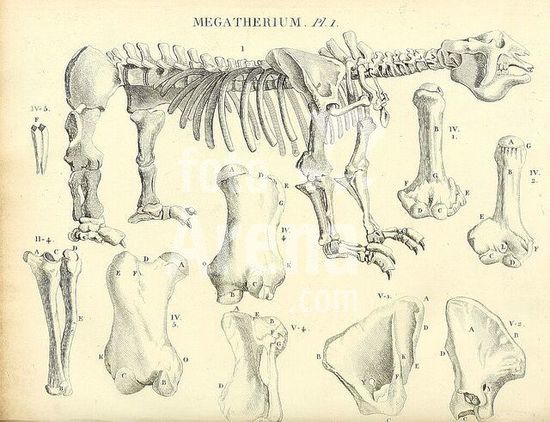
alb15255159 Recherches sur les ossemens fossiles de quadrupèdes, Paris, Deterville, 1812, France, Geology, Mammals, Fossil, Paleontology, Paris region, Vertebrates, Fossil, This illustration features a comprehensive anatomical study of the skeleton of a Megatherium, an extinct giant ground sloth. The various bones are labeled systematically, showcasing the skull, limb bones, vertebrae, and other skeletal structures. Each part is drawn with precision, highlighting their shapes and sizes. The image serves as an educational reference for understanding the unique skeletal features of this prehistoric creature, illustrating the complexity and scale of its anatomy. The arrangement of bones suggests a scientific approach to the study of paleontology, emphasizing the importance of fossil records in reconstructing the physical attributes of ancient species.
DC
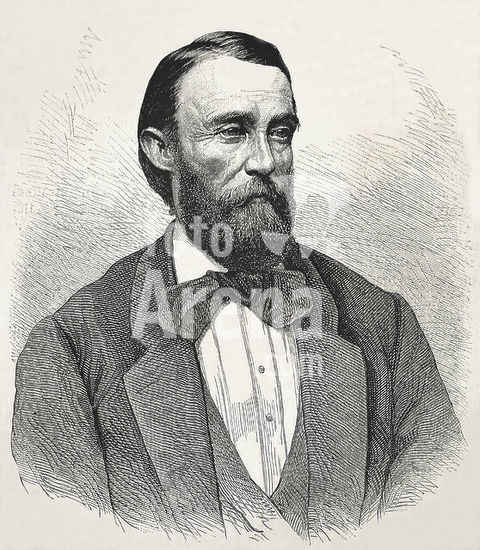
alb11644981 Ferdinand Vandeveer Hayden, geologist (1829-1887) who made Yellowstone known to the public. Engraving 19th century.
DC
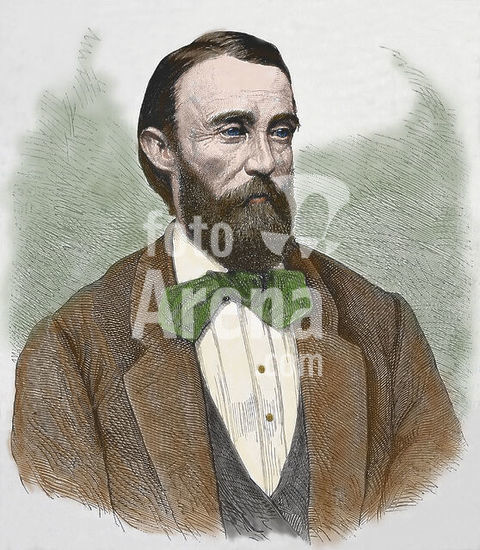
alb11642992 Ferdinand Vandeveer Hayden, geologist (1829-1887) who made Yellowstone known to the public. Colored engraving 19th century.
DC
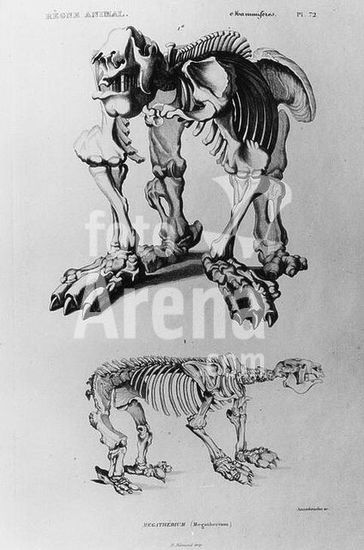
akg231892 Zoology / Paleozoology / Megatherium. "Megatherium". Copper engraving by Annedouche. From: Georges Cuvier, Le règne animal distribué d'après son organisation, 4 Bde., 1816/17, Pl. 72.
DC
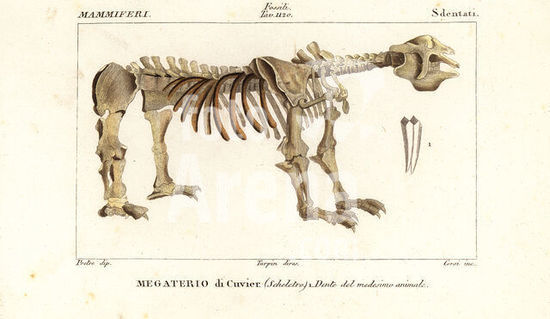
alb9869868 Fossil skeleton of the giant ground sloth, Megatherium americanum. Megaterio di Cuvier. Handcoloured copperplate stipple engraving from Antoine Laurent de Jussieu's Dizionario delle Scienze Naturali, Dictionary of Natural Science, Florence, Italy, 1837. Illustration engraved by Corsi, drawn by Jean Gabriel Pretre and directed by Pierre Jean-Francois Turpin, and published by Batelli e Figli. Turpin (1775-1840) is considered one of the greatest French botanical illustrators of the 19th century.
DC
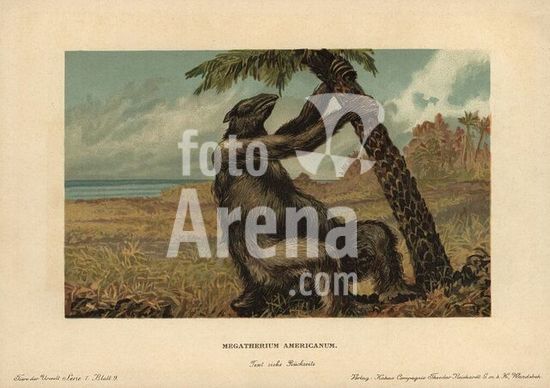
alb9872859 Megatherium americanum pulling on a palm tree. Extinct species of ground sloth endemic to South America, Early Pliocene to the Pleistocene. Megatherium americanum. Colour printed illustration by F. John from Wilhelm Bolsches Tiere der Urwelt (Animals of the Prehistoric World), Reichardt Cocoa company, Hamburg, 1908.
DC
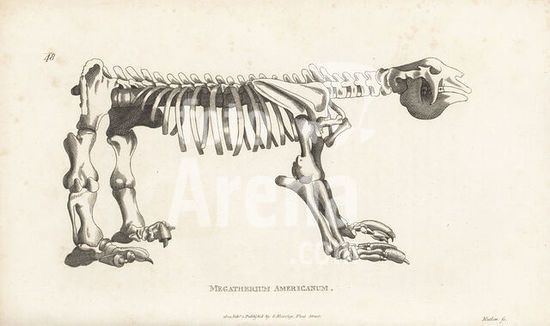
alb9870332 Fossil skeleton of an extinct giant ground sloth or megathere, Megatherium americanum. After an illustration by the Spanish artist Juan Bautista Bru de Ramón for zoologist Georges Cuvier, 1796. Copperplate engraving by Henry Mutlow from George Shaws General Zoology: Mammalia, G. Kearsley, Fleet Street, London, 1800.
DC
alb9879952 Megatherium americanum (Great Beast) in the moonlight. Megatherium is an extinct genus of elephant-sized ground sloths native to America from the Pliocene through Pleistocene eras. Riesenfaultier. Colour printed illustration by Heinrich Harder from Wilhelm Bolsches Tiere der Urwelt (Animals of the Prehistoric World), Reichardt Cocoa company, Hamburg, 1908. Heinrich Harder (1858-1935) was a German landscape artist and book illustrator.
DC
akg2102092 Mylodon robustus, Art Megatherium, Zahnlücker, Dinosaurier, Saurier, Skelett.
DC
akg2102090 Skelett des Megatherium Cuvieri, Art Megatherium, Zahnlücker, elefantengroßes, eiszeitliches Riesenfaultier Südamerika.
DC
alb1946865 Megatherium americanum (Great Beast) was a genus of elephant-sized ground sloths native to America from the Pliocene through Pleistocene eras.. Colour printed illustration by Heinrich Harder from "Tiere der Urwelt" Animals of the Prehistoric World, 1916, Hamburg. Heinrich Harder (1858-1935) was a German landscape artist and book illustrator. From a series of prehistoric creature cards published by the Reichardt Cocoa company. Natural historian Wilhelm Bolsche wrote the descriptive text.
DC
alb1949017 Megatherium americanum, extinct genus of elephant-sized ground sloths that lived from the Pliocene through Pleistocene periods. Colour printed (chromolithograph) illustration by F. John from "Tiere der Urwelt" Animals of the Prehistoric World, 1910, Hamburg. From a series of prehistoric creature cards published by the Reichardt Cocoa company.
DC
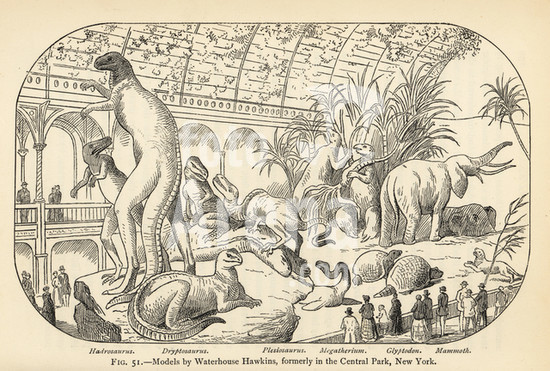
alb4634270 Dinosaur models by Benjamin Waterhouse Hawkins, formerly in Central Park, New York. Hadrosaurus foulkii, Dryptosaurus aquilunguis, Plesiosaurus dolichodeirus, Megatherium americanum, Glyptodon clavipes and Mammuthus primigenius. Engraving after an illustration by Joseph Smit from Henry Neville Hutchinsons Creatures of Other Days, Popular Studies in Palaeontology, Chapman and Hall, London, 1896.
DC
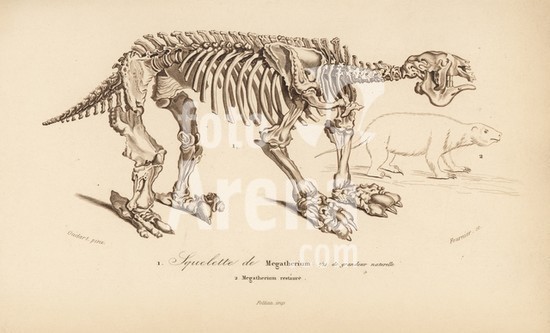
alb2339722 Skeleton of a megatherium, extinct giant ground sloth, and reconstruction of the animal. Engraving by Fournier after an illustration by Oudart from Charles d'Orbigny's Dictionnaire Universel d'Histoire Naturelle (Dictionary of Natural History), Paris, 1849.
DC
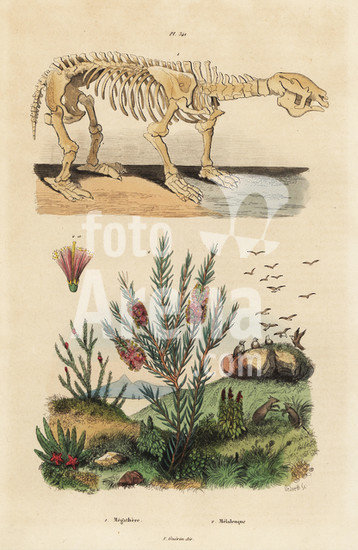
alb4634564 Fossil skeleton of an extinct giant ground sloth, Megatherium americanum, and tea tree or honey myrtle bush, Melaleuca species. Handcoloured steel engraving by Pedretti after an illustration by Adolph Fries from Felix-Edouard Guerin-Meneville's Dictionnaire Pittoresque d'Histoire Naturelle (Picturesque Dictionary of Natural History), Paris, 1834-39.
DC
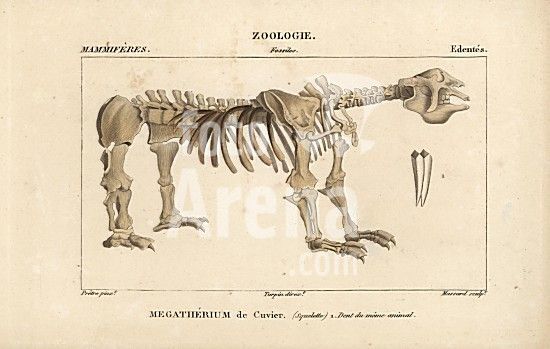
alb1944574 Fossil skeleton of a Great Beast, Megatherium, an extinct elephant-sized ground sloth of the Pliocene to Pleistocene. Copperplate stipple engraving from Frederic Cuvier's "Dictionary of Natural Science: Mammals," Paris, France, 1816. Illustration by J. G. Pretre, engraved by Massard, directed by Pierre Jean-Francois Turpin, and published by F.G. Levrault. Jean Gabriel Pretre (1780~1845) was painter of natural history at Empress Josephine's zoo and later became artist to the Museum of Natural History. Turpin (1775-1840) is considered one of the greatest French botanical illustrators of the 19th century.
DC
926_09_cdns00888 Megatherium
DC
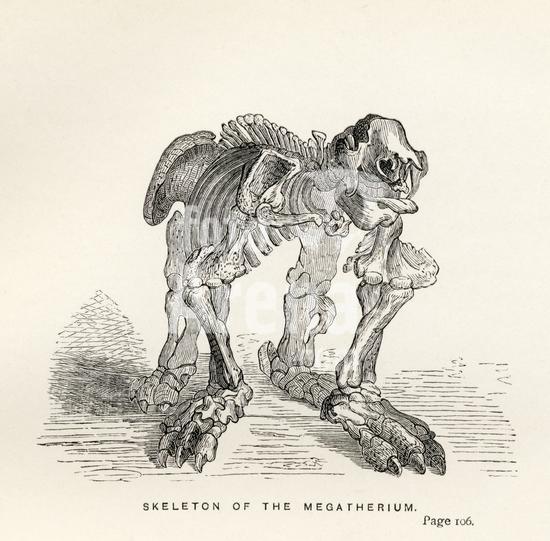
902_05_1856402 Skeleton of the Megatherium From the book Journal of Researches by Charles Darwin also known as Darwin's Journal of a Voyage Around the World published 1890
DC
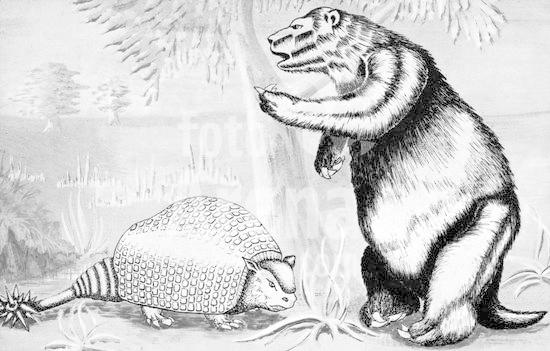
0000458 GLYPTODONT AND SLOTH. Glyptodont, at left, and ground sloth (Megatherium), at right. Illustration, 20th century.
DC

Total de Resultados: 38

Página 1 de 1