alb3649571
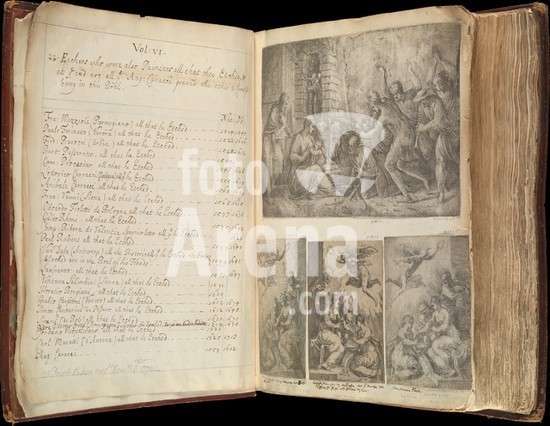
Chief Etchers and Best Italian (Wilton House Album). Date: early 18th century binding.The Metropolitan Museum acquired five albums from the 1917 sale (Sotheby's July 6th) of the 'historical collections at Wilton House, Salisbury, the property of the Right Hon. The Earl of Pembroke & Montgomery', all of which were disassembled and integrated into the collection, now forming a large part of the Italian print collection. The albums possibly originated with Thomas Herbert, eighth earl of Pembroke (1656-1733) and by descent to Reginald Herbert, fifteenth earl of Pembroke (British, 1880-1960) who sold the collection. Although the albums were taken apart, their original contents can be identified by the accession numbers (17.50.15 - 17.50.19). In 1927, the MMA acquired from Colnaghi a sixth album (the present album) which was vol. VI from the original set of seventeen albums (only the first fourteen were numbered, and volume thirteen was in two parts). This album has remained largely intact (see below). A systematic account of the collection of prints from the Pembroke Collection has not been undertaken, but there is an article on one of the other albums from the sale containing Italian chiaroscuro prints, which ended up at the Library of Congress (Vol. VIII). This article addresses the issue of provenance, concluding that the album was probably assembled in the eighteenth century but may include parts of the collection of Peter Lely, among others. The present album contains a number of prints bearing the collector's mark of Peter Lely. The authors were unaware that six of the other albums were in the MMA. See Alan M. Fern and Karen F. Jones, 'The 'Pembroke' Album of Chiaroscuro Woodcuts', first published in the January 1969 issue of the Quarterly Journal of the Library of Congress and reprinted in 1970 by Library of Congress. With regard to the connection with Inigo Jones, the best proof of this association comes from Mariette, who mentions, among his proofs that Andrea Meldolla and Schiavone are one and the same, '...j'ay scu que le précieux recueil des estampes de ce maitre qu'Inigo Jones, célèbre architecte et disciple du Palladio, avoit apporté autrefois de son voyage d'Italie et qui est actuellement entre les mains de milord Pembrock, étoit intitulé: Estampes de André Schiavon.' (Abecedario de P.J. Mariette, vol. III, Paris, 1854-56, p. 314). He also observes, 'Le plus belle ouvre du Parmesan qu'il y ait en Angleterre est celle que possède milord Pembroke. M. Zanetti, qui l'a vue, m'a écrit que c'etoit le recueil le plus complet qu'il eut vû des estampes gravées par André Schiavon ou André Meldolla ... M. Hyckman, qui l'a veu depuis M. Zanetti, m'a fait écrire que ce recueil de pieces, au nombre de cent une, venoit originairement de l'architecte Inigo Jones, qui y avoit rassemblé tout ce qu'il avoit pu découvrir d'estampes d'André Schiavon, entre autres toutes les planches imparfaites et manquées de ce maistre ... '(p. 315). Mariette continues to describe certain rare impressions that match those in the Met's Wilton Album. This comment also fits well with the inscription on p. 19 of the Met album, reading 'Inigo Jones, so fond of Parmegiano, that he bought the Prints of the Imperfect Plates, which are no[w] here in this Book.' The prints on that and the following pages are by Schiavone. Mariette also talks about how many people confuse the prints of Schiavone with those of Parmigianino and it seems that, although Jones himself was clear about it, by the time the book was inscribed the knowledge had been lost. The Met album is bound in English gold-tooled eighteenth-century red morocco. Vol. VI of the seventeen volumes from the Pembroke collection sold at Sotheby's sale of Wilton House collections on July 6, 1917 (No. 304). The binding measures 46 x 41 cms and the folios a uniform 44.5 x 36 cms. The binding is the same as the album in the Library of Congress. The album contains prints, primarily etchings by sixteenth and seventeenth century printmakers, including Parmigianino, Schiavone, Battista del Moro, Paolo and Orazio Farinati, the Carracci, Bartolomeo Passerotti, Ventura Salimbeni, Orazio Borgianni, Guido Reni, Ribera, Rubens, Van Dyck, and Giordano sometimes several or more to a page. There are many notes accompanying the prints in what is probably an eighteenth-century hand. There are 144 folios containing prints out of an original 167 folios, some of which have been removed. The folios numbered up to 144 in modern hand (pencil) take into account the pages removed. Mottled fly leaves at front and back. Recto of first unnumbered folio has pen and ink inscription 'Vol 6th 25 prints taken out: 1772 / N 3 all double'. Verso of first unnumbered folio inscribed 'Vol: VI / 23 Etchers who were also Painters all that they Etched, & '/ at ye end are all yt Aug: Caracci graved, the other 2 Carats's / being in this book', followed by list of artists with their birth and death dates. In 2013/14 the album underwent conservation treatment at the Metropolitan by Sophia Kramer. The spine leather was removed and the spine cleaned with a poultice of thick wheat starch paste. After the first lining of Okawara and wheat starch paste, German sewing tapes were attached to the existing raised bands and slipped under the leather on the front board. The loose signatures in the front were repaired, re-enforced and resewn around the tapes. New endbands were sewn using silk embroidery thread and cord wrapped with Okawara Japanese paper. Next, a layer of airplane linen was adhered with PVA to the spine and slipped under the split boards. Then two layers of Archival kraft paper were adhered to the spine panels. After dry, a matching goatskin was cut, pared and pasted on the spine. The textblock was cleaned and the pages were consolidated and repaired. The corners and edges were consolidated and repaired with dyed Japanese paper and wheat starch paste. The original spine leather was pasted back onto the new leather.Mark McDonald and Jamie Gabbarelli. Museum: Metropolitan Museum of Art, New York, USA.
DC