



















































Busque também em nossas outras coleções:

Data da imagem:
Agência
Fotógrafo
Estado
Cidade
Local
Tipo de licença
Orientação
Coleção

Total de Resultados: 7

Página 1 de 1

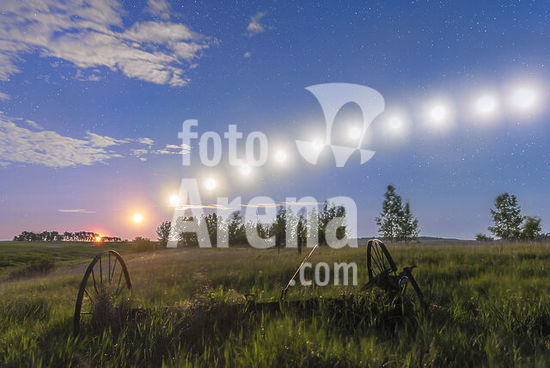
alb5570505 A composite stack of 12 images taken June 11/12, 2017 of the waning gibbous moon tracking low across the southern sky on a June nght, from moonrise at left at 11:30 pm to when it began to leave the frame at right at 4 a.m. and when the sky was brightening with dawn. Images are at 25-minute intervals. The sky is blue here from the moonlight. This demonstrates how the summer moon at and around full phase tracks low across the south just as the Sun does during winter.
DC
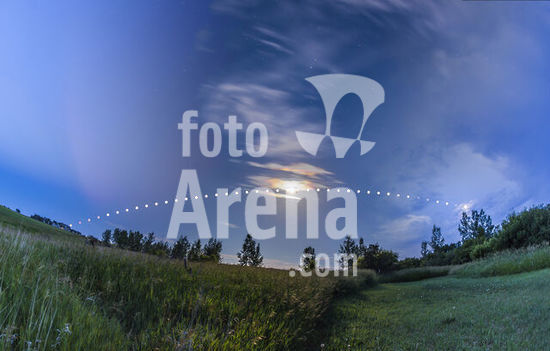
alb5568741 A multiple exposure composite showing the arc of the full moon of July 9/10, 2017 low across the southern sky on a summer night from dusk to dawn in Alberta, Canada. This illustrates the low arc of the moon across the sky in northern summer, from southeast at left to southwest at right. The sky is a blend of three long exposures:. a) the dusk 10 p.m. sky (left) with crepuscular rays in the clear twilight, . b) the 2 a.m. middle-of-the-night sky with the moon nearly due south (middle) with stars and iridescent colors around the moon in light cloud, . c) the dawn 5 a.m. sky (right) with increasing clouds hiding the moon.
DC
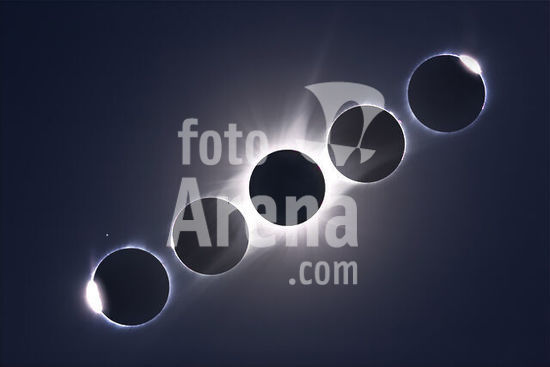
alb5568888 A composite of the August 21, 2017 total eclipse of the Sun, showing the second and third contact diamond rings and Bailys Beads at the start (left) and end (right) of totality, flanking a composite image of totality itself. The diamond ring and Bailys Beads images are single images. Regulus is the star at lower left. The totality images is a blend of 12 exposures from 1/1600 sec to 1 second, stacked as a smart object and combined using the Mean stack mode to blend the images. Several High Pass filter layers were added to sharpen and increase the contrast in the coronal structures. Placement of the images only roughly matches the actual position and path of the Sun across the sky. However, the time sequence runs from left to right. Shot from a site in the Teton Valley, Idaho, north of Driggs.
DC
alb5568042 June 9, 2017 - The rising full moon of June, dubbed the Strawberry Moon, as seen rising over a prairie pond in southern Alberta, Canada. At right, the glitter path from the moon also combines on the water. This illustrates the effect of the moon brightening and becoming less red/yellow as it rises into clearer air above the horizon, with less atmospheric absorption of the short wavelengths.
DC
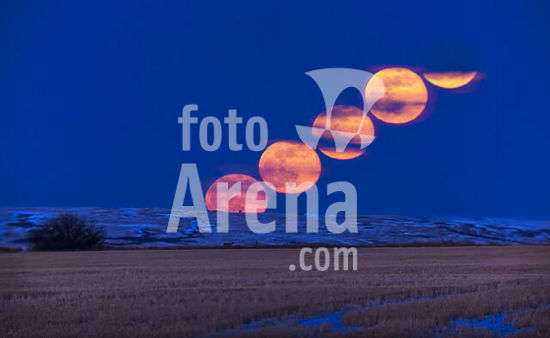
alb5568587 The rising of the full moon on March 9, 2020, (sometimes known as the Worm Moon) with a deer in the foreground, and in a composite of images of the moon taken 3 minutes apart. The sky and foreground come from the first image with the moon on the horizon. The moon was into the cloud for the last exposure.
DC
alb5566085 A composite image depicting the path and position of the low waxing crescent moon of autumn across the southwest evening sky over five nights, September 30 to October 4, 2019. The ecliptic, the blue line, is always low in the sky at this time of year, placing the moon and planets low as well in the evening twilight. This was photographed in southern Alberta, Canada at latitude 50 degrees North. Earthshine is just visible on the dark side of the moon in the later images. The base panorama image of the sky and landscape is from Oct 1, which also provides the moon image second from the right. The Sept 30 (farthest to the right), plus Oct 2, Oct 3 and Oct 4 moons (to the left, from R to L) are added in with separate exposures taken from exactly the same spot and with the same camera and lens on the other nights, with those images layered and masked into the Oct 1 sky. The moon positions are close to the actual positions relative to the horizon and to Jupiter, bright at left. The ecliptic line looks straight but is actually a shallow curving arc. The ecliptic line is correctly placed below the moon, as the moons path does not coincide with the ecliptic but is tilted 5 degree to the ecliptic and it was above the ecliptic on most of these nights, but approached and crossed the ecliptic on Oct. 4. Jupiter, however, is on the ecliptic.. Antares and the stars of Scorpius are also visible in the deep twilight.
DC
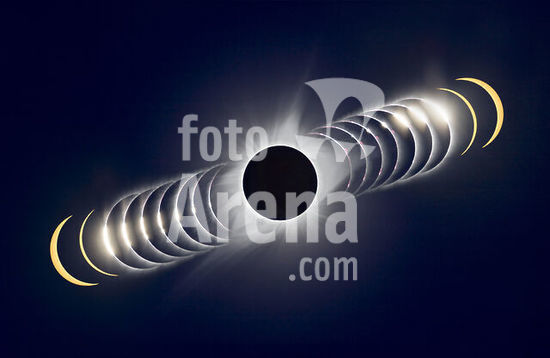
alb5568456 A time-sequence composite of the August 21, 2017 total solar eclipse. In this case, time runs from left to right, from the last filtered partial phases I shot, through unfiltered shots of the rapidly changing last glimmer of sunlight disappearing behind the advancing Moon at Second Contact, forming Bailys Beads, to totality at centre. The sequence continues at right with the Sun emerging from behind the Moon in a rapid sequence at Third Contact, followed by two post-totality filtered partials to bookend the total eclipse images. The C3 limb had a beautiful array of pink prominences.. The Contact 2 and 3 images were taken in rapid-fire continuous mode and so are only fractions of a second apart in real time. Most are 1/4000th second exposures. The totality image is a blend of 7 exposures, from 1/1600 second to 1/15 second to preserve detail in the corona from inner to middle corona. These were aligned, and merged into a smart object and blended with a Mean combine stack mode. The partials are 1/2500-second exposures through a Thousand Oaks metal-on-glass solar filter for the yellow colour. The placement of the frames here only roughly matches the actual position and motion of the Sun across the sky during the time around totality. Partials and C2 and C3 images layered into Photoshop and blended into the background totality image with a Lighten blend mode, and masked to reveal just the wanted bits of each arc. The site was north of Driggs, Idaho in the Teton Valley, north of the centreline. Thus the diamond rings are above the centre of the Moons disk.
DC

Total de Resultados: 7

Página 1 de 1